
For almost three years the Ukraine War has raged across the eastern and southern oblasts of the country as the Russian Federation continues its invasion. The invasion by Russian Federations Armed Forces (RFAF) began by assaulting Ukraine along five major axes with strikes at major city centers, including the capital in Kyiv.1 However, when the invasion stalled by the end of Spring 2022, RFAF had to transition from large-scale combat operations (LSCO) involving divisions and brigades to company and below assault forces predominantly in eastern and southern Ukraine, fully withdrawing from its northern axis along the Kyiv, Chernihiv, and Sumy oblasts. Simply put the Russian forces had failed to accurately assess the level of resistance, public support of Ukrainian resistance, and the strength of the Ukrainian Armed Forces (UAF) in relation not only to their own forces, but a more capable force than the army Russia had fought in the first Donbas War in 2013 through 2014.2
Today the RFAF continues to use small scale rifle actions between dismounted infantry forces assaulting adversarial fighting positions.3 Despite this reality, the forward line of own troops (FLOT) is anything but static as UAF and RFAF trade fighting positions weekly, if not daily, with Russia being primarily on the offensive.4,5 The exception being the UAFs incursion into Kursk which began in August 2024 and has seen the UAF transition primarily to the defensive as the RFAF have retaken more than half of the territory that was originally seized.6-8 This is in addition to North Korea deploying thousands of its soldiers to the Kursk region and fighting alongside the RFAF.9
Russia’s transition to smaller, predominantly dismounted infantry offensive actions, was a result of many factors in the Ukraine conflict. Perhaps the largest factor is the inundation of both commercial off the shelf (COTS) and military-grade unmanned aerial systems (UAS) across the battlefield utilized down to the squad and fire team levels of both RFAF and UAF. The obvious benefits of these UAS are the ability to provide both intelligence, surveillance, and reconnaissance (ISR) and kinetic strike weapons down to the lowest level. More importantly however is that these UAS have removed the ability of either Ukraine or Russia to effectively mass forces near the FLOT to plan and execute battalion and above offensive operations, accounting to 60 -80% of all combat casualties in the Ukraine conflict in 2025.10-14
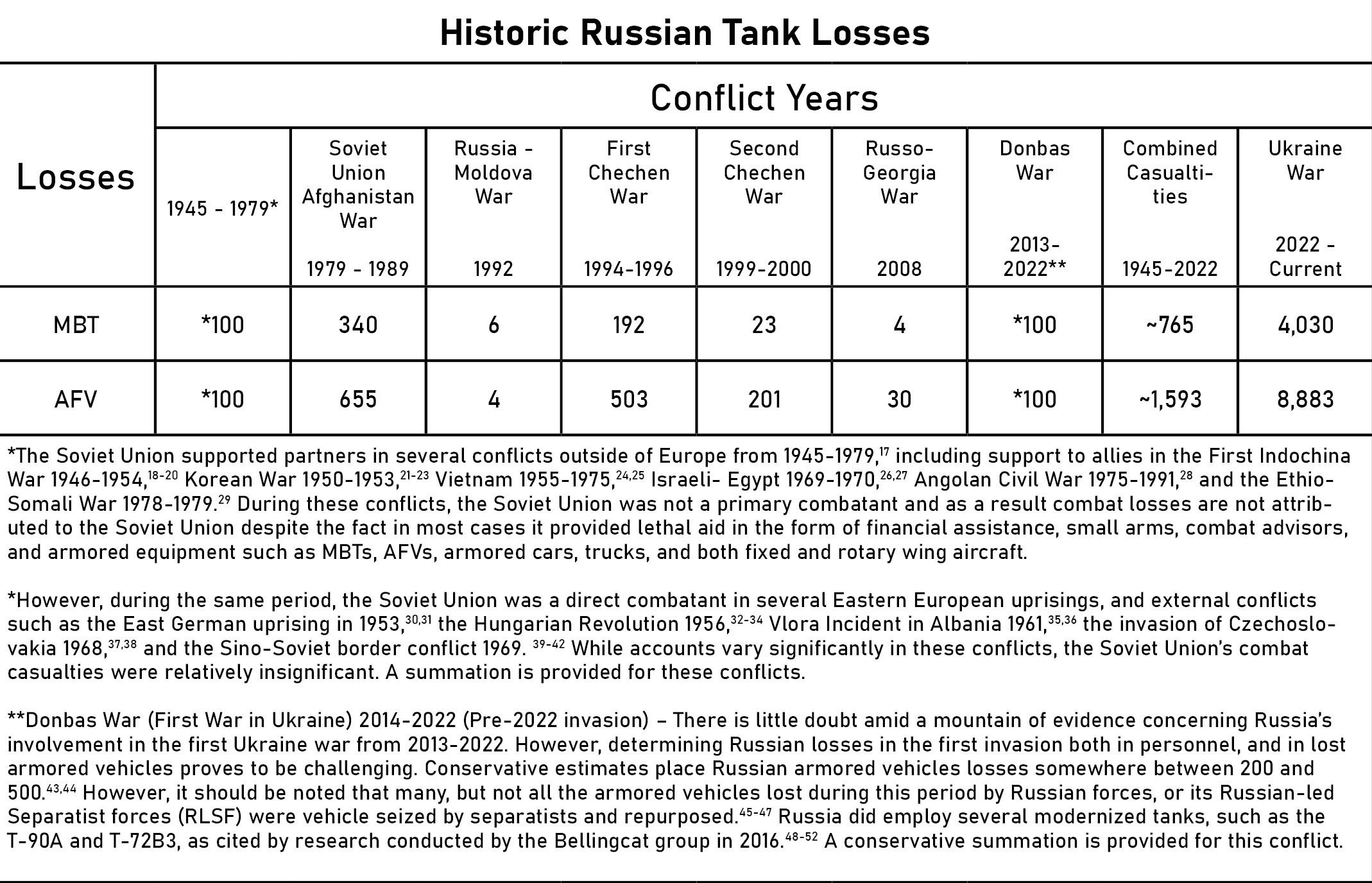
A critical factor of Russia’s inability to mass, specifically the ability to mass armored formations, is its critical main battle tank (MBT) and armored fighting vehicle (AFV) losses in the conflict. As of 1 June 2025, Russia is said to have lost 4,030 MBTs and 8,833 AFVs, based upon the credible open-source database tracker Oryx which monitors and analyzes damaged and destroyed combat vehicles in conflict.15 According to the International Institute for Strategic Studies’ (IISS) 2021 Military Balance, Russian ground forces (or SV) had between 2,800 and 3,330 operational tanks at the start of the full-scale invasion, which would mean that Russia has suffered between 121-143% losses of its operational tank force.16 The same report claimed Russia had between 13,000 and 14,000 AFVs at the start of the war, which would account for between 63-67% of its pre-war inventory. These losses account for the largest armored vehicle losses that Russia has suffered since World War II, and a higher total number of losses than compared to all armored vehicles losses incurred in conflicts from 1946-2022, in which Russia, or its predecessor the Soviet Union participated.
Ukrainian Math = Army Math
It is worth noting that the Ukrainian General Staff has repeatedly reported a significantly higher number of Russian armored vehicles losses than what is usually cited by national defense ministries or independent think tanks.53,54 There are certainly some political and informational operation aspects that play into the General Staff’s considerations. Analysis should consider that a fraction, albeit an unknown quantity, of the vehicles the General Staff records are likely only damaged and either self-evacuate from the field or are extracted by Russian forces themselves to be repaired and fight again. This could account for dozens, if not, hundreds of armored vehicles which are counted as “lost” or destroyed and are in fact double counted.55 This explanation is plausible considering Russia is well known for its subordinate repair-refit battalions and defense factories, including its tank repair factories, or BroneTankovyy Remontny Zavod (BTRZ), that are established during combat operations for the reconstitution of combat capability.56,57
Why Are Russian Armor Forces Suffering?
Despite these significant losses, and the questions remaining of Russia’s capability to reconstitute it’s forces amid the ongoing conflict, there is little doubt that the Kremlin will continue to push forward regardless of their personnel and armored vehicle casualties. The de-evolution of tactics undertaken by the SV troops serving in Ukraine has seen Russia deploy its armor forces in near suicidal front assaults. These armored vehicle assaults are often as small as two lone vehicles or up to company sized assaults, featuring MBTs and AFVs with anti-drone or “cope cages”, ad-hoc armor and metal slapped onto the sides or top of the vehicle to protect against first person view (FPV) drone attacks and drone dropped munitions. Although these tactics more closely resemble what one would expect of a Mad Max movie, the tactics are nothing new as Russia utilized similar tactics in its wars in Chechnya, as did the Islamic State of Iraq and Syria (ISIS), with some Russian forces even using the armored vehicles as modified vehicle-borne improvised explosive devices (VBIEDs).58
Noticeably absent almost from the start of the invasion from Russian armored vehicles assaults are coordinated movements indicating trained vehicle crews and unit formations.61,62 Instead, these assaults rely heavily on advancing as quickly as possible in column formations and almost always in front assaults on Ukrainian positions.63 Once forces are engaged, and armored vehicles begin to be targeted chaos ensues as vehicle drivers have, in more than purely anecdotal incidents, driven over their own dismounted infantry forces, to withdraw from the battlefield.64 One could argue that there is logic in such tactics, with the battlefield being inundated with attack drones and anti-tank guided missile systems; especially if the Russians used it as a diversionary attack with older model Soviet armored vehicles, while keeping modernized systems such as T-90M, T-72B3M or T-80BVM MBTs in reserve.65 However, in the Ukraine conflict Russian forces are as likely to use a 1960s era vehicle in the same suicidal attacks as they are a vehicle produced the previous month.66
Ukraine is not immune to some of these same failed tactics as demonstrated during the summer 2023 counteroffensive, where Ukrainian armored columns became mired in Russian minefields.67 Unfortunately, the 2023 counteroffensive failed to present Ukraine with an operational breakthrough and came at great cost to both personnel and much of its armaments of Western supplied vehicles.68 Despite the obvious futility of such tactics, surmounting losses amid a war of attrition, one most also judge the fact that Russia is not risk adverse to high casualties. So, in terms of personnel the Kremlin will almost certainly continue to push forward with mobilization, contract personnel, and prisoners, but can the defense industry meet the needs of the Army?
Draining Strategic Reserves and Shades of Revitalization of Defense Industry
Given that the Ukraine conflict is predominantly a large-scale combat operation based on ground forces supported by air, naval, and strategic rocket forces, estimation of ground force capabilities are often reserved the highest analysis. The Russian Ministry of Defense and Kremlin officials have claimed since 2023, that the defense industry is capable of building more than 1,500 MBTs annually, with Russia’s former President and current deputy chairman of the Security Council of Russia, Dmitry Medvedev, claiming the vast majority of these tanks are T-90Ms.69,70 Despite the high number of vehicle losses, Russia maintains one of, if not the largest stockpiles of strategic reserve in the world with anywhere between 3,000 and 4,000 MBTs and more than 7,000 AFVs and personnel carriers.71 The strategic depots are under the control of Russia’s Main Automotive-Armored Directorate of the Ministry of Defense, or Glavnoye Avtobronetankovoye Upravleniye MO RF (GABTU).

Throughout the conflict, intelligence assessments released by defense think tanks, and NATO public releases have cautioned on Russia’s strategic reserve and defense industry capabilities.72-75 Ironically, many of the most accurate assessments of Russia’s capability to withdraw from strategic depots have come from and often cited for in-depth but independent users on social media and other outlets using commercial imagery and open-source research. In 2024, special attention was given to open-source researchers Covert Cabal, @HighMarsed, @Jonpy99, and Vishun (Military Prophet) and the release of dozens of social media threads, open-source assessments, and videos which detailed the depletion of Russia strategic reserves.76
Conservative estimates made by the culmination of these assessments, both think tanks and open-source researchers, put Russia’s strategic reach through 2025, and likely culminating sometime in 2026.77,78 Additionally, the output from Russia’s defense industry is reliant almost entirely on the refurbishment of Soviet-era MBTs and AFVs, including archaic T-55/54 MBTs, BMP-1 IFVs, BTR-Ms, and BTR-60/70 series APCs.79,80 That’s not to say that Russia is not capable of producing new production vehicles such as the BMD-4 and BMP-3 IFV, and T-90M MBTs; however, estimates place production levels for new hull production at only a few hundred of each vehicle system with the more modernized production still reliant on modernization of Soviet-era systems into T-72B3 and T-80BVMs.81,82
Historically, tank counting is one of the most challenging aspects of modern warfare, with roots to the second World War when the Western Allies attempted to better understand the output of Nazi Germany’s tank factories, specifically for the Panther (Panzerkampfwagen V) and Tiger (Panzerkampfwagen VI) model tanks. The Western Allies ingeniously created a mathematical equation which examined the tanks captured and studied the serial numbers of parts to determine the number of factories and possible outputs. The challenge would become known as the “German Tank Problem”.83-85 Russia has likely increased production rates at several of its primary tank and armored vehicle factories such as Omsk, Nizhny Tagil, Kurgan, and Arzamas.86-89 Despite economic sanctions placed on Russia by mostly Western nations, it has not prevented Russia’s defense industry from mobilization to at least partially meet the demands of the current conflict.

Assessments, however, should shy away from comparing the defense industry’s mobilization to that of the Soviet Red Army of World War II. Simply put the Red Army had the benefit of additional personnel manning, labor forces, and most importantly factories which today are local in sovereign Ukraine, such as the Kyiv and Kharkiv tank factories, or the 140th repair plant in Belarus, among others.90,91 Russia has re-opened and increased its refurbishment and modernization rates at several of its own repair plants including the 61st BTRZ in Saint Petersburg, the 81st BTRZ in Armavir, 103rd BTRZ in Chita, 144th BTRZ in Yekaterinburg, 60th BTRZ in Vozzhaevka.92-96 Like the German tank problem the use of the BTRZs to refurbish multiple variants of vehicles, both MBTs and AFVs presents analysts with a difficult challenge in attempting to understand output potential as the vehicles arrival to the battlefield could come from multiple facilities. As a result, without the ability to exploit captured or abandoned vehicles, Western and Ukrainian analysts must rely heavily on persistent intelligence collection on individual factories.
Why Accuracy Matters
Along with its internal defense industry, Russia continues to benefit from economic partners in nations such as Kazakhstan and China which have seemingly ignored sanctions with critical parts and funding to its defense industrial base.98 However, not all is perfect in Russia’s defense industry. Russian pundits have begun to call into question the sustainability of the conflict given increasing labor shortages and record high inflation, which has plagued many facets of not only the defense industry but the average daily life of Russian citizens.99,100 The work force across the nation, especially that of the defense industry has only gotten “older” in age as young able-bodied men are sent to Ukraine to fight, leaving their fathers and grandfathers behind to build their systems of war and the ammunition to support ongoing operations.101,102 This too is affecting deployed soldiers as the economic issues have forced pensioners, disabled persons, and ill citizens to serve in combat roles.103,104 Russian ground forces in Ukraine have continued its offensive actions but are in many ways losing its armored teeth relying on light armored vehicles, personally owned vehicles, all-terrain vehicles, etc., which offer little in protection, speed, or firepower.105
While the war in Ukraine continues to rage, accurate intelligence assessments will be key, especially when presented to major political players in the West. The assessments which underestimated the UAF in 2022 are just as dangerous as overestimation of Russian capabilities today. The factors which will lead to future assessments must examine all aspects of Russia’s defense industry, political and public will, and combat casualty rates, and must be free of Western intent to influence political narratives. History has proven that estimation of adversarial capability and allied combat power is not always the strong suit of Western or U.S. intelligence. From GEN George B. McClellan’s overestimation of the size of the Army of Northern Virginia in the American Civil War, to France overestimating the size and intent of the invading Wehrmacht forces in 1940, the belief the Afghanistan National Security Forces would hold its resistance to the Taliban in 2020, or that the UAF would collapse in three days in 2022, overestimating the correlation of forces of one’s adversary and underestimating the capability or failures of allies burdens battlefield commanders with command paralysis and forces policy makers to make strategic and long lasting decisions that could affect generations.106-110
Bryan Powers is U.S. Army veteran with more than a decade of service including four deployments to Iraq, Afghanistan, and Jordan. Bryan is the author of The Bloody Path to Valkyrie: How Duty, Faith, and Honor Inspired the German Resistance 1933 – 1946 and Infantry Magazines’ The Battle for Bakhmut: When Is a Battlefield Loss a Strategic Victory? He holds a master’s of art in intelligence studies and a master’s of art in military history from American Military University. Bryan is married to his loving wife Allie, and father to their daughter Emma. He continues to serve the U.S. Army as a civilian and lives in Virginia, where he and his wife strive to continue their work in writing and in humanitarian support efforts for the Ukrainian people.
Notes
1 Nolan Peterson. Russian Troops Enter Belarus, Escalating Threat of Kyiv Encirclement. 17 January 2022. Coffee or Die magazine, https://coffeeordie.com/russian-troops-belarus; accessed 2 January 2025.
2 Neveen Shaaban Abdalla, Philip H.J. Davies, Kristian Gustafson, Dan Lomas, and Steven Wagner. Intelligence and the War in Ukraine, Part 2. War on the Rocks, 19 May 2022.
3 Constant Meheut. Ukraine’s Donbas Strategy: Retreat Slowly and Maximize Russia’s Losses. The New York Times. 5 October 2024, https://www.nytimes.com/2024/10/05/world/europe/ukraine-donbas-strategy-russia-war.html; accessed 11 January 2025.
4 Associated Press. Russia’s Push On Eastern Front Prompts Ukraine Civilian Evacuation. 10 August 2023. Coffee or Die magazine, https://coffeeordie.com/russia-push-ukraine-evacuation, accessed 2 January 2025.
5 Frontelligence Insight. Overview of the Operational and Tactical Situation in Ukraine: From Kharkiv to Zaprozhzhia. 10 December 2024. https://frontelligence.substack.com/p/overview-of-the-operational-and-tactical; accessed 11 January 2025.
6 International Crisis Group. Ukraine War Map: Tracking the Frontlines, https://www.crisisgroup.org/content/ukraine-war-map-tracking-frontlines; accessed 11 January 2025.
7 Olena Mukhina. Ukraine exploits Russian troop rotation to launch assaults across Kursk front, says military expert, 5 January 2025. EuroMaidan Press.
8 Adam Givens and Gian Gentile. Ukraine, Kursk, and the Importance of Lines of Operation in History. 6 September 2024. RAND Corporation.
9 Dr. Choi Yonghwan. The Meaning and Significance of North Korean Troops’ Deployment to Russia. 4 December 2024. Royal United Services Institute for Defence and Security Studies, https://rusi.org/explore-our-research/publications/commentary/meaning-and-significance-north-korean-troops-deployment-russia; accessed 11 January 2025.
10 Dr Jack Watling and Nick Reynolds. Stormbreak: Fighting Through Russian Defences in Ukraine’s 2023 Offensive. 4 September 2023. Royal United Services Institute for Defence and Security Studies, https://www.rusi.org/explore-our-research/publications/special-resources/stormbreak-fighting-through-russian-defences-ukraines-2023-offensive, accessed 3 January 2025.
11 Michael Kofman. The Return of Global Russia: Assessing Russian Military Adaptions in 2023. Carnegie Endowment for International Peace. October 2024.
12 David Hambling, Forbes Magazine, February 2025. New RUSI Report: Drones Now Inflicting Two Thirds Of Russian Losses; https://www.forbes.com/sites/davidhambling/2025/02/18/new-report-drones-now-destroying-two-thirds-of-russian-targets/; accessed 4 June 2025.
13 Dr. Jack Watling Nick Reynolds. February 2025. Tactical Developments During the Third Year of the Russo–Ukrainian War; https://www.rusi.org/explore-our-research/publications/special-resources/tactical-developments-during-third-year-russo-ukrainian-war; Royal United Services Institute for Defence and Security Studies, accessed 4 June 2025.
14 Steve Brown. 28 March 2025. ANALYSIS: Casualty Figures Reveal Game-Changing Impact of Drones on Ukrainian Battlefield, Kyiv Post, https://www.kyivpost.com/analysis/49712; accessed 4 June 2025.
15 Jakub Janovsky, Naalsio, Aloha, Dan, Kemal, and Alexander Black. Attack On Europe: Documenting Russian Equipment Losses During The Russian Invasion Of Ukraine, Oryx, https://www.oryxspioenkop.com/2022/02/attack-on-europe-documenting-equipment.html, accessed 1 June 2025.
16 The International Institute for Strategic Studies (IISS), The Military Balance 2021, February 2021, Chapter 5, pages 192-193, https://www.iiss.org/publications/the-military-balance/the-military-balance-2021/; accessed 29 December 2024.
17 Wikipedia. List of wars involving Russia; https://en.wikipedia.org/wiki/List_of_wars_involving_Russia; accessed 31 December 2024.
18 Office of the Chairman of the Joint Chiefs of Staff. History of the Joint Chiefs of Staff. The Joint Chiefs of Staff and the First Indochina War, 1947-1954. 2004.
19 Alpha History. Chinese and Soviet Involvement in Vietnam. https://alphahistory.com/vietnamwar/chinese-and-soviet-involvement/; accessed 31 December 2024.
20 Wikipedia. First Indochina War. https://en.wikipedia.org/wiki/First_Indochina_War; accessed 31 December 2024.
21 Kathryn Weathersby. The Korean War: A Crucial Turning Point in the Cold War. The Wilson Center. https://digitalarchive.wilsoncenter.org/essays/korean-war-crucial-turning-point-cold-war; accessed 31 December 2024.
22 Wikipedia. Soviet Union in the Korean War. https://en.wikipedia.org/wiki/Soviet_Union_in_the_Korean_War#:~:text=Though%20not%20officially%20a%20belligerent,B%2D29s%2C%20Korea%201951; accessed 31 December 2024.
23 Charles Kraus. Preparing for War: Soviet-North Korean Relations, 1947-1950. The Wilson Center. https://www.wilsoncenter.org/blog-post/preparing-war-soviet-north-korean-relations-1947-1950; accessed 31 December 2024.
24 Central Intelligence Agency (CIA). Status of Soviet and Chinese Military Aid to North Vietnam. September 1965. https://www.cia.gov/readingroom/docs/DOC_0000652931.pdf; accessed 31 December 2024.
25 Wikipedia. International participation in the Vietnam War. https://en.wikipedia.org/wiki/International_participation_in_the_Vietnam_War#:~:text=From%20July%201965%20to%20the,save%20South%20Vietnam%20from%20collapse; accessed 31 December 2024.
26 Wikipedia. War of Attrition. https://en.wikipedia.org/wiki/War_of_Attrition; accessed 31 December 2024.
27 Isabella Ginor and Gideon Remez. The Soviet-Israeli War, 1967-1973: The USSRs Military Intervention in the Egyptian-Israel Conflict. Journal of Powers Institutions in Post-Soviet Societies. 2017. Hurst and Company, UK.
28 Jeremy Bervoets. The Soviet Union in Angola: Soviet and African Perspectives on the Failed Socialist Transformation. Geohistory, https://geohistory.today/soviet-union-angola-history/; accessed 31 December 2024.
29 Sam Wilkins. Buried in the Sands of the Ogaden: Lessons from an Obscure Cold War Flashpoint in Africa. War on the Rocks, https://warontherocks.com/2019/09/buried-in-the-sands-of-the-ogaden-lessons-from-an-obscure-cold-war-flashpoint-in-africa/; accessed 31 December 2024.
30 Christian Ostermann. East German Uprising. Wilson Center, https://digitalarchive.wilsoncenter.org/essays/east-german-uprising; accessed 31 December 2024.
31 Wikipedia. East German Uprising of 1953, https://en.wikipedia.org/wiki/East_German_uprising_of_1953; accessed 31 December 2024.
32 Matt Fratus. The 1956 Hungarian Revolution and the Russian Tanks That Crushed It. 20 January 2022. Coffee or Die Magazine, https://coffeeordie.com/hungarian-revolution; accessed 2 January 2025.
33 Nicholas Smith. The Beast of Budapest. 19 July 2018. HistoryNet, https://www.historynet.com/the-beast-of-budapest; accessed 2 January 2025.
34 Central Intelligence Agency (CIA). Analysis of the Hungarian Revolt. 17 January 1957. https://www.cia.gov/readingroom/docs/DOC_0001302853.pdf; accessed 2 January 2025.
35 Ana Lalaj, Christian F. Ostermann, and Ryan Gage. Albania is not Cuba.” Sino-Albanian Summits and the Sino-Soviet Split. Cold War International History Project Bulletin, Issue 16. The Wilson Center, https://www.wilsoncenter.org/sites/default/files/media/documents/publication/CWIHPBulletin16_p3.pdf; accessed 2 January 2025.
36 Wikipedia. Expulsion of Soviets from Albania, https://en.wikipedia.org/wiki/Expulsion_of_Soviets_from_Albania; accessed 2 January 2025.
37 Matt Fratus. Russia’s Invasion To Crush ‘Prague Spring’ Mirrors Ukraine Buildup. 19 January 2022. Coffee or Die Magazine. https://coffeeordie.com/prague-spring; accessed 2 January 2025.
38 Wikipedia. Battle for Czechoslovak Radio. https://en.wikipedia.org/wiki/Battle_for_Czechoslovak_Radio; accessed 2 January 2025.
39 Wikipedia. Sino-Soviet conflict. https://en.wikipedia.org/wiki/Sino-Soviet_border_conflict; accessed 31 December 2024.
40 Miles Maochun Yu. The 1969 Sino-Soviet Border Conflicts As A Key Turning Point Of The Cold War. The Hoover Institution. https://www.hoover.org/research/1969-sino-soviet-border-conflicts-key-turning-point-cold-war; accessed 31 December 2024.
41 Michael S. Gerson. The Sino-Soviet Border Conflict. Deterrence, Escalation, and the Threat of the Nuclear War in 1969. November 2010. Center for Naval Analysis.
42 William Burr. The Sino-Soviet Border Conflict, 1969. U.S. Diplomatic Reactions and Diplomatic Maneuvers. The National Security Archive. George Washington University; https://nsarchive2.gwu.edu/NSAEBB/NSAEBB49/index2.html#:~:text=On%202%20March%201969%2C%20the,50%20Soviet%20soldiers%20were%20killed; accessed 31 December 2024.
43 International Crisis Group. Conflict in Ukraine’s Donbas: A Visual Explainer; https://www.crisisgroup.org/content/conflict-ukraines-donbas-visual-explainer; accessed 11 January 2025.
44 Kyiv Post. Nuland says 400-500 Russian soldiers killed in eastern Ukraine. 10 March 2015, https://archive.kyivpost.com/article/content/war-against-ukraine/us-claims-400-500-russian-soldiers-killed-in-eastern-ukraine-383079.html; accessed 11 January 2025.
45 Wikipedia. War in Donbas, https://en.wikipedia.org/wiki/War_in_Donbas; accessed 11 January 2025.
46 RadioFreeEurope, Radio Liberty. Ukraine’s Armored Vehicles Significantly Damaged in First 2 Years of Donbas Conflict.12 February 2020, https://www.rferl.org/a/ukraine-armored-vehicles-significantly-damaged-2-years-of-donbas-conflict/30429979.html; accessed 11 January 2025.
47 Bellingcat. Tanks of Buhaivka: A training facility in Eastern Ukraine, 17 March 2017, https://www.bellingcat.com/news/uk-and-europe/2017/03/17/tanks-buhaivka-training-facility-eastern-ukraine/; accessed 11 January 2025.
48 Bellingcat. Russia’s 200th Motorized Infantry Brigade in the Donbass: The Hero of Russia. https://www.bellingcat.com/news/uk-and-europe/2016/06/21/russias-200th-motorized-infantry-brigade-in-the-donbass-part-2/; accessed 11 January 2025.
49 Bellingcat, author, Askai707. Russia’s 200th Motorized Infantry Brigade in the Donbass: The Tell-Tale Tanks, 4 July 2026, https://www.bellingcat.com/news/uk-and-europe/2016/07/04/russias-200th-motorized-infantry-brigade-donbass-tell-tale-tanks/; accessed 11 January 2025.
50 Bellingcat, author, Askai707. Russia’s 6th Tank Brigade: The Dead, the Captured, and the Destroyed Tanks (Pt. 1), 22 September 2015, https://www.bellingcat.com/news/uk-and-europe/2015/09/22/russias-6th-tank-brigade/; accessed 11 January 2025. This post originally appeared in Russian on the LiveJournal of Askai707, sled-vzayt.livejournal.com.
51 Ibid
52 Veli-Pekka Kivimaki. Tankspotting: T-90As in the Donbass. 2 April 2017. Bellingcat, https://www.bellingcat.com/news/uk-and-europe/2017/04/02/tankspotting-t-90as-donbass/; accessed 11 January 2025.
53 Chris York, As Russian tank losses in Ukraine pass 9,000, here’s what you need to know. Kyiv Independent. 1 July 2024, https://kyivindependent.com/as-russian-tank-losses-in-ukraine-continue-to-mount-heres-what-you-need-to-know/#:~:text=the%20early%201980s.-,How%20many%20tanks%20does%20Russia%20have%20left?,of%207%2C000%20tanks%20in%20storage, accessed 29 December 2024.
54 Centre for Strategic Studies. Russia’s war on Ukraine.11.01.25, Operational Situation. 11 January 2025. https://substack.com/home/post/p-154628419; accessed 11 January 2024.
55 Yohann Michel and Michael Gjerstad. Equipment losses in Russia’s war on Ukraine mount. 12 February 2024. The International Institute for Strategic Studies (IISS), https://www.iiss.org/online-analysis/military-balance/2024/02/equipment-losses-in-russias-war-on-ukraine-mount/?utm_source=chatgpt.com; accessed 11 January 2025.
56 Dara Massicot and Richard Connolly. Russian Military Reconstitution: 2030 Pathways and Prospects. Carnegie Endowment for International Peace. September 2024.
57 Covert Cabal. BTRZs - Tank Repair Factories. Can They Keep Up? YouTube, https://youtu.be/_EHpGXbOrY8?si=EyXVxpQZDSqS0P_w; accessed 12 January 2025.
58 Max Haupman. Russia’s antique tanks are finding a second life as VBIEDs. Task and Purpose, 20 June 2023; https://taskandpurpose.com/news/ukraine-russia-tanks-vbied/. Accessed 19 January 2025.
59 Social Media platform X user @CITeam_en | Russian MODs Zvezda Television Channel showcasing Russia’ Center Grouping of Forces utilizing rebar spiked turrets in tanks referred to as “HedgeHogs”, posted 30 May 2025.
60 Social Media platform X user Chuck Pfarrer | Indications & Warnings | @ChuckPfarrer, posted on 26 December 2023; https://x.com/ChuckPfarrer/status/1739705046177042868.
61 James Bickerton. Untrained Russian Troops Struggling to Fit Tank Armor, Causing Losses: U.K. Newsweek, 18 August 2022; https://www.newsweek.com/untrained-russian-troops-struggling-fit-tank-armor-causing-losses-u-k-1734741; accessed 19 January 2025.
62 David Axe. The Russians Aren’t Just Running Out Of Tanks—They’re Running Out Of Tank Crews, Too. And It’s Going To Get Worse. Forbes, 7 August 2023, https://www.forbes.com/sites/davidaxe/2023/04/07/the-russians-arent-just-running-out-of-tanks-theyre-running-out-of-tank-crews-too-and-its-going-to-get-worse/; accessed 19 January 2025.
63 Sky News. Ukraine War: Dramatic drone footage shows Russian convoy ‘ambush’. YouTube, 10 March 2022, https://youtu.be/dcYOjbyttvM?si=JHWkknYUxPzmwRzS; accessed 19 January 2025.
64 The Sun. Watch as Russian tank commander takes out FIVE of his own men using turret in blundering footage. YouTube, 1 February 2023, https://youtu.be/FqlDtdyAo3M?si=CWK1HsZDPUucH0z4; accessed 19 January 2025.
65 David Axe. It Was ‘Unfortunate Suicide’ For A Lonely Russian Crew Conducting A One-Tank Assault In Eastern Ukraine. Forbes, 16 January 2025, https://www.forbes.com/sites/davidaxe/2025/01/16/it-was-unfortunate-suicide-for-a-lonely-russian-crew-conducting-a-one-tank-assault-in-eastern-ukraine/.
66 Dr Jack Watling and Nick Reynolds. Meatgrinder: Russian Tactics in the Second Year of Its Invasion of Ukraine. Royal United Services Institute for Defence and Security Studies, https://rusi.org/explore-our-research/publications/special-resources/meatgrinder-russian-tactics-second-year-its-invasion-ukraine; 19 May 2023. Accessed 20 January 2025.
67 Dr Jack Watling and Nick Reynolds. Stormbreak: Fighting Through Russian Defences in Ukraine’s 2023 Offensive. 4 September 2023. Royal United Services Institute for Defence and Security Studies, https://www.rusi.org/explore-our-research/publications/special-resources/stormbreak-fighting-through-russian-defences-ukraines-2023-offensive, accessed 3 January 2025.
68 Robert E. Hamilton. Tanks a Lot (Well, Actually Not That Many for Ukraine). Foreign Policy Research Institute, 2 February 2023; https://www.fpri.org/article/2023/02/tanks-a-lot-well-actually-not-that-many-for-ukraine/. Accessed 19 January 2025.
69 Military Watch Magazine. Russia’s Medvedev Reveals 1500 T-90M Tanks Will Be Built This Year: Expresses Confidence They Can Tackle Top Western Armour, 25 March, 2023; https://militarywatchmagazine.com/article/medvedev-t90m-built-tackle-western; accessed 12 January 2025.
70 Sergio Miller. 1,500 new and modernised tanks – really? Wavell Room. 1 May 2023, https://wavellroom.com/2023/05/01/1500-new-and-modernised-tanks-really/; accessed 12 January 2025.
71 Military Prophet (Vishchun). The pace of decommissioning of armored vehicles is falling: what is happening at Russian storage bases; 24 April 2024, https://www.vishchun.com/post/tempy_rozkonservatsii_bbm_padaiut_shcho_vidbuvaietsia_na_rosiiskykh_bazakh_zberihannia; accessed 12 January 2025.
72 Congressional Research Service. Russian Military Performance and Outlook. 10 October 2024, https://crsreports.congress.gov/product/pdf/IF/IF12606; accessed 12 January 2025.
73 Dr. Jack Watling and Nick Reynolds. Russian Military Objectives and Capacity in Ukraine Through 2024; 13 February 2024. Royal United Services Institute for Defence and Security Studies, https://www.rusi.org/explore-our-research/publications/commentary/russian-military-objectives-and-capacity-ukraine-through-2024; accessed 12 January 2025.
74 Chatham House. Assessing Russian plans for military regeneration. 9 July 2024, https://www.chathamhouse.org/2024/07/assessing-russian-plans-military-regeneration; accessed 12 January 2025.
75 Pavel Luzin. Challenges to Russian Arms Resupply: Tanks, Combat Aviation, Artillery Ammunition, 7 July 2022. Eurasia Daily Monitor Volume: 19 Issue: 101, the Jamestown Foundation, https://jamestown.org/program/challenges-to-russian-arms-resupply-tanks-combat-aviation-artillery-ammunition/; accessed 12 January 2025.
76 Covert Cabal. Good on Paper, Looming Disaster in Reality - The Remains of Russia’s Soviet Arsenal. 28 December 2024. YouTube, https://youtu.be/K8CcuVCDEUw?si=3HVzGKzSyDZlCoTH; accessed 12 January 2025.
77 Military Prophet (Vishchun). Calculation and analysis of Muscovy’s tank potential at the beginning of 2024. 18 April 2024, https://www.vishchun.com/post/pidrakhunok_ta_analiz_tankovoho_potentsialu_moskovii_na_pochatku_2024; accessed 12 January 2025.
78 Dr. Jack Watling and Nick Reynolds. Russian Military Objectives and Capacity in Ukraine through 2024. RUSI, 13 February 2024; https://www.rusi.org/explore-our-research/publications/commentary/russian-military-objectives-and-capacity-ukraine-through-2024. Accessed 19 January 2025.
79 Military Prophet (Vishchun)., Statistical analysis of Russian tank losses. 18 April 2024.
80 Covert Cabal. Russia’s Central Tank Storage Base is now Virtually Empty - The 22nd. 28 December 2024. YouTube; https://youtu.be/J8wIKhujASE?si=APJIchwjTpn1qS-J; accessed 12 January 2025.
81 Michael Gjerstad. Russian T-90M production: Less than meets the eye. 11 June 2024. The International Institute for Strategic Studies (IISS), https://www.iiss.org/online-analysis/military-balance/2024/06/russian-t-90m-production-less-than-meets-the-eye/; accessed 12 January 2025.
82 Brent M. Eastwood. Russia’s New Ukraine Problem: Running Out of Tanks? 24 November 2024. 1945, https://www.19fortyfive.com/2024/11/russias-new-ukraine-problem-running-out-of-tanks/; accessed 12 January 2025.
83 NStatum (@nstatum8290). The German Tank Problem: How the Allies defeated the Nazis with statistics. YouTube, https://youtu.be/eAvsLFrwGfI?si=Do7MgPYeBawrlULu; 16 March 2023. Accessed 20 January 2025.
84 Wikipedia. German tank problem. YouTube, https://en.wikipedia.org/wiki/German_tank_problem; accessed 10 January 2025.
85 Anthony Lee and Steven Miller. Generalizing the German Tank Problem. PUMP Journal of Undergraduate Research, https://journals.calstate.edu/pump/article/view/3547, Volume 6, 31 January 2023. Accessed 20 January 2025.
86 Pavel Luzin. Russia’s Military Industry Forecast 2023-2025. Foreign Policy Research Institute, 20 April 2023; https://www.fpri.org/article/2023/04/russias-military-industry-forecast-2023-2025/#_edn26. Accessed 20 January 2025.
87 Boyko Nikolov. Russian plant producing BMP-3 & BMD-4 IFVs faces risk of submersion. Bulgarian Military, https://bulgarianmilitary.com/2024/04/11/russian-plant-producing-bmp-3-bmd-4-ifvs-faces-risk-of-submersion/; 11 April 2024. Accessed 20 January 2025.
88 David Axe. The BTR-82A Massacre: How Russian Regiments Lost 13 Of The Wheeled Vehicles In A Single Day. Forbes, https://www.forbes.com/sites/davidaxe/2023/10/21/the-btr-82a-massacre-how-russian-regiments-lost-13-of-the-wheeled-vehicles-in-a-single-day/; 21 October 2023.
89 Global Security. Arzamaz Machine-Building Plant, https://www.globalsecurity.org/military/world/russia/amz.htm; accessed 20 January 2025.
90 Wikipedia. Maylshev Factory, https://en.wikipedia.org/wiki/Malyshev_Factory; accessed 19 January 2025.
91 Joint Stock Company, 140 Repair Plant, homepage, https://140zavod.by/en/.
92 Dr. Lester Grau and Charles K. Bartles. The Russian Way of War. Force Structure, Tactics, and Modernization of the Russian Ground Forces. 2016. Foreign Military Studies Office, Fort Leavensworth, KS; https://www.armyupress.army.mil/portals/7/hot%20spots/documents/russia/2017-07-the-russian-way-of-war-grau-bartles.pdf. Accessed 20 January 2025.
93 MilitarNYI. Russia shows modernization of T-62 tanks. Ukrainian Military public webpage, https://mil.in.ua/en/news/russia-shows-modernization-of-t-62-tanks/; 12 March 2023. Accessed 20 January 2025.
94 Army Recognition. Rostec enterprises working hard to repair Russian military hardware damaged in Ukraine, 4 October 2022; https://armyrecognition.com/news/army-news/2022/rostec-enterprises-working-hard-to-repair-damaged-russian-military-hardware. Accessed 20 January 2025.
95 Open Sanctions. JSC Armour Repair Plant No. 560, https://www.opensanctions.org/entities/NK-gTJmnsvZnbjPWvBXFjDQDT/; accessed 20 January 2025.
96 Covert Cabal. BTRZs - Tank Repair Factories. Can They Keep Up? YouTube, https://youtu.be/_EHpGXbOrY8?si=EyXVxpQZDSqS0P_w; accessed 12 January 2025.
97 X Social media post, user D’Mithridates, @Rhaescuporis, 18 April 2025, https://x.com/Rhaescuporis/status/1913223387138113795; citing press release by the Russian Ministry of Defense on Russian social media platform Telegram; https://t.co/XtEYvmbN9V.
98 Oliver Ruth. The Impact of Sanctions and Alliances on Russian Military Capabilities. RUSI.
99 Evgeniy Fedorov. Military-industrial complex-2024: personnel shortage becomes threatening. Top War, RU, military blog. 30 December 2024.
100 Dara Massicot and Richard Conolly. Russian Military Reconstitution: 2030 Pathways and Prospects. Carnegie Endowment for International Peace. September 2024.
101 NewIZV. Only “Old Men” Are Going Into Battle*: The country’s defense factories cannot recruit workers. https://en.newizv.ru/news/2023-01-19/only-old-men-are-going-into-battle-the-country-s-defense-factories-cannot-recruit-workers-394358; 19 January 2023. Accessed 20 January 2025.
102 Abbey Fenbert. Russia desperate to recruit workers at defense plants amid personnel shortage, BBC reports. The Kyiv Independent, 2 October 2024; https://kyivindependent.com/russia-desperate-to-recruit-workers-at-defense-plants-amid-personnel-shortage-bbc-reports/. Accessed 20 January 2025.
103 BNE Intellinews. Russian Army hiring pensioners as young people refuse to sign up, 10 October 2024; https://www.intellinews.com/russian-army-hiring-pensioners-as-young-people-refuse-to-sign-up-347535/. Accessed 20 January 2025.
104 Neil MacFarquhar and Milana Mazaeva. Where is Russia Finding New Soldiers? Wherever it can. The New York Times. 30 December 2024, https://www.nytimes.com/2024/12/30/world/europe/russia-ukraine-war-soldiers.html; accessed 20 January 2025.
105 Marc Santora. On E-Scooters and ATVs, Russian Forces Swarm Ukrainian Positions in the East. The New York Times, 2 January 2025; https://www.nytimes.com/2024/12/31/world/europe/ukraine-russia-attacks-eastern-front.html#:~:text=The%20Russian%20troops%20have%20also,quite%20easily%2C%E2%80%9D%20he%20said. Accessed 20 January 2025.
106 Ronald Roberts. Lessons on Mission Command from McClellan’s Failures At Antietam. Modern War Institute. 13 November 2020.
107 Drew Thompson, American Battlefield Trust Youth Leadership Team 2020. The Peninsula Campaign: McClellan’s Strategic Masterstroke and Tactical Blunder. American Battlefield Trust, 27 April 2021, https://www.battlefields.org/learn/articles/peninsula-campaign-mcclellans-strategic-masterstroke-and-tactical-blunder. Accessed 20 January 2025.
108 LTC (Ret.) Dale Spurlin and LTC (Ret.) Matthew Green. Demystifying the Correlation of forces Calculator. Infantry Magazine, Fort Moore, GA. January – March 2017 Issue, https://www.moore.army.mil/infantry/magazine/issues/2017/JAN-MAR/index.html; accessed 20 January 2025.
109 Karl-Heinz Frieser. The Blitzkrieg Legend: The 1940 Campaign in the West. Association of the United States Army, Naval Institute Press, 15 January 2013.
110 Jacqui Heinrich and Adam Sabes. Gen. Milley says Kyiv could fall within 72 hours if Russia decides to invade Ukraine: sources. Fox News, https://www.foxnews.com/us/gen-milley-says-kyiv-could-fall-within-72-hours-if-russia-decides-to-invade-ukraine-sources; 5 February 2022. Accessed 20 January 2025.
Social Sharing