
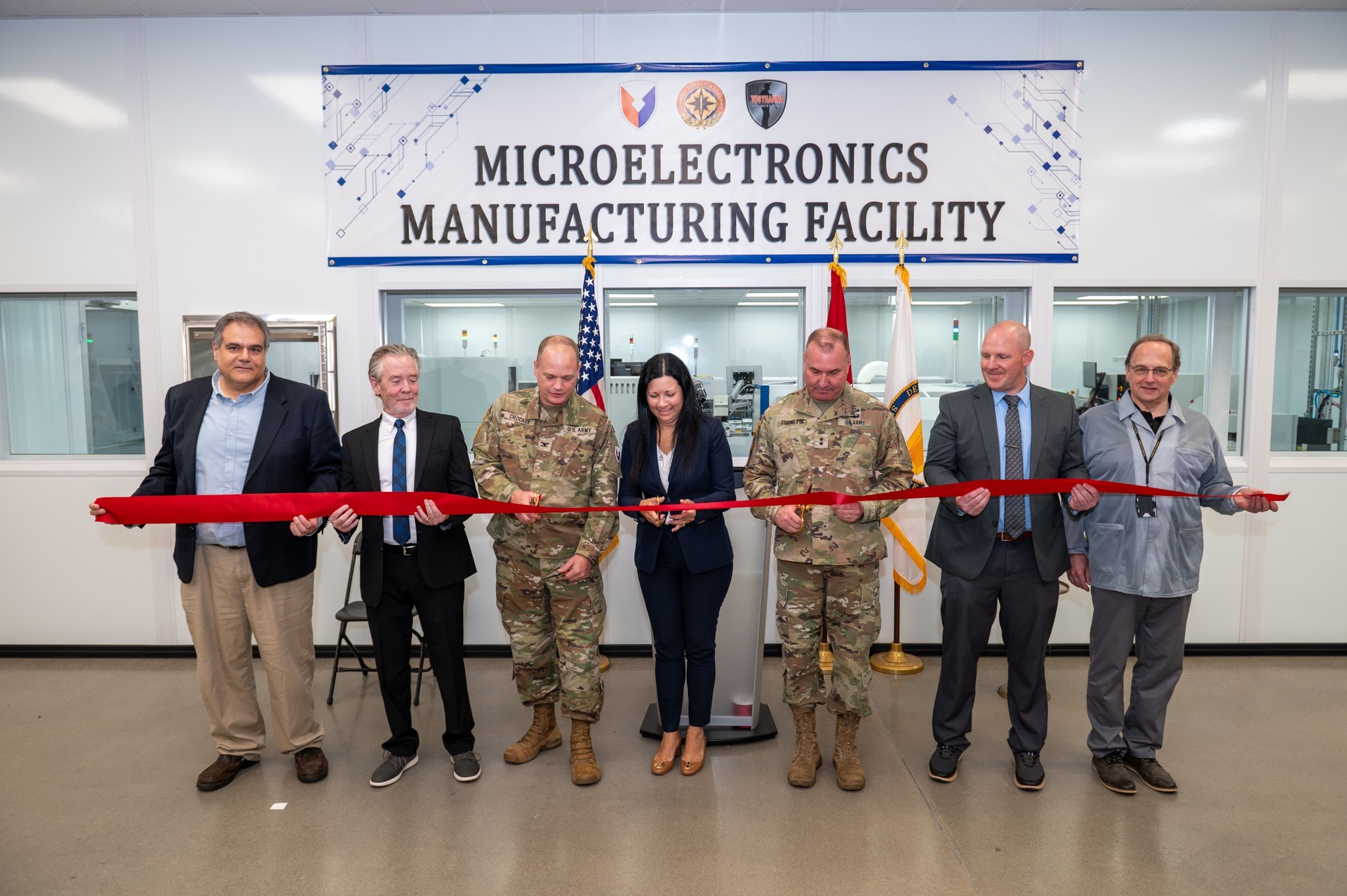
From left: Anthony Shebelock, Tobyhanna; Martin Nealon, Tobyhanna; Depot Commander Col. James L. Crocker; Army Materiel Command Executive Deputy to the Commanding General Ms. Liz Miranda; CECOM Commanding General Maj. Gen. James D. Turinetti IV; Jeffrey Burrell, Tobyhanna; and Mark Sgobba, Tobyhanna VIEW ORIGINAL

As 2025 draws to a close, Tobyhanna Army Depot reflects on a groundbreaking year, marked by significant achievements and an enduring commitment to equipping Ameican heroes – today, tomorrow and into the future.
Depot personnel celebrated the official opening of its Microelectronics Manufacturing Facility in June, enabling the organization to lead the Department of War (DOW) into a new era of warfighter readiness, one microchip at a time.
The depot’s new capability directly addresses current supply chain hurdles faced by the U.S. Armed Forces. Like many other industries, the DOW depends on foreign electronics suppliers to provide microelectronics components to develop and sustain weapons systems. This reliance on the global supply chain as well as the emergence of counterfeit parts results in a significant risk for national security.
Enter Tobyhanna’s microelectronics facility, where a team of talented engineers and technicians develop repair, manufacturing and testing capabilities for circuit cards required by complex military weapons systems. This operation keeps existing equipment running, meets new technology needs, and, most importantly, reduces reliance on foreign suppliers.
June's ribbon cutting was hosted by Communications-Electronics Command Commanding General, Maj. Gen. James D. Turinetti IV. Also in attendance was Ms. Liz Miranda, Executive Deputy to the Commanding General of Army Materiel Command, other distinguished visitors, depot leaders and members of the workforce.
During the keynote address, Miranda emphasized the importance of the new mission.
“This facility is a direct investment in Army modernization, enabling us to not only sustain our legacy systems, but to rapidly adapt and integrate cutting-edge technologies into future platforms,” she said.
In support of DOW efforts to unleash American drone dominance, Tobyhanna successfully completed its first delivery of first-person view small uncrewed aircraft systems, commonly referred to as sUAS, in August, marking a significant milestone in advancing its mission to enhance readiness for America’s warfighters.
The collaborative effort, led by the Army Materiel Command, leverages the unique capabilities of multiple Army organizations, including the U.S. Army Tank-Automotive & Armaments Command. Rock Island Arsenal’s Joint Manufacturing and Technology Center provides 3D-printed airframes, while Tobyhanna Army Depot provides essential logistics and electronics expertise to complete the integration of sUAS systems.
Those leading the initiative describe it as a thrilling and transformative period for Team Tobyhanna.
“We are excited to seize the opportunity to integrate and ship cutting-edge drones to units across the United States. This effort stands to transform the landscape and future of the organic industrial base, positioning Tobyhanna at the forefront of innovation and readiness for our nation’s defense,” said Steven Wiltz, a logistics management specialist supporting the emerging mission.
Depot Commander Col. Benjamin L. Kilgore agreed, noting the importance of the accomplishment.
“This new mission is an opportunity for Tobyhanna Army Depot to support the Army’s readiness needs of today, evolve our capabilities, and align with the future of the force,” he said, adding that the initial delivery was just the first step of Tobyhanna’s sUAS journey.
“In the coming years, we will establish a robust capability to produce sUAS motors and circuit card assemblies to support emerging warfighter needs for the multi-domain battlefield.”
Tobyhanna was also named the Army Materiel Command center of excellence for the development and control of the Army’s industrial control network, or ICN. The depot will lead the design, implementation and long-term management of a network that connects industrial production floor machinery across all 23 Army organic industrial base locations. Once established, depot personnel will maintain the network, while seeking opportunities to continuously improve and strengthen it.
The ICN will enable secure, real-time monitoring and remote access to production equipment, reducing downtime for depot artisans and increasing local ability to make data-driven decisions. Its scalable and flexible design also positions Tobyhanna to lead future integration and expansion efforts across the AMC industrial enterprise.
After an exhaustive search for the perfect location, Tobyhanna was selected for this designation based on its robust cybersecurity capabilities and highly skilled workforce. The depot’s cyber professionals have a strong track record of delivering complex Army hardware and software integration solutions, supported by dynamic cross-functional experts.
According to Al Lyons, a key leader in the ICN initiative, the network will create a standardized operational technology baseline across the AMC.
“When fully implemented, the ICN will reduce system downtime, increase security across industrial machinery, and ensure the AMC has a standard baseline of operational technology across the organic industrial base,” he said.
As 2025 concludes, Tobyhanna Army Depot stands poised to continue its legacy of excellence, consistently exceeding the needs of American warfighters and ensuring they are prepared for any battlefield.
Tobyhanna Army Depot is designated as the Center of Industrial and Technical Excellence for Command, Control, Communications, Computers, Intelligence, Surveillance and Reconnaissance, electronics, avionics and missile guidance and control. TYAD provides cradle-to-grave lifecycle support through depot-level repair, systems integration, software and cyber engineering, and field support. A key enabler of operational readiness for Joint and Allied Forces globally, TYAD leverages new and emerging technologies to further expand the Department of Defense’s organic capabilities for microelectronics, secure communications infrastructure, unmanned aerial systems, Joint All-Domain Command and Control, Integrated Air and Missile Defense (IAMD), and the Army’s Next Generation Combat Systems. TYAD’s ability to rapidly surge production, deploy field support teams, and scale for contingency or theater-level operations makes it a vital contributor to strategic readiness and operational reach.
With additional reporting by Nicolo Manzo.
Social Sharing