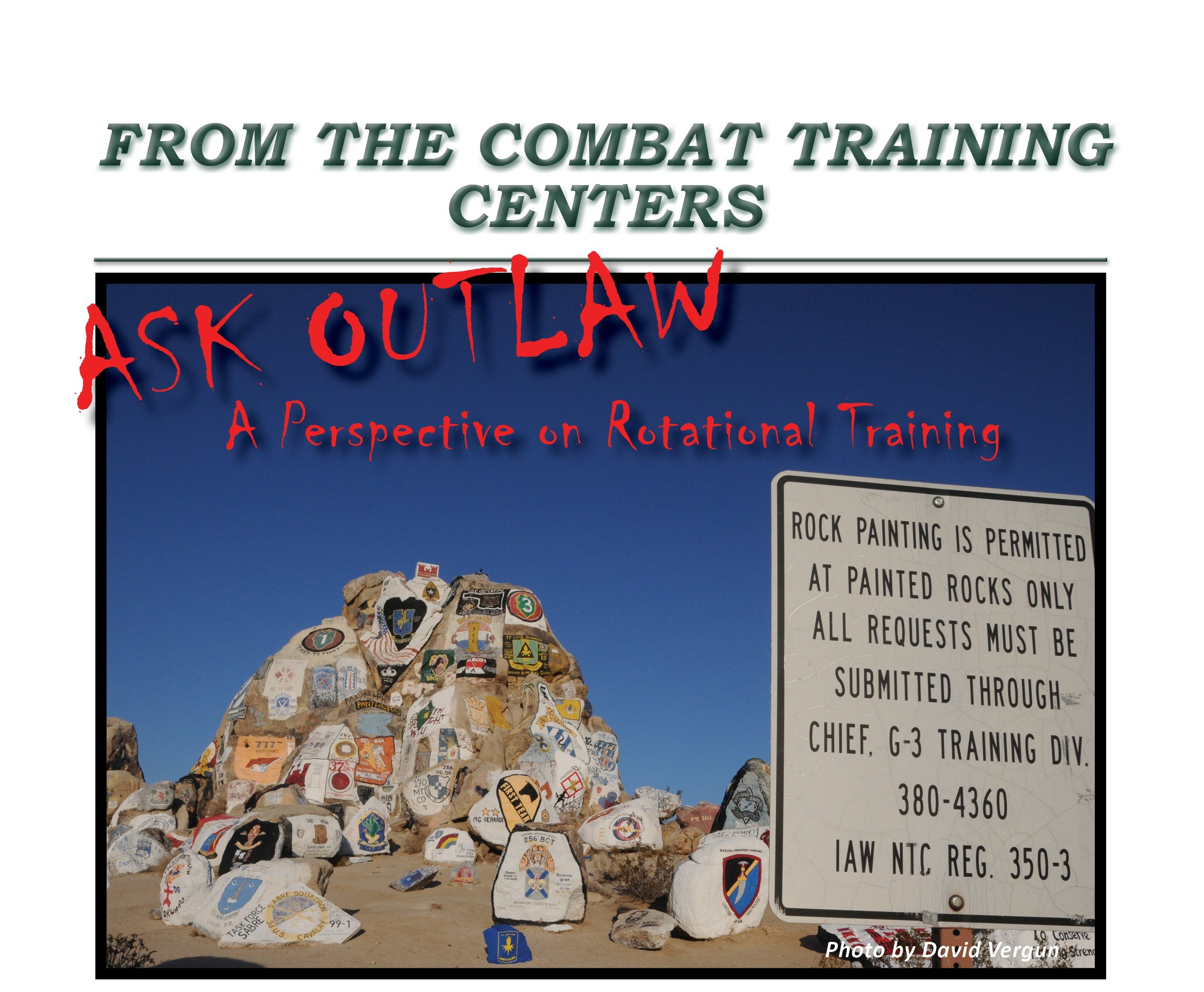
Every commander understands the gravity of a rotation to the National Training Center (NTC). It is a defining experience for both the unit and its commanders. NTC rotations reveal character and impose generational lessons in an often-unforgiving way. As a commander, you often bounce between excitement for the opportunity to employ your unit in a purely tactical capacity and the apprehension associated with external assessments. You consider how to leverage personal experiences in the High Mojave to develop a train-up that is tailored to reduce the friction you expect. Every commander is also anchored by the sobering thought that there will never be enough time to train everything. However, any unit that has left it all on the field, no matter how battered or bruised, returns from “the box” comprehensively trained. For a short period, a unit regenerating combat power in the sands of Fort Irwin can, without hyperbole, call itself the most lethal brigade combat team (BCT) in the world.
As the Commander of Operations Group (COG), I have had the privilege of watching cohorts of the U.S. Army’s most talented leaders rotate through Fort Irwin and experience the journey. In doing so, I have validated some assumptions, invalidated others, and have continued to learn as a warfighting professional. In this article, I intend to describe the NTC experience in terms of the training environment, its limitations and opportunities, and finally offer some insights in an earnest desire to empower commanders with confidence. Confidence grounded, not in how to win against the opposing force (OPFOR), but in how to optimize the training experience. My perspective below is grounded in the humility that comes from personally sharing the experience of commanding during an NTC rotation. I have been, as many of you will be, what President Roosevelt famously called, “The Man in the Arena”. As such, my comments are informed by what I wish I would have known as a rotational unit commander, and by what I have observed as the COG.
Your rotational training experience at NTC will present three challenges that no other training event can replicate. First, you will fight as a BCT operating within a division in contact. Putting an entire brigade in the field reveals under-appreciated, interdependent systems and processes. It reprioritizes efforts in unexpected ways. Second, the training environment forces BCTs to establish and maintain tempo over time and space. The NTC experience is not synonymous with BCT situational training exercises (STX). Advantages, opportunities, and vulnerabilities are fleeting. Finally, BCTs are challenged to transition under persistent contact. With ubiquitous sensors and dynamic, free-thinking subordinate commanders, the OPFOR will challenge a BCT’s ability to gain and maintain the initiative. Commanders must continuously assess their position by considering who is reacting to whom. Rotational units can consider these three challenges in advance of a rotation but will not collectively appreciate them until they are in rotation.
The NTC experience is, at best, an approximation of the rigors of large-scale combat operations. To achieve realistic training, we must assess the limitations of the training environment. To some degree, rotational designs deliberately over-emphasize acute threat capabilities, while other enduring aspects of combat are under-replicated. The training scenario does not force commanders to consider the psychological effects of maneuver warfare amplified by proximity at the tactical level. There are unpredictable performance modifiers for dislocated units. It is also improbable that an enemy force would be content to exploit penetration with a small force not likely to survive an enduring combat situation. Likewise, neither the multiple integrated laser engagement system (MILES) nor the combat vehicle tactical engagement simulation system (CVTESS) can effectively replicate the suppressive effects of our weapon systems. Consequently, units are presented with a false picture of maneuver that is disconnected from its definition of the combination of fire and movement. As a training enterprise, we must recognize these limitations and, where possible, ensure that we apply reason when attributing cause and effect.
While an important caveat, the imperfect training environment does not diminish the proven results of combat training center (CTC) training. CTCs are factories for brigade-level readiness and are indispensable to aligning the performance standards to expected levels of proficiency. NTC founders like GEN Donn Starry promoted the CTC model to provide institutional mechanisms for validating doctrine, readiness, and modern combat concepts. While operational imperatives will always define the relative value of those aims, such as the need to generate forces for deployment or our current efforts towards transformation in contact, what does not change is the NTC experience. The crucible of replicated ground combat will strain systems, expose unpreparedness, and highlight leader qualities that are best suited to thriving in our future wars.

Operations Group, the driving mechanism behind the NTC experience, serves as both the mirror that enables a unit to see itself and as the lens through which senior trainers can objectively assess their unit’s readiness. Ultimately, it is senior leaders who are accountable for evaluating and reporting on readiness. As Operations Group, we expand our aperture beyond rotational unit proficiency to include validating doctrine and experimentation as our founders intended. Commanders often look to Operations Group to provide trends in an effort to preclude common mistakes. The pursuit of trends reversal, however, can be an endless task condemning the force to a cycle of frustration or worse, a misappropriation of organizational efforts if we do not apply rigor to the qualification of those trends.
Accordingly, Operations Group distinguishes observations into three categories. These categories were developed collaboratively through engagements with former commanders of operations groups across the CTCs. The first are binary observations, by which an observer-coach can draw a proximate cause of an effect to a causal agent. The unit either did or did not do something and, consequently, something happened. These observations are easy to highlight and often verifiable by data through which we can influence unit behavior. Non-binary observations are the second type. These are observations related to those tasks that, by virtue of either the complexity of modern combat or the Clausewitzian “fog and friction of war”, are just hard to do well. We have all heard the observer-coach ask, “do we have shared understanding?”. Of course, this is difficult to measure and rife with subjectivity and external influences. From these observations, observer-coaches are obligated to identify associated best practices or tactics, techniques, and procedures (TTPs) that, through experimentation, have demonstrated capacity to mitigate or alleviate challenges. Finally, the third category of observations are gaps, both doctrinal gaps and capabilities gaps. These are problems that a brigade is not trained to or does not have the organic capacity to solve. These observations are critical for informing the efforts of the institution or the larger transformation enterprise.
The brigade combined arms rehearsal is a perfect case study for all three types of observations. I can easily generate data that shows that when a unit does a rehearsal, they are more likely to achieve the purpose of their mission. A true cause and effect verified by objectives secured or enemy units destroyed in execution. The format of the rehearsal is a target-rich environment for non-binary observations on how to maximize shared understanding. The ability to execute a tactical rehearsal in a contested brigade area of operations is challenged by countless gaps. From the dearth of robust counter-UAS (C-UAS) capabilities to mitigate detection and targeting to the lack of assured upper-tactical internet capacity or a doctrinal framework through which drive a distributed rehearsal. Distinguishing between our observation types is critical to enabling the larger Army to define what the problems are and apply doctrine, organization, training, material, leadership and education, personnel, and facilities (DOTMLPF) solutions to address them.

I recognize, however, that none of the perspectives above enable a commander to prepare for a CTC rotation in a tangible way. While important for contextual purposes, our BCT commanders are, and should be, hungry to win. They are driven to succeed and incentivized to demonstrate the collective proficiencies that their unit has achieved. My goal is to provide commanders at all BCT and below echelons with a point for entry for driving CTC preparation. At the heart of the NTC experience is a qualification of what it means to win. It is an expediency to provide an answer that ultimately centers on “beating Blackhorse”. I would go further by stating that it is a disservice to our formations and to our responsibilities as commanders. The OPFOR is only a feature of a training environment that, by virtue of its ever-changing conditions, enables a BCT to achieve mission-essential task (MET) proficiency. It would be absurd to assume that the competitive spirit through which many commanders have achieved success does not play a significant role in driving training. However, achieving success against the OPFOR is highly contingent and often a loss or win is predicted by a variety of factors unrelated to collective proficiency. Winning is a state of mind, and while beating the OPFOR is a tangible indicator, it is a flawed metric of training proficiency. It resonates well at the company and below where victory is often a measure in blinking “whoopie lights”, but professionals, whether on the sidelines of a football field or in caffeine-fueled command posts, must always sand down the veneer of competition to assess true strengths and weaknesses.

First and most importantly, units that do well focus on the fundamentals. Fight the temptation to “game” your rotation. Often, this results in poor execution of mission-essential tasks against an enemy that is inoculated against surprises by experience. There are no secret avenues of approach or divergence from the division’s directed plan that will achieve anything beyond a temporary advantage, and often, it results in a loss of mission-focus and maneuver opportunity. This is not to say that generating options and creating multiple dilemmas in time, space, and force, is not critical. Rather, avoid gimmicks and perceived loopholes and focus on doing the fundamentals well. Defining those fundamentals is a difficult proposition, however, there are several that I have observed that I assess are most salient.
More than any other population, NTC trains commanders. In a typical rotation, commanders will develop both in terms of the method and means of driving operations. First, commanders who dialogue in risk, informed by staff estimates, often achieve the most coordinated application of combat power. That requires that commanders establish dialogue as a codified practice structured by expected operational outcomes. It can, and should at times, be transactional as subordinate commanders describe their desired outcome in terms of risk and higher commanders assume, defer, mitigate, or dismiss that risk. Risk cannot be the exclusive domain of commanders. Commanders often outpace staffs that focus on refining warfighting products and planning processes that are not dynamic enough to adjust to the constantly changing operational environment. Staffs must inform that risk rather than defer to a commander’s almost certain overmatch in experience. Staffs that play their role as a commander’s “hive” brain and allow commanders the cognitive maneuver space to understand and appreciate the situation, see themselves, the enemy, the terrain, and apply risk to decision-making benefit the entire organization. Commander and staff engagement that transcends the day-to-day updates and business of the BCT in garrison is essential to this end. Take the time to work through how you visualize and dialogue best with your staff and subordinate commanders during your train-up. BCT commanders must establish commander informed dialogue as a primary means to drive operations.

On more than one occasion, small groups of well-trained Soldiers have had outsized impacts on the outcome of a battle. It is possible that a poorly executed BCT plan can be saved by lethal crews that hit what they are aiming at, use terrain to move tactically, and apply direct and indirect fires to achieve maneuver. The Armored Force Fundamentals for ABCTs are a responsible place to start as commanders design training events. Rotational units usually arrive with some version of a daily execution checklist that conforms to the DA Big Ten. Enforcement of routine things done routinely cannot practically start in “the box.” NCOs must carry them forward from a home-station train-up.
Commanders that arrive with a starting point have the advantage of shifting from a known point. This entails defining “how we fight”, not necessarily as a codified standard operating procedure (SOP), but as an initial orientation with shared understanding of purpose. Ultimately, the rhythm of the battle is a cycle of arraying forces, deploying to a position of advantage, delivering effects, exploiting or consolidating, and re-arraying forces. Commanders are often reticent to commit to a particular method of warfighting, perceiving that it will deny options. I argue that doctrine, our METs, and our table of organization and equipment (TOE) provide us with all the necessary tools to establish a baseline approach to fighting as a BCT. Regardless of the type of fighting arena, a fighter has a stance, validated through observation and hard knocks. Do not shy away from assigning primary responsibilities that may improve a unit’s performance. This may be as simple as identifying a company as the habitual reserve or may be more comprehensive such as assigning one unit to focus on military operations in urban terrain, another to serve as the primary breaching force, or another to serve as the assaulting force. These do not necessitate employment but, instead, streamline planning. At a minimum, BCTs should arrive at their NTC rotations with planned SOPs with a clear method for execution of the rapid decision-marking and synchronization process (RDSP); a validated PACE plan exercised during home-station training; and expectations and formats for minimum fighting products that you have designated.
As stated, I argue that “gaming” your scenario is unhelpful at best. However, I strongly recommend wargaming your warfighting approach through either a table-top exercise or in a simulated environment. First, this validates your team’s shared understanding of the BCT warfighting approach. Second, it provides commanders and staffs at all levels with invaluable insight into how the commanders think, communicate, and approach risk. An often-repeated platitude is that the rotational unit fails to present multiple dilemmas to the enemy. While broadly valid, take caution to superficial and predictable application of an approach that may drive towards fixing the brigade along multiple axes of attack. BCTs will often see this as an admonition against sequential action and consequently seek to engage the enemy in multiple objectives simultaneously. While potentially impacting the OPFOR’s commitment of mobile combat power, advantages are more likely offset by the diffusion of combat power. Rather, establish an operational framework with a weighted main effort and nested supporting efforts. An approach to warfighting is most successful when seeking opportunities for overmatch. As an example, find opportunities to make one-battalion problems into two-battalion problems. Wargaming scenarios help bring to light the conditions that must exist to effectively achieve that overmatch.
Finally, a simple rule for developing a home-station train-up prior to an NTC rotation is to validate everything that you can. If you expect a system to work, validate it. As an example, distributed logistics has emerged as a battlefield imperative and defining a sustainment warfighting function starting point means addressing this problem in a more meaningful way than conceptual planning. Whether by a nodal distribution of the brigade support area (BSA) or a more aggressive distribution of commodities, if it is not exercised at home-station and validated, it is not likely to perform as expected. This is not to discourage experimentation at NTC, but rather to temper expectations and drive training that commanders may otherwise defer to the rotation. Commanders cannot approach the home-station training by dogmatically adhering to a gated training strategy. The most impactful training a unit can do for NTC is battalion-level maneuver at home-station. This is, by all measures, a tall order and may require units to execute battalion-level tasks without subordinate-level proficiencies. However, the opportunity this presents to exercise all battalion systems in a competitive environment will enable rotational training units to focus on BCT competencies sooner.

Regardless of training readiness, no rotational training unit should seek an NTC experience that is free from friction. At NTC, the after-action review (AAR) is the coin of the realm, but it is a poor substitute for experiential learning and self-reflection. The NTC AAR is little more than a scene setter to enable a unit to execute its own comprehensive AAR program, at echelon, by both warfighting and integrating functions. A successful unit at NTC is audacious in its preparations, humble and hungry in execution, and highly self-critical in its assessments. At NTC, a rotational unit leaves with a contextualized understanding of their readiness and a way ahead for enhanced training. That they are, if only until the next rotation, the most trained and lethal brigade combat team in the world.
Colonel Ian J. Lauer is the Commander of Operations Group at the National Training Center, Fort Irwin, CA. His previous positions include Commander of the 1st Brigade, 1st Infantry Division at Fort Riley, KS; Commander of the 3rd Squadron, 4th Security Force Assistance Brigade at Fort Carson, CO; Commander of the 1st Battalion, 64th Armor Regiment at Fort Stewart, GA; Chief of Plans and Operations at the National Training Center; and Operations Officer for the 3rd Battalion, 66th Armor Regiment in Grafenwoehr, Germany. He completed the Joint Command and General Staff College at the Baltic Defense College in Tartu, Estonia, and the Army War College in Carlisle, PA. COL Lauer holds a bachelor’s of art in international relations from the University of Minnesota and an master’s of art in strategic studies from the Army War College.
Social Sharing