Key Brigade Support Battalion Headquarters Observations from JMRC
Download the article here: No. 26-1119, Winning with Sustainment - Key Brigade Support Battalion Headquarters Observations From JMRC [PDF - 1.9 MB]
Introduction
Combat Training Centers (CTCs) offer a realistic training environment, simulating near-peer opposing forces (OPFOR) to replicate the challenges of modern warfare. The Joint Multinational Readiness Center (JMRC) is unique as the U.S. Army’s only forward-stationed CTC in the European command (EUCOM) theater and integrates multinational participation in every rotation. These factors, combined with challenging weather conditions and unforgiving terrain converge to give rotational training units (RTU) a uniquely realistic experience.
JMRC designs exercises to stress logistics systems at the brigade and battalion levels. The brigade support battalion (BSB), tasked with overcoming these logistical challenges, plays a pivotal role in ensuring mission success. This article presents an analysis of observations documented in executive summaries for BSB headquarters by the JMRC Sustainment Observer, Coach, Trainer (OC/T) team. JMRC analysis provides BSB commanders and staff with insights into common trends identified during rotations from 2022 to 2024, offering lessons they can incorporate into home station training programs.
The analysis reveals the four most common recurring themes where BSB headquarters should prioritize training:
- the use of analog products
- adherence to operations order processes
- use of a logistics common operational picture (LOGCOP)
- brigade support area (BSA) security
Building analog products
The BSB Commander and staff rely heavily on having updated and pertinent information readily available for battle tracking. Battle Tracking is a process that “combines receiving, processing, analyzing, and monitoring information into a cohesive image that assists the commander in visualizing the current and future states of friendly and enemy operations.” A decision support matrix (DSM), commander’s critical information requirement (CCIR) tracker, execution synchronization matrix, and LOGCOP are just a few examples of the fighting products that are critical to a BSB commander and staff to effectively plan sustainment operations during large-scale combat operations (LSCO).
BSB staff observed during exercises at JMRC often rely solely on digital systems for battle tracking, resulting in vital information being stored on spreadsheets, shared drives, or personal devices like government-issued cell phones and tablets. In an environment where a near-peer adversary may contest the cyber domain, over-reliance on digital products can prove detrimental. Analog products—when displayed in the command post (CP)—offer redundancy, enhance decision-making, and support the staff military decision-making process (MDMP). In the event of a cyber compromise, these analog products provide an immediate alternative while the signal section (S6) solve digital communication problems.
JMRC recommends that BSB commanders and their staff incorporate analog products into their home station training. A sample analog battle tracking system is provided in FM 6-0, Figure 9-2, and the Training and Evaluation Outline Report (T&EO) for establishing a command post can be found on the Army Training Network (ATN) under task number 71-BN-0050. Commanders should consider the operational lifespan of these products and ensure their effective use and upkeep.
Utilizing proper operations order processes
The operations order (OPORD) process is integral to the execution of sustainment tasks including pushing logistics packages (LOGPAC), recovery missions, and the establishment of Role II medical facilities. The OPORD articulates the commander’s intent, planning guidance, CCIRs, and essential elements of friendly information.
BSB commanders and their staff often struggle with establishing an effective orders process. This is primarily due to the inconsistent adherence to the MDMP, which diminishes the commander’s capacity to execute operations effectively. Additionally, battalion staffs often fail to produce and disseminate orders promptly, hindering subordinate commanders from adhering to the troop leading procedures (TLP) or the “one-third, two-thirds” rule. Poor communication between the support operations (SPO) cell and the operations (S3) section hinders mission success, a problem worsened by dispersed command elements and a weak command and control architecture. The dispersed footprint hinders the battalion staff’s ability to connect the BSB’s logistical support requirements identified by the SPO.
ATP 4-90, Ch. 1-65 underscores the importance of the S3 section translating support requirements into missions for the BSB units. However, when the SPO bypasses the BSB operations section, subordinate companies receive orders that often conflict with prior directives, resulting in logistical disarray.
To remedy this, BSB Executive Officers (XOs) should integrate MDMP exercises into their training schedules as outlined in ATP 5-0.2-1, Ch. 2, and regularly produce tactical OPORDs to maintain staff proficiency. Replicating communication between the SPO’s emerging requirements and the S3 who translates it into an OPORD in a timely manner will be critical to the BSB’s success.
Maintaining an effective logistics common operational picture (LOGCOP)
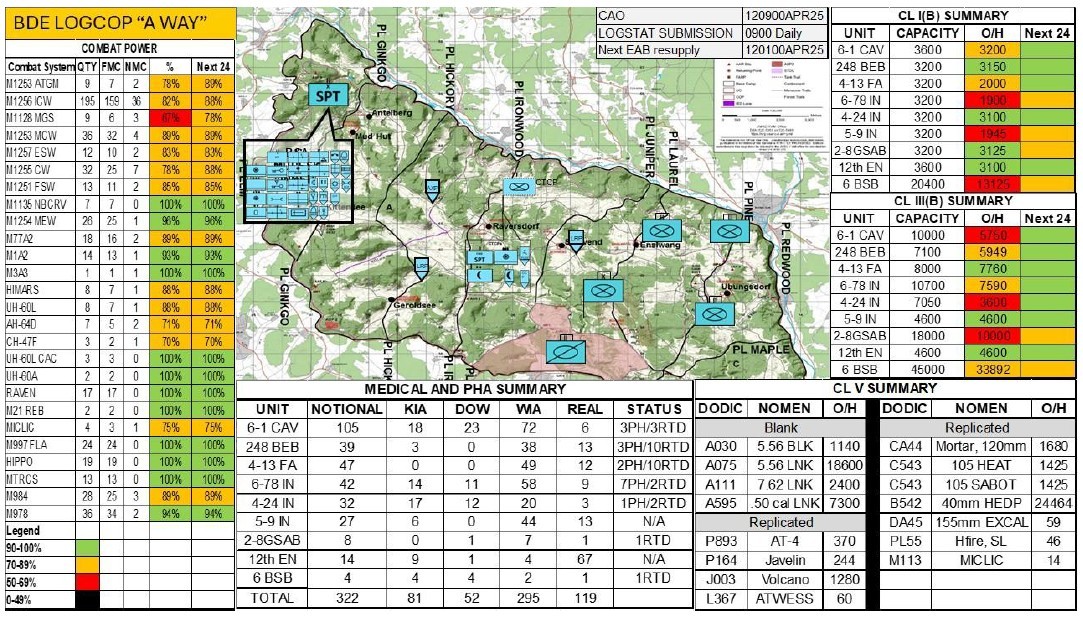
The LOGCOP is a critical tool that provides a synchronized, real-time view of logistics, human resources, and medical information across the brigade. The LOGCOP “links the battalion to the brigade combat team (BCT) and the BCT to the sustainment brigade and theater planners.” The SPO section compiles the LOGCOP from logistics status reports (LOGSTATs) and develops it further during logistics synchronization (LOGSYNC) meetings. A well-maintained LOGCOP provides visibility of supply locations, quantities, and critical maintenance metrics for all friendly units in the brigade’s area of operations.
BSB staff observed during exercises at JMRC neglect to create, share, and update a LOGCOP that enables brigade level decision making. In some cases, the BSB SPO and the brigade S4 maintain different versions of the LOGCOP, causing confusion about ownership of the product within the brigade. Some organizations use visually appealing tools like Power BI, but the brigade commander often directs the brigade S4 to create a traditional LOGCOP for decision support. Units that fail to consistently update their LOGCOP experience logistical desynchronization, resulting in critical shortages and unplanned resupply efforts.
Accurate, timely LOGSTATs, full participation in LOGSYNC meetings, and consistent staff collaboration are essential to creating an effective LOGCOP. The BSB SPO coordinates with staff sections, the brigade S4, forward support company (FSC) commanders, and battalion S4s to ensure timely and accurate LOGSTAT submissions and enforce LOGSYNC attendance. The BSB SPO or the BDE S4 owns the brigade’s LOGCOP, but all parties must clearly understand this assignment. The party responsible (SPO or BDE S4) should disseminate the LOGCOP digitally and in an analog format. Brigade-level staff exercises-incorporating battalions-during gunneries, situational training exercises (STX), and combined arms live fire exercises (CALFEX) build and maintain LOGCOP proficiency. See the example LOGCOP in figure 1 below.
Maintaining effective Brigade Support Area (BSA) security
The BSA is “the designated area where sustainment elements provide support to a brigade.” It serves as the operational hub for the BSB, where logistics operations and defensive actions converge. Effective BSA security is critical irrespective of the distance from the forward line of own troops (FLOT); a BSB cannot successfully support its combat units if it is vulnerable to enemy action. In addition to recent proliferation of aerial threats, the BSB must remain capable of repelling a level I threat, defined as a “small enemy force that can be defeated by those units normally operating in the echelon support area or by the perimeter defense”.
At JMRC, Sustainment OC/Ts have observed deficiencies in base defense, particularly in balancing the need for dispersion with the ability to defeat a level I threat. Units often achieve dispersion by using the base cluster method, splitting the BSA into two or more geographically separated locations. While dispersion helps mitigate vulnerabilities to aerial surveillance and indirect fires, it complicates the creation of mutually supportive defensive positions and interlocking fields of fire. Rotations frequently reveal poor quality and unsustainable fighting positions, and a lack of communication between those positions and the base defense operations cell (BDOC). Personnel assigned to these positions often lack familiarity with the weapon systems or the necessary training and experience needed for an effective defense.
To address these issues, BSBs should conduct comprehensive training on survivability measures and practice BDOC and security protocols. Training should incorporate all four components of BSB security:
- protection
- detection
- disruption
- destruction of enemy forces
Prioritize active and passive enemy detection measures, such as establishing listening posts/observation posts (LP/OP). Furthermore, regular squad and team level training on constructing and maintaining individual fighting positions enable sustained proficiency. Units should conduct base defense rehearsals frequently and collectively, regardless of BSA configuration, to enhance preparedness. Integrating the FSC field trains command post (FTCP) into the BSA defense enhances survivability. Units can practice these tactics, techniques, and procedures (TTP) throughout their training progression, both partially and fully, as the BSB supports collective training before a CTC rotation or deployment.
Conclusion
The key to success for BSB headquarters in a CTC environment lies in home-station training that mirrors current lessons learned from relevant LSCO operations and tests brigade-level logistics systems. Effective sustainment operations are contingent upon accurate and timely information. Leaders across the brigade must provide synchronized logistics support through accurate LOGSTATs and other fighting products. The production and dissemination of clear and concise orders enable subordinate units to execute their tasks in a timely manner, ensuring that the sustainment mission contributes to the overall success of the brigade combat team. BSB commanders can capitalize on JMRC’s observations by incorporating these focus areas during home station training. To do so, the BSB should always be tactically involved in brigade-level field training exercises with the BDE S4 and BSB Staff jointly planning sustainment under realistic conditions. Relying on administrative resupply or conducting sustainment planning in an office during home station training is a missed training opportunity for the brigade’s logistics enterprise.
Social Sharing