VIEW ORIGINAL
The Training Management Directorate (TMD) published the third in a series of Training Circulars (TCs) to further amplify subjects introduced and discussed in training doctrine publications ADP 7-0 and FM 7-0, Training. Training Circular (TC) 7-0.3, Plan an Event, outlines key frameworks for planning training activities and provides guidance on techniques and models which are useful at the company, battery, and troop level. It provides leaders with practical strategies to efficiently plan, execute, and evaluate training events at various levels.
TC 7-0.3 contains two chapters:
Chapter One explores the processes and principles of planning training events, emphasizing platoon-level planning and execution strategies. It offers a comprehensive and detailed methodology for planning training events, aimed at enhancing coordination, skill development, and overall effectiveness. Every activity, from individual task through collective task training, is aligned with the commander’s training guidance.
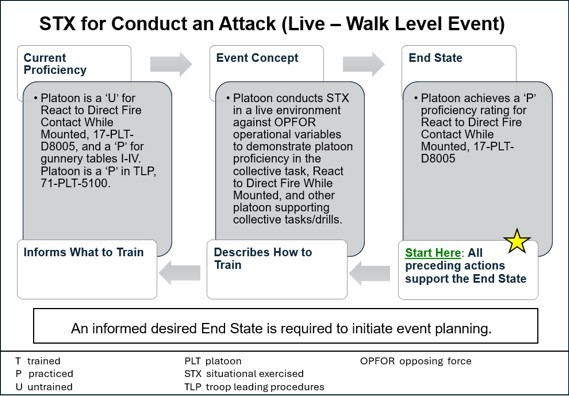
Army training events are structured activities aimed at enhancing the skills, coordination, and overall readiness of a unit. These events focus on tasks critical to the unit's mission, including mission essential tasks (MET), tactical tasks, battle tasks, weapons training, battle drills, and communication exercises. The primary objective of a training event is to ensure that the unit functions as a cohesive and effective entity in all scenarios.
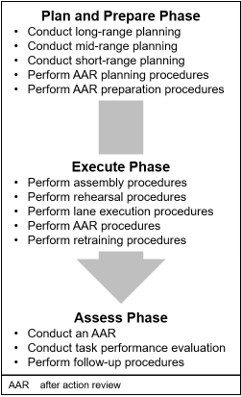
Training events are typically guided by the Army's operations process, which encompasses planning, preparation, execution, and assessment phases. This process involves coordination and support from the company, battalion, and higher echelons. Training events are integrated into the organization’s unit training plan (UTP) and are aligned with the commander's training guidance. Leaders prioritize tasks, allocate necessary resources, and conduct after action reviews (AAR) to evaluate performance and identify areas for improvement.
Chapter Two provides detailed planning for lane training. Lane training supplies leaders with a systematic and effective approach to improving unit proficiency in individual and collective tasks, battle tasks, and battle drills within a controlled environment. This method focuses on repeated practice, immediate feedback, and retraining, enabling units to efficiently meet tactical and technical standards. Training is effectively structured, administered, supported, and evaluated by limiting the number of tasks, time, terrain, facilities, or other resources.
Chapter Two also examines the principles, planning processes, advantages, and practical applications of lane training at the platoon level and beyond, providing leaders with strategies to optimize training outcomes and operational efficiency. The chapter also outlines the different types of lane training, the characteristics of lane training, components of lane training, and the lane training process, as well as participants and their responsibilities.
TC 7-0.3 includes two appendices:
Appendix A outlines the 8-step training model. The 8-step training model is a flexible framework for planning and executing small-unit training events efficiently while ensuring key activities are completed. Though not a substitute for troop leading procedures (TLP) or the operations process, the 8-step training model offers leaders a straightforward framework to effectively plan and manage simpler training activities with continuity and consistency. The model is best suited for squad and below, and adaptable to unit needs. Units can modify training models, often by adding additional steps and procedures, based on leader experience. Modified training models often closely align with installation resourcing requirements and leaders gain efficiencies by their use. The familiar but adaptable structure of the 8-step training model allows for continuity in planning, coordinating, and managing simple training events.
Appendix B outlines Army troop leading procedures, a detailed 8-step process used by small-unit leaders to efficiently plan, prepare, and execute training. Troop leading procedures assist small unit leaders in translating the commander’s intent into actionable tasks and to coordinate actions to execute the mission. When developing training events and plans at company level and below, leaders can follow TLP as the framework for planning. Although some of the planning activities performed for operations differ for training, they are similar enough that TLP provide a sound and reliable basis for planning training events.
Lane training provides a simple method to focus training on specific tasks under experienced evaluators. Leaders plan, prepare, execute and assess training to prepare their formation to execute their assigned mission. Becoming familiar with Army operations and planning processes in training can help leaders and units more seamlessly transition to operations and planning processes when deployed.
TC 7-0.3, Plan an Event, is one of a series of Training Circulars that further expand the discussion of selected topics and provide leaders with detailed information on performing critical leader tasks in the training management process. These TCs include:
TC 7-0.1: After Action Reviews
TC 7-0.2: Training Meetings
TC 7-0.3: Plan an Event
TC 7-0.4: Training and Evaluation Outlines
Interested parties can find a list of Army Training Circular publications at Army Publishing Directorate – Training Circulars. Readers can find all TMD-published TCs at the link above or on the Army Training Network (ATN) at https://atn.army.mil.
TMD, part of the Combined Arms Center-Training at Fort Leavenworth, is the Army’s training management proponent. As such, TMD develops Army training doctrine for publication, administers the Army Training Network (ATN), and maintains the Army Training Management System (ATMS). ADP 7-0, FM 7-0, the Platoon Leader's Guide to Training Management, and much more can be found on the ATN Webpage at https://atn.army.mil
Social Sharing