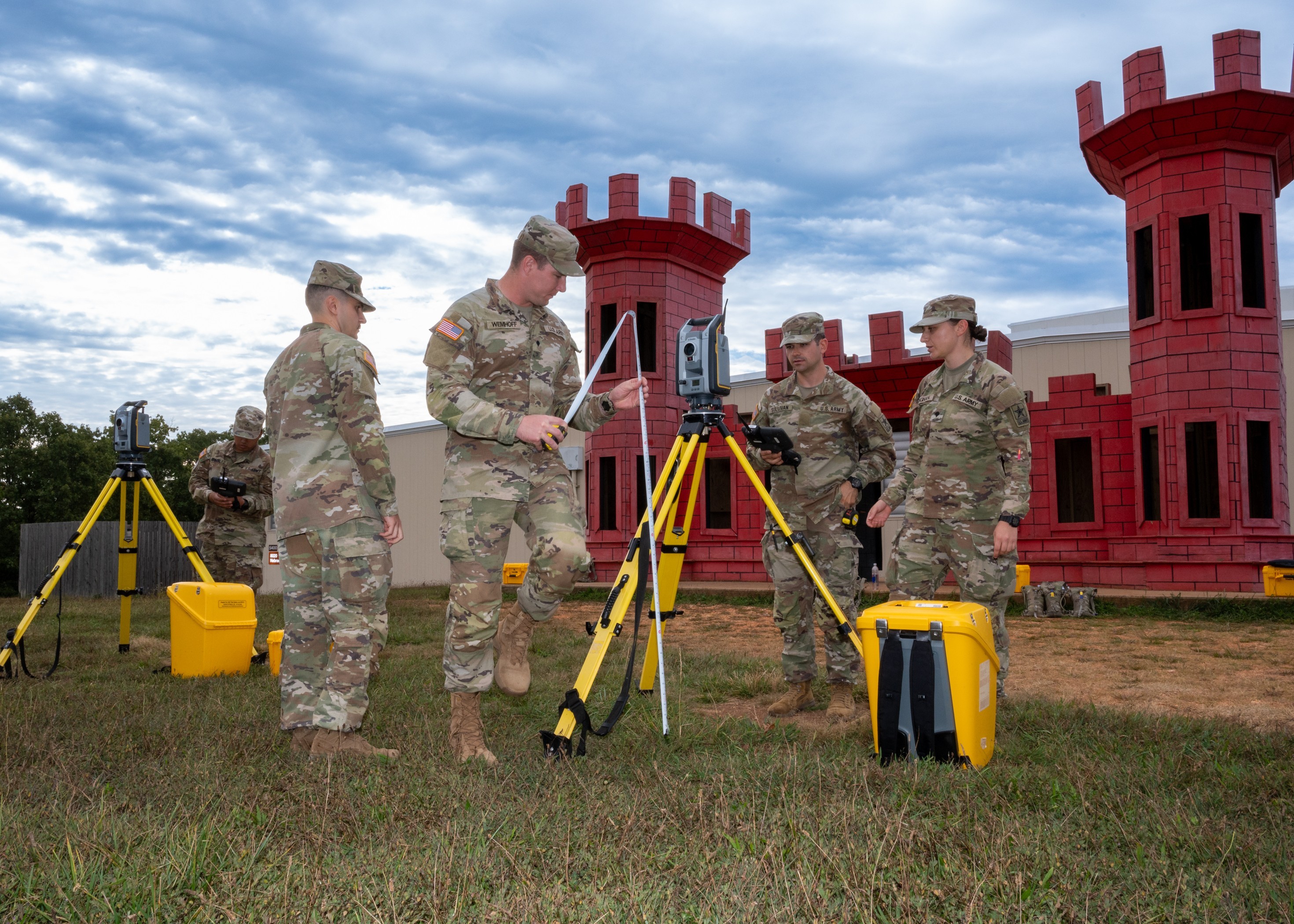

FORT LEONARD WOOD, Mo. — The U.S. military’s technical engineers begin their careers at Fort Leonard Wood during advanced individual training to learn their military occupational specialty.
The 12T Technical Engineer Course under the Technical Engineer Skills Division, 169th Engineer Battalion, teaches Soldiers, Sailors, Airmen and Marines in the technical engineering MOS. Once finished with the course, 12T Soldiers supervise and execute construction site development with technical investigation, surveys, draft, and construction plans and specifications.
Staff Sgt. Domenick Pupo, 12T Technical Engineer Course instructor, said he chose this MOS because it is a “unique job.”
“All construction starts with us and ends with us,” he said.
According to David Brzozowski, 12T Technical Engineer Course manager, the course trains about 500 service members over the span of 17 weeks with 20 classes held each year.
He said the course is broken down into four phases — Phase 1, Phase 2a, Phase 2b and Phase 3.
The first phase of the course jointly trains the Army, Air Force, Navy and Marines in the skills of manual and computer aided drafting.
“Students begin their journey learning about the basic composition of structures, such as different materials they can be built out of, different framing techniques and different build styles depending on the environment,” Brzozowski said.
Students then sketch out plan views of floor layouts by hand.
“They transfer these skills to computer-aided design software and expand on them. They will add in completing mechanical and detail drawings, along with foundation plans, utility plans, sectional views and elevation views,” Brzozowski said.
Phase 2a proceeds with only Army and Navy students, as Air Force and Marine students move on to their own separate phases.
“Here they will tackle learning all about soils engineering and composition. Using laboratory tests, they will determine grain and particle sizes in the soil, moisture content, specific gravity, liquid limit and plastic limit,” Brzozowski said.
Using that knowledge, students will determine proper techniques and percentages to ensure weight bearing capacity of the soil.
“We wrap up with mixing concrete, quality control for concrete deliveries and calculating the concrete’s compressive and flexural strength,” he said.
Phase 2b continues with Soldiers and Sailors learning the principles and techniques of land surveying.
“They begin with dusting off their math skills and learning to calculate a survey using the same techniques honed for centuries by their predecessors to build the world around us,” Brzozowski said.
Incorporating modern survey instruments and machines that perform precise movements and calculations for students is a foundational skill for the job, he said.
“With these instruments they learn to establish vertical and horizontal control over a survey project, which is one of the first things they will need to do at every job site they visit,” Brzozowski said.
Next, students learn to process the survey data they collect using computer software to image the project site and create building and parking structures.
“They learn to account for and engineer drainage areas so that water will not infiltrate and destroy the product they are trying to create,” Brzozowski said. “Designing roads along hills and curves is next, so that construction equipment and traffic can reach their project site.”
The final step in this phase has students take the product they created on a computer and transfer it back to survey instruments, allowing them to stake out those points on the project site.
Pvt. Zachary Sullivan, Company B, 169th Engineer Battalion, said he was surprised by the amount of math he is doing during this phase, but is loving the technical skills he is gaining.
“We are learning that even minuscule differences in what we're surveying can make or break a project,” Sullivan said.
In Phase 3, only Soldiers move on to building and validating existing airfields.
“They begin with learning the basic components of an airfield,” Brzozowski said. “Then they use the skills they learned in surveying to establish control over an airfield with GPS survey equipment.”
According to Brzozowski, Soldiers use this equipment to collect data on a project site, airfield or construction, and process it using the same software as before.
Technical engineers will use these skills to build and certify airfields, Pupo added.
“Airfields need to be recertified every five years,” Pupo said. “For instance, if a cell phone company wants to build a new tower somewhere, technical engineers have to make sure it is not an obstruction, and the pilot’s charts are updated with the new information.”
He said his students leave AIT with a “solid foundation” that will carry them throughout their careers.
“They are ready to perform all the tasks they learn here. This is such a technical job, so they will continue to learn with every project they work on,” Pupo said.
For more information about the Army’s 12T Technical Engineer MOS, visit goarmy.com.
Social Sharing