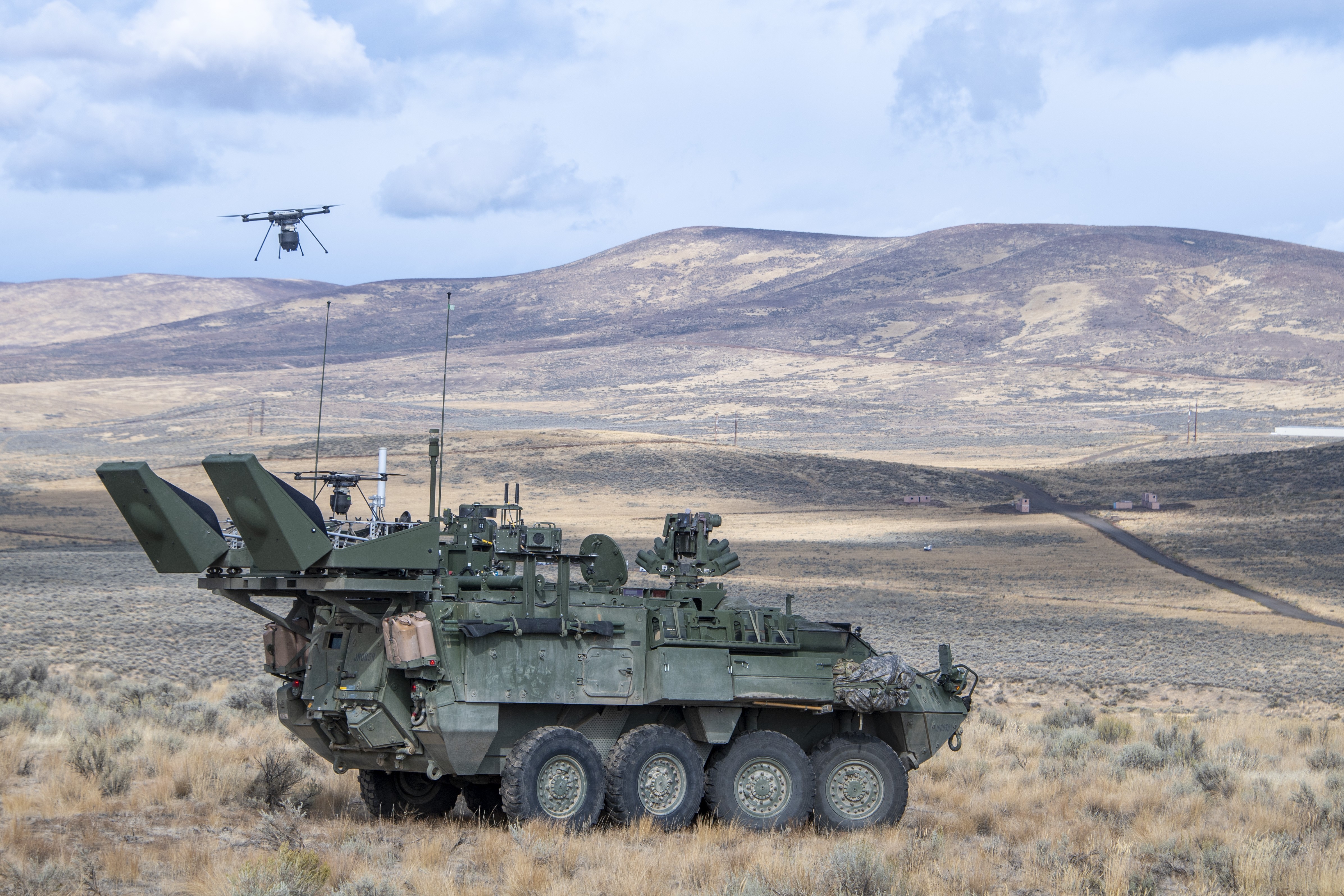
ABERDEEN PROVING GROUND, MD – In October 2023, the U.S. Army Test and Evaluation Command (ATEC) demonstrated a Multi-Domain Operations Distributed Live, Virtual, Constructive (LVC) Initial Operational Capability across ATEC’s geographically diverse sites on a distributed network. Since that demonstration, ATEC has been maturing its capability by creating even more complex virtual environments, which are critical to ATEC’s digital transformation and the Army’s ability to test and evaluate cutting-edge technologies faster and more efficiently.
Distributed LVC test and evaluation enables a unified and data-driven approach by linking real-world test assets with advanced simulations in secure, networked environments. By leveraging simulations, trusted models and relevant mission representations, ATEC is expanding its capacity and expertise to evaluate systems-of-systems against operational mission threads. This enables ATEC to conduct early, continuous and repeatable testing at scale — reducing cost, accelerating learning and optimizing complex test scenarios.
Growing LVC Capabilities
In 2023, the demonstration executed seven operationally relevant scenarios spanning land, air, space and cyberspace domains, and it employed more than 60 live military systems, virtual assets and constructive simulations. The U.S. Army Evaluation Center provided near-real time data collection, reduction, analysis and visualization throughout execution of the event, transposing raw data to dashboard visualizations in under a minute.
Today, ATEC’s scalable test capability to emulate these environments in support of experimentation and testing is known as the ATEC Next Integrated MDO Distributed Operational Test Environment, or ANIMDOTE. It threads systems integration labs, hardware in the loop facilities and open-air test ranges into a collective digital LVC sandbox via distributed test networks.
“The operational environments in which our warfighters will be employing the Army’s new capabilities are becoming continually more complex,” said William Wiesner, lead of ATEC’s Integrated Solutions Team. “Replication of these operating environments will require calling upon test assets and capabilities not only across ATEC, but likely across the Joint test and experimentation communities.”
An Intentional Approach
ATEC is utilizing a crawl, walk, run approach to create an operationally realistic distributed LVC environment, capable of generating decision-quality data. As the capability continues development and integration at greater scale, ATEC has employed ANIMDOTE in support of the Command and Control Cross Functional Team and digital fires, building connections to the U.S. Army Combat Capabilities Development Command’s Combined Joint Systems Integration Laboratory and the National Cyber Range Complex’s Orlando site. Digital fires refer to the modernization of the Army’s fire support with automated, networked digital systems.
ATEC is also working in support of Joint Program Office Guam Defense Systems to create a mission engineering environment that will employ assets from across the Joint force and the Test Resource Management Center.
“We need to orient test and evaluation to address the collective system-of-systems and think beyond platform-centric events towards mission-representative operational threads,” said Paul J. Kwashnak, chief of the Futures and Concepts Division at ATEC. “Efforts like this help inform capability relevance and readiness at scale for realistic, multi-domain scenarios, which will build better and timely insights to extend trust and reliability in warfighting systems.”
The Way Forward
The ability to replicate the complexity of the future operating environment is central to the Army’s test and evaluation mission, enabling the validation and refinement of emerging warfighting capabilities. ATEC is positioning itself to support experimentation and conduct efficient and timely test and evaluation in distributed LVC environments, directly supporting senior leader fielding decisions.
Social Sharing