
DUGWAY PROVING GROUND, Utah – Dugway Proving Ground (DPG) played a crucial role in showcasing the capabilities of BAE Systems’ APKWS® laser-guidance kit during a test event earlier this year, firing it from a multi-rotor Unmanned Arial System (UAS) and effectively destroying both air and ground targets.
The West Desert Test Center (WDTC) conducted the proof-of-concept trial, deploying an APKWS laser-guided rocket from a heavy-lift multirotor UAS. The goal was to engage a stationary box van and winged UAS to showcase the system's accuracy and effectiveness.
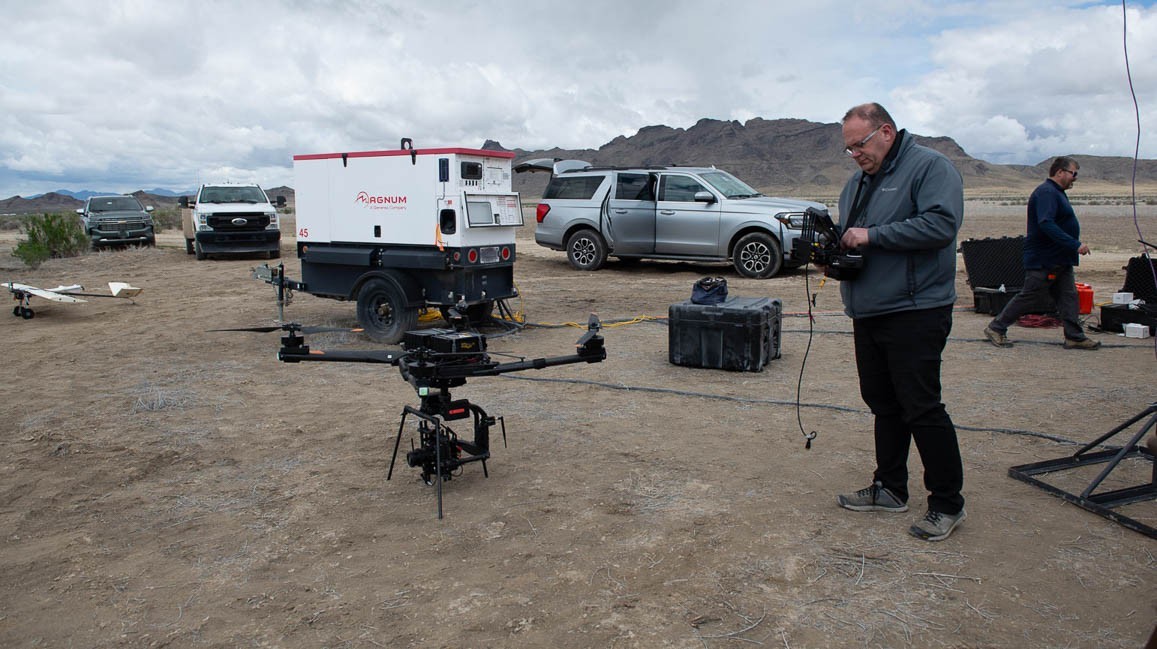

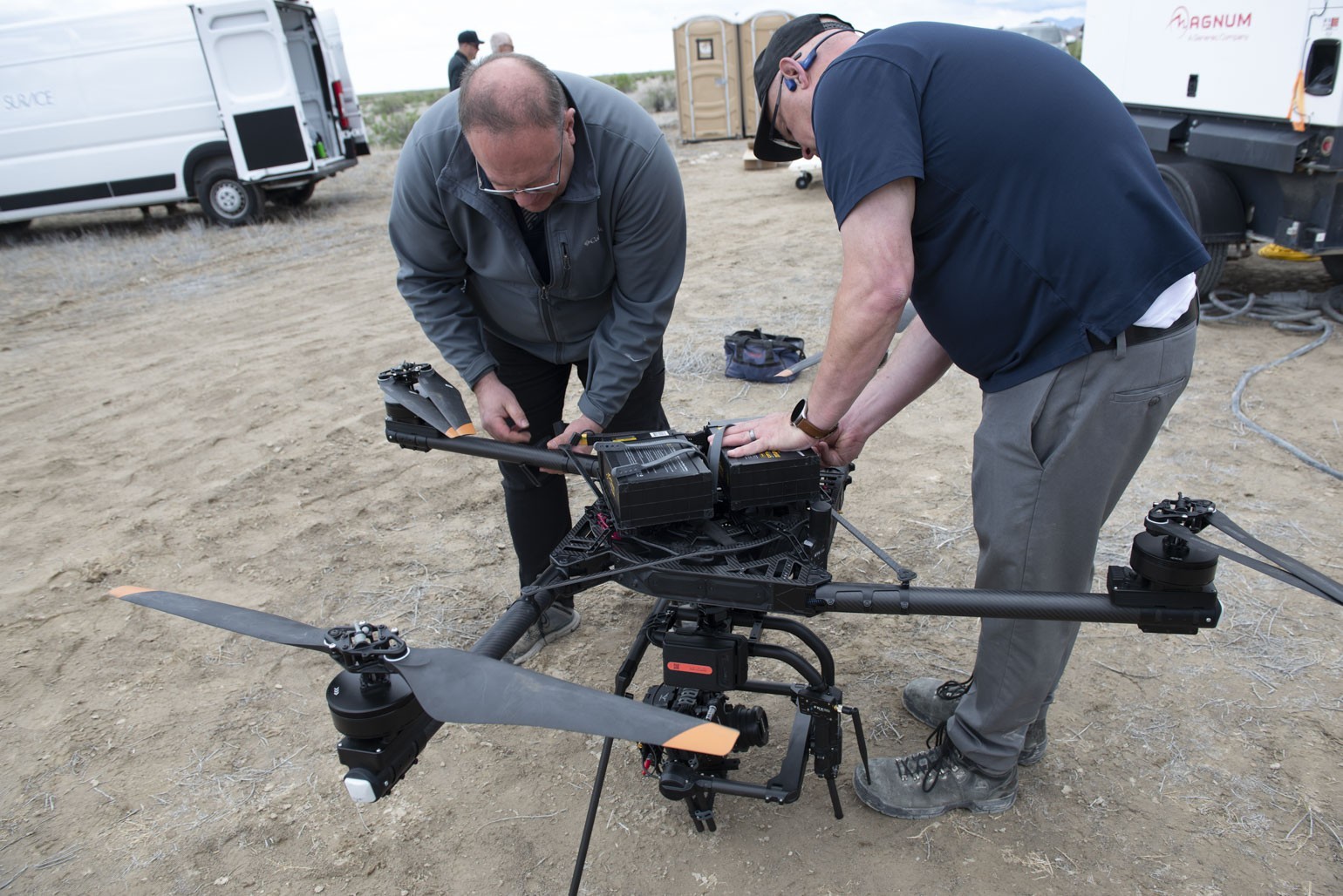
The three photos show the WDTC-providing a quadcopter to capture video of the TRV-150 firing the APKWS during the trial.
Several companies collaborated to ensure the trial’s success, including BAE Systems, SURVICE Engineering, and Invariant Corporation. They were supported by Arnold Defense, General Dynamics UK, and L3Harris. This collaboration leveraged the collective knowledge and expertise of teams in both the U.S. and UK.
Army Test and Evaluation Command (ATEC) accepted the test effort in February. The “Quad Shot” test window was conducted at DPG in April. Upon arrival the test team immediately began preparing for flight operations. The team fired three laser-guidance kits during this trial iteration: one inert proof-of-concept, one live warhead at a ground designated target vehicle, and one live warhead at a winged UAS. All three kits successfully hit their intended target.
The test used a SURVICE TRV-150, a modified version of the BAE Systems’ Malloy T-150 adapted to meet U.S. Marine Corps logistics requirements. The proven APKWS laser-guidance kit technology was integrated into this new delivery platform, exceeding expectations in all aspects, including platform performance and target engagements, with zero misses.
In today’s evolving battlefield, the U.S. Department of Defense (DoD) and its allied military forces are increasingly seeking to leverage UAS for both defensive and offensive operations in modern-day warfare. This system is a low-cost, reliable and user-friendly solution that allows soldiers to operate remotely, removing them from the line of fire. It represents an ideal weapon capability for countering current and future UAS threats and fills a critical gap in modern defense capabilities.
Social Sharing