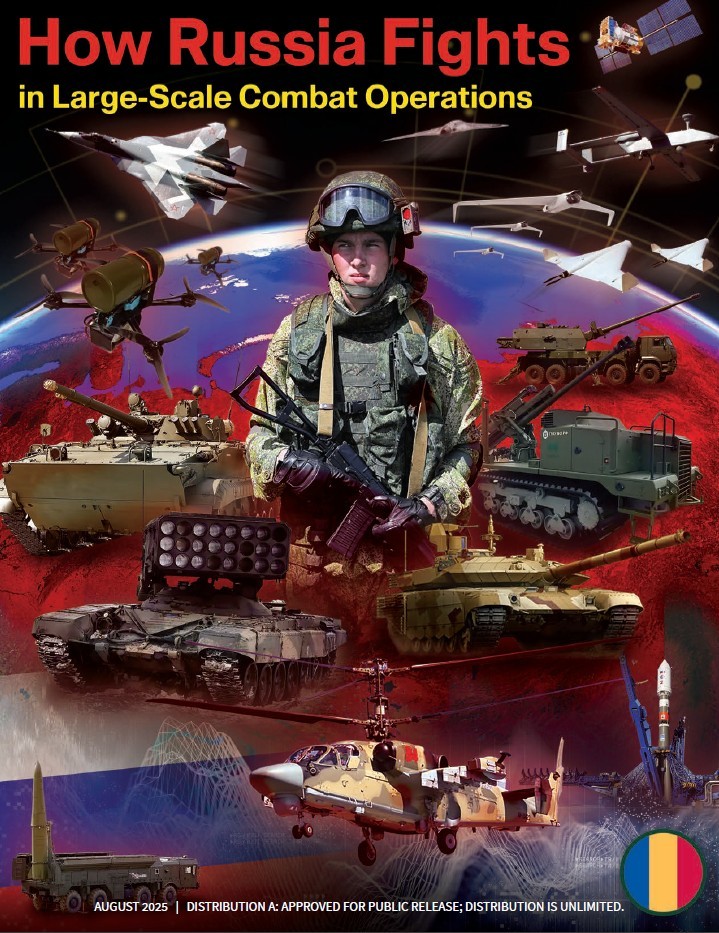
Download the full document here: TRADOC G2, How Russia Fights in Large-Scale Combat Operations (Aug 25) [PDF - 9.3 MB]
Foreword
As Commanding General of the U.S. Army Training and Doctrine Command (TRADOC), I am pleased to introduce this critical publication, How Russia Fights in Large-Scale Combat Operations. It could not arrive at a better time, as we prepare to stand up the new Army Transformation and Training Command to face a rapidly evolving and increasingly dangerous Operational Environment. This document provides a comprehensive assessment of how Russia is likely to approach large-scale combat operations (LSCO) in the European theater over the next decade.
This document is the second in a series, following How China Fights in Large-Scale Combat Operations, and builds upon two seminal TRADOC publications. The first is TRADOC Pamphlet 525-92, The Operational Environment 2024-2034: Large-Scale Combat Operations, which addresses 12 key conditions we assess are present in LSCO and adds another five implications for the U.S. Army when contemplating LSCO. The second is Army Techniques Publication 7-100.1, Russian Tactics, which serves as a foundation for how Russian ground forces think and act in tactical operations.1 How Russia Fights in Large-Scale Combat Operations draws from Russia’s operational art dating back several decades and more recent lessons learned in Ukraine, addressing how the leadership in Moscow sees Russia’s security environment and how this threat perception shapes its way of warfare.
While China is identified as our pacing threat, Russia remains a near-peer competitor with a global intelligence apparatus, a robust nuclear deterrent, and a demonstrated willingness to use force—especially in the former Soviet republics. This document provides detailed insights into how Russia’s armed forces will likely evolve doctrinally in the coming decade and how they will fight at echelon. Further, it is intended to inform U.S. Army professional military education, support curriculum development, and ensure our combat training centers incorporate relevant threat modeling into training scenarios.
I encourage all leaders, planners, and educators across the U.S. Army to engage with the content of this document and to consider its implications for doctrine, force structure, and training. Our ability to understand and anticipate the security challenges posed by Russia—especially in the complex and lethal context of LSCO—is essential to deterrence, maintaining overmatch, and ensuring victory in future conflicts.

Social Sharing