Historian offers glimpse of Buffalo Soldier regiment at Fort Leavenworth

By Melanie Libby-Fort Leavenworth LampJuly 31, 2025

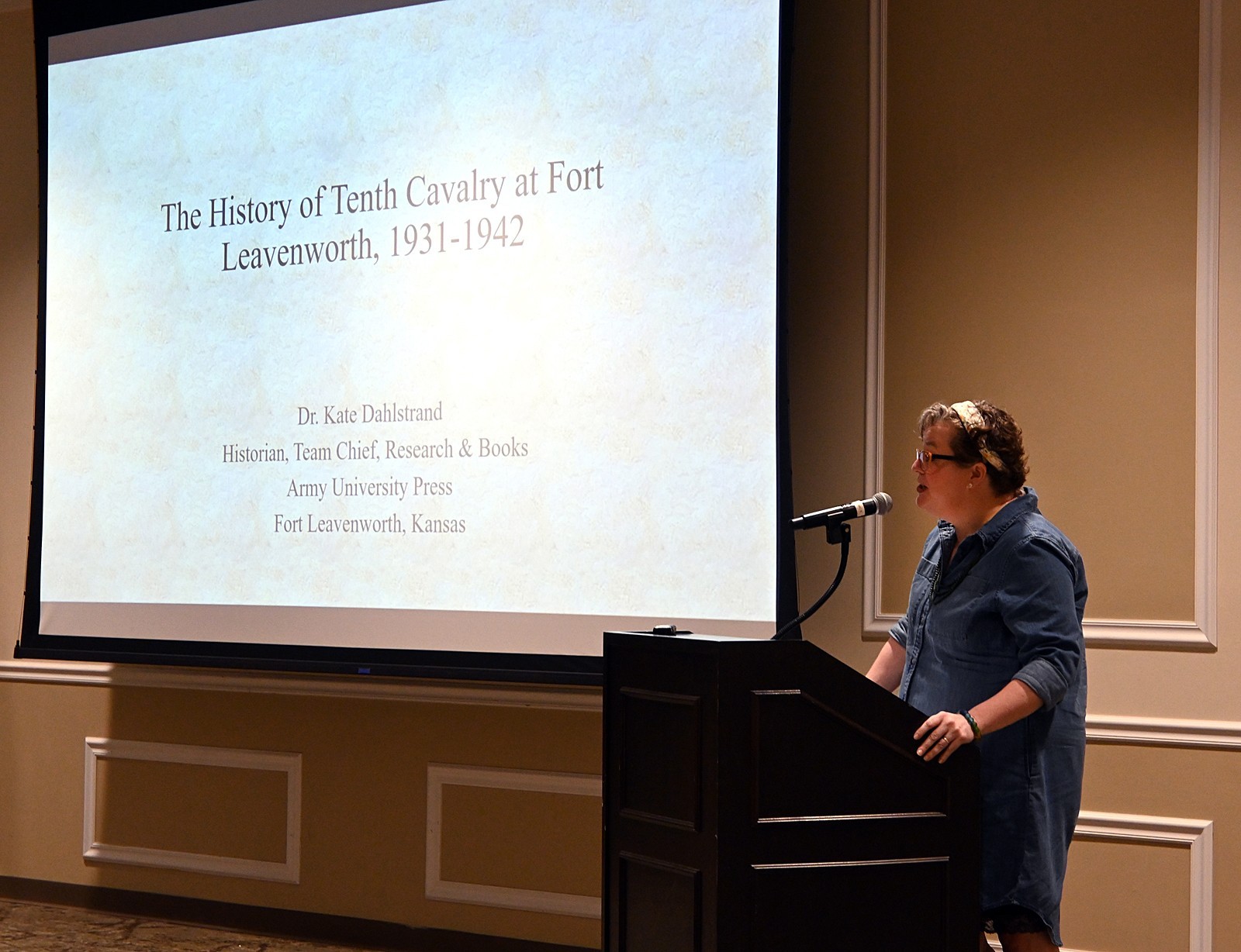
Dr. Kate Dahlstrand, historian and team chief at Army University Press, presents her lecture intended to educate Fort Leavenworth community members on Buffalo Soldiers and 10th Cavalry history July 25, 2025, at the Frontier Conference Center at...
1 / 7 Dr. Kate Dahlstrand, historian and team chief at Army University Press, presents her lecture intended to educate Fort Leavenworth community members on Buffalo Soldiers and 10th Cavalry history July 25, 2025, at the Frontier Conference Center at Fort Leavenworth, Kansas. Dahlstrand opened her lecture by sharing that her research began about two years ago and that she discovered that Black soldiers in the late 1800s faced varying levels of acceptance in the communities where they served. Photo by Melanie Libby/Fort Leavenworth Lamp Intern (Photo Credit: Photo by Melanie Libby/Fort Leavenworth Lamp Intern) View original
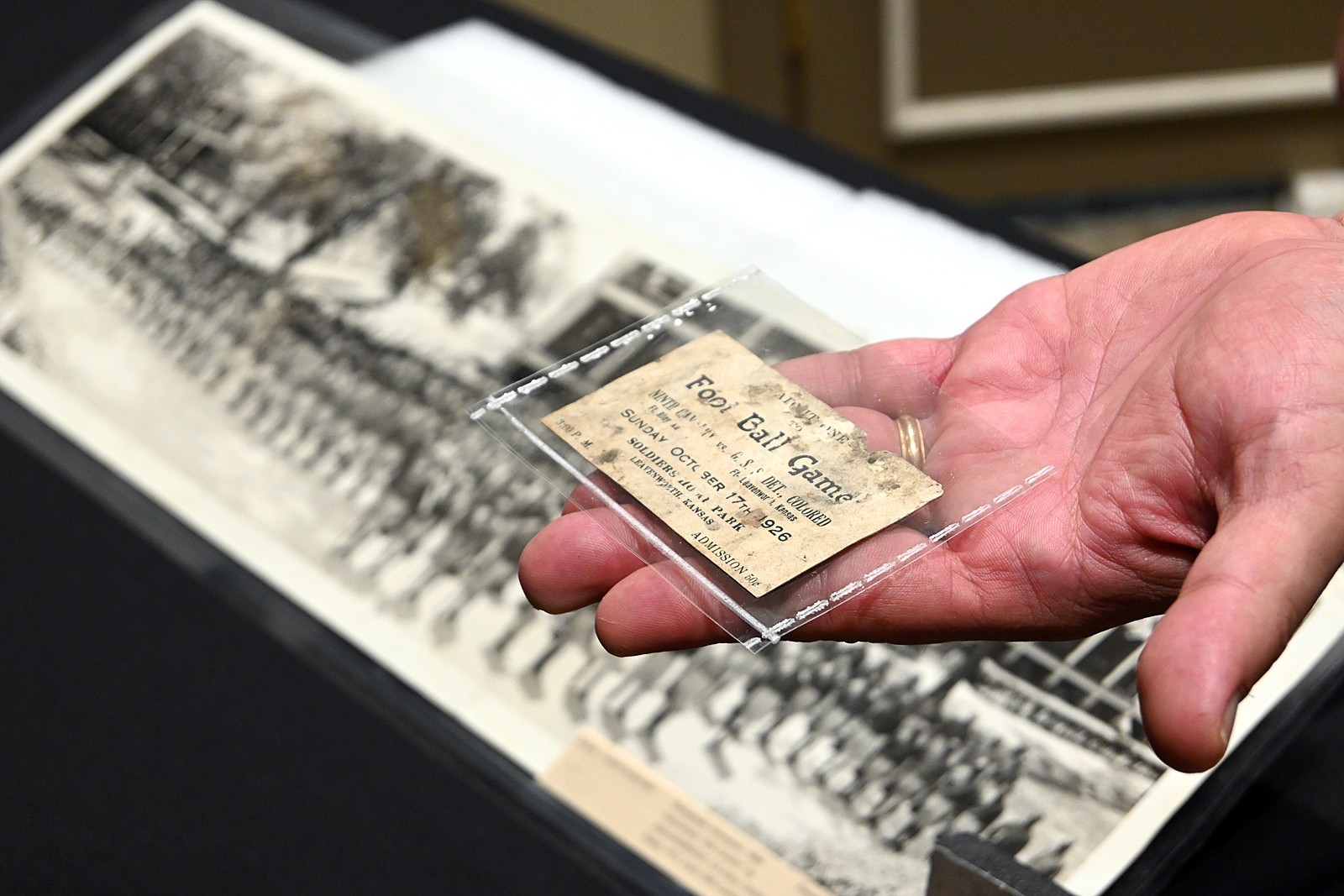
Kary Goetz, museum specialist at the Frontier Army Museum, shows Buffalo Soldiers history lecture event attendees a ticket for a 1926 football game between Black soldiers from the Fort Leavenworth and Fort Riley communities, part of a history...
2 / 7 Kary Goetz, museum specialist at the Frontier Army Museum, shows Buffalo Soldiers history lecture event attendees a ticket for a 1926 football game between Black soldiers from the Fort Leavenworth and Fort Riley communities, part of a history display about the 10th Cavalry at Fort Leavenworth, July 25, 2025, at the Frontier Conference Center at Fort Leavenworth, Kansas. Photo by Melanie Libby/Fort Leavenworth Lamp Intern (Photo Credit: Photo by Melanie Libby/Fort Leavenworth Lamp Intern) View original
Historian Dr. Kate Dahlstrand, Army University Press Research and Books team chief, begins her lecture intended to educate Fort Leavenworth Community members on Buffalo Soldiers and 10th Cavalry history July 25, 2025, at the Frontier Conference...
3 / 7 Historian Dr. Kate Dahlstrand, Army University Press Research and Books team chief, begins her lecture intended to educate Fort Leavenworth Community members on Buffalo Soldiers and 10th Cavalry history July 25, 2025, at the Frontier Conference Center at Fort Leavenworth, Kansas. Dahlstrand opened her lecture by sharing that her research began about two years ago and that she discovered that Black soldiers in the late 1800s faced varying levels of acceptance by other community members where they served. Photo by Melanie Libby/Fort Leavenworth Lamp Intern (Photo Credit: Photo by Melanie Libby/Fort Leavenworth Lamp Intern) View original
Veteran Robert Stevenson shares information about his service experience with the lecture speaker and audience members during the question-and-answer session following the Buffalo Soldiers and 10th Cavalry history lecture July 25, 2025, at the...
4 / 7 Veteran Robert Stevenson shares information about his service experience with the lecture speaker and audience members during the question-and-answer session following the Buffalo Soldiers and 10th Cavalry history lecture July 25, 2025, at the Frontier Conference Center at Fort Leavenworth, Kansas. Stevenson served in the military for more than 20 years, serving in a segregated Army unit for two of those years. Photo by Melanie Libby/Fort Leavenworth Lamp Intern (Photo Credit: Photo by Melanie Libby/Fort Leavenworth Lamp Intern) View original
An enlisted dress coat and a baseball trophy won in 1926 are displayed with other Buffalo Soldier-related artifacts July 25, 2025, at the Frontier Conference Center at Fort Leavenworth, Kansas. The coat was worn by Quartermaster Sgt. Otho J....
5 / 7 An enlisted dress coat and a baseball trophy won in 1926 are displayed with other Buffalo Soldier-related artifacts July 25, 2025, at the Frontier Conference Center at Fort Leavenworth, Kansas. The coat was worn by Quartermaster Sgt. Otho J. Woodward, a member of 10th Cavalry Troop C. The jacket was worn near the early 1900s. The trophy reads "Leavenworth Baseball Champions 1926" for the "General Service School Detachment Colored." Photo by Melanie Libby/Fort Leavenworth Lamp Intern (Photo Credit: Photo by Melanie Libby/Fort Leavenworth Lamp Intern) View original
Lt. Gen. Milford H. Beagle Jr., Combined Arms Center and Fort Leavenworth commanding general, thanks Dr. Kate Dahlstrand, historian and team chief at Army University Press, for her presentation on the 10th Cavalry July 25, 2025, at the Frontier...
6 / 7 Lt. Gen. Milford H. Beagle Jr., Combined Arms Center and Fort Leavenworth commanding general, thanks Dr. Kate Dahlstrand, historian and team chief at Army University Press, for her presentation on the 10th Cavalry July 25, 2025, at the Frontier Conference Center at Fort Leavenworth, Kansas. Photo by Melanie Libby/Fort Leavenworth Lamp Intern (Photo Credit: Photo by Melanie Libby/Fort Leavenworth Lamp Intern) View original
A circa-1930 honor guard banner, used during military ceremonies, is displayed with other artifacts related to the 10th Cavalry at Fort Leavenworth July 25, 2025, at the Frontier Conference Center at Fort Leavenworth, Kansas. The banner reads "Ad...
7 / 7 A circa-1930 honor guard banner, used during military ceremonies, is displayed with other artifacts related to the 10th Cavalry at Fort Leavenworth July 25, 2025, at the Frontier Conference Center at Fort Leavenworth, Kansas. The banner reads "Ad Bellum Pace Parati," which translates to "prepared in peace for war" and was adopted as the official crest and motto of the Command and General Staff College. Photo by Melanie Libby/Fort Leavenworth Lamp Intern (Photo Credit: Photo by Melanie Libby/Fort Leavenworth Lamp Intern) View original

FORT LEAVENWORTH, Kansas — Working to better educate the Fort Leavenworth, Kansas, community on the historical significance of Black soldiers as part of the 10th Cavalry, Dr. Kate Dahlstrand, historian and team chief at Army University Press, lectured on her research findings July 25, 2025, at the Frontier Conference Center.

Lt. Gen. Milford H. Beagle Jr., Combined Arms Center and Fort Leavenworth commanding general, introduced Dahlstrand.

“Buffalo Soldier Day has always been about honoring the past, but today, by design, we shift from celebration to education,” Beagle said. “Those keywords, not to lose the spirit of reverence but to deepen, and not to replace tradition but to reinforce insight. Remembering without understanding is just nostalgia. Remembering to understand is legacy.”

Dahlstrand began her lecture focusing on where Black soldiers in the late 1800s were stationed and why the 10th Cavalry Regiment was split into multiple, smaller elements for training support.

“Robust and successful Black civilian communities could provide support, services and safety outside of the military sphere. Fort Leavenworth, then, was an ideal space for 10th Cavalry to work, serve and live a life; especially compared to the alternative: military bases situated near predominantly white and notably hostile communities that enforced segregation through threat, violence and intimidation,” Dahlstrand said.

She added, however, that despite efforts made to place Black soldiers in communities where they would receive the best treatment, these soldiers failed to receive recognition for their service.

“After the First World War, Black soldiers throughout the U.S. military returned home to a country that did not acknowledge their contributions to the war effort,” she said.

She said although Fort Leavenworth allowed for Black soldiers to serve without “constant fear of violence based on the color of (their) skin,” Black soldiers still faced discrimination within the community.

“First, 10th Cavalry soldiers were barred from purchasing tobacco products from the PX, the men were ‘only’ allowed to purchase tobacco from the 10th Cavalry Club, which was only open for two-and-a-half hours during the middle of the workday and closed on weekends and holidays,” Dahlstrand said.

She also shared instances regarding bathroom facility policies that barred Black community members from using them, limited dining options for 10th Cavalry soldiers, the banning of Black soldiers from using the swimming pools and banning of Black children from attending schools on the installation, and more.

Dahlstrand emphasized the role baseball teams served for the members of the 10th Cavalry.

“Tenth Cavalry played baseball. Here, they played at a baseball diamond located where Munson (Army Health) Center is today,” Dahlstrand said. “They were incredible, and just miles away from the Kansas City Monarchs and a destination for barnstormers, exhibition games and regional clubs.”

Dahlstrand shared that often the 10th Cavalry soldiers would play against other Buffalo Soldier teams. She noted that these games were seen as opportunities for soldiers and their families to socialize.

“Baseball served to demonstrate skill, develop esprit de corps and unit pride, as well as endear soldiers to a sports community that invited exhibitions and series. They also fostered strong relations throughout the local communities who watched and kept score,” she said.

In addition to the lecture on Dahlstrand’s findings, historical items associated with the 10th Cavalry were on display, including a 10th Cavalry enlisted dress coat and a 1926 football game ticket for a game between Black soldiers.

During the question-and-answer session following the lecture, audience members, comprised primarily of active-duty soldiers and veterans, asked for more information about Congressional Medal of Honor recipients and historical photographs presented during the lecture.

Veteran Robert Stevenson shared some of his own experiences with Dahlstrand. He served with some of the first troops in Europe to integrate in 1952. He served in both the Army and the Air Force for more than 20 years.

Beagle said that the lecture was an important way for community members to better understand and share a historically accurate truth with others.

“There's a difference between telling a good story and telling a great story filled with relevant facts and context,” Beagle said. “Context in today's information age, we're past the point of everyone owning their own opinions. In today's information age, everyone owns their own facts — experts and expertise help us close that gap.”