PISA, Italy – On March 20, a theatrical troupe from U.S. Army Garrison Rheinland-Pfalz Army Substance Abuse Program, performed “The Introduction” at Camp Darby. The “Soldiers training Soldiers” production portrayed various situations related to sexual harassment and assault, and potential pathways to prevention. The performance was written, produced and directed by Risk Reduction Program Coordinator Russell Jordan, of the USAG Rheinland-Pfalz Army Substance Abuse Program.

Jordan began writing plays in 2013 as a more engaging way to teach audiences about sexual assault, suicide, racism and extremism. “Sitting through 60-70 PowerPoint slides, people were falling asleep; they weren’t getting the message,” he said. “I thought it would be more effective if individuals could see it; if we could take it from their head to their heart … so they'd be more apt to do something.”
“The Introduction” was staffed by 21 volunteers, who traveled from Germany to Camp Darby for the performance. “This is the first show that we brought to Italy,” said production coordinator and Army Master Sgt. William Frazer with the 39th Transportation Battalion in Kaiserslautern, Germany. “I think it is a more effective and interactive way to train on sexual harassment prevention. People participating can relate and feel empowered.”
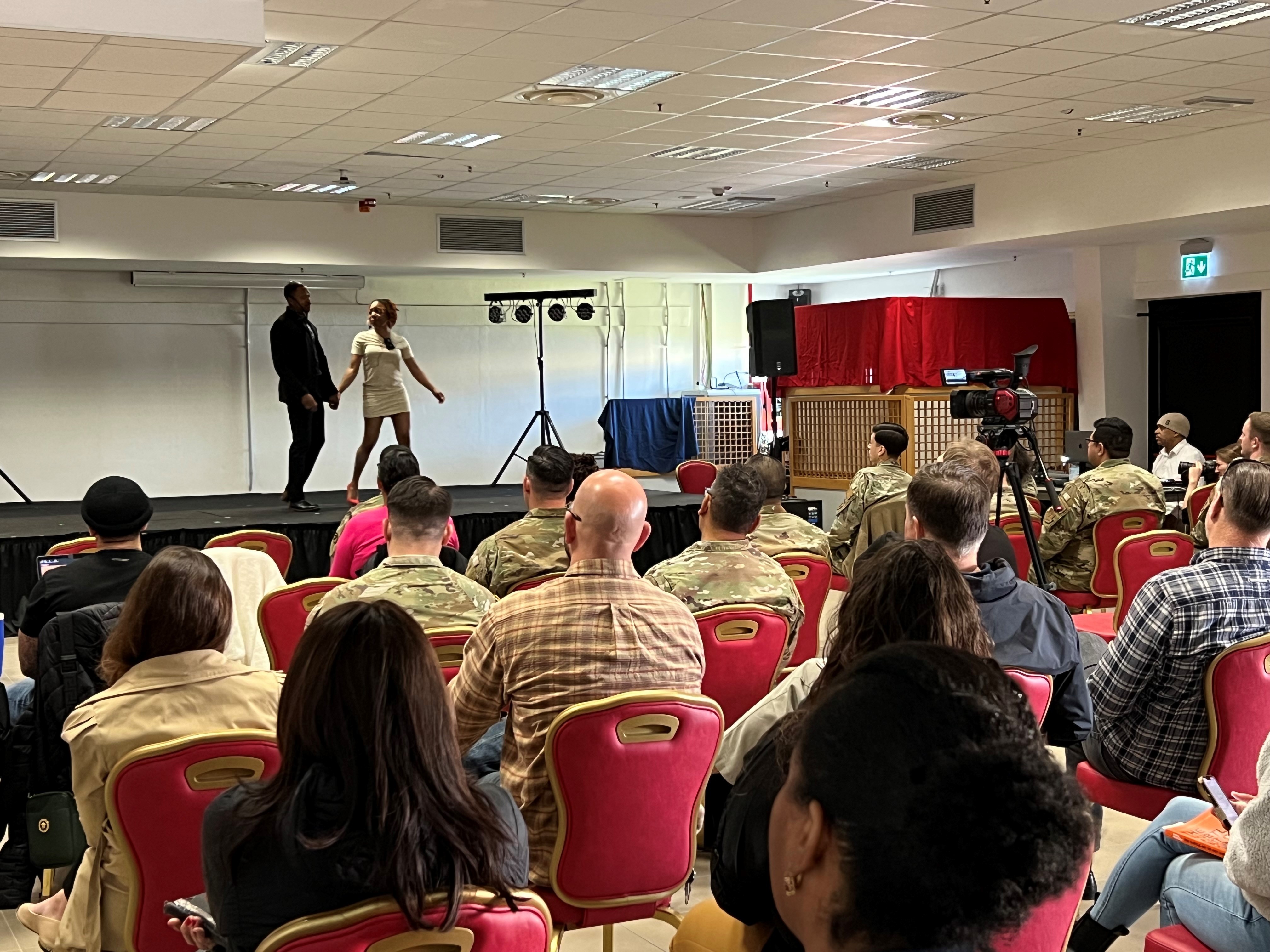
The production resonated with many in attendance. Army Lt. Col. Carey Way said, “This [performance] gives us the tools in our kit bag to combat this type of toxic behavior, these things that tear at the fabric of who we are ... Seeing these wonderful actors empowers me to want to go out and do more."
"It was very insightful, informative and enlightening,” said Senior Airman Aisha Bailey with the 731st MUNS. “It’s good to prepare you for real life situations."
After portraying several scenarios related to sexual harassment and assault, “The Introduction” actors performed a “rewind” in which they replayed each scenario to show how easily a bystander could have intervened to prevent the situation from occurring. "It's up to us individually to be the change,” Jordan said. “If we walk past it … we're becoming enablers for that behavior to continue. Being a bystander means that when [you see something] happen, you don't just stand by - but stand up."
Social Sharing