ABERDEEN PROVING GROUND, Md. — The Signal Corps laboratories at Fort Monmouth and Camp Evans, both in New Jersey, broke new scientific ground 76 years ago this month with Project Diana, making the first “space communication” between the Earth and the moon. Some 40 years after that event, the first Martin Luther King, Jr. Day was observed in 1986. In 1994, the national Martin Luther King Day of Service was signed into law.
What binds these events together, along with making both occasions in January, is the dedication towards service that was the hallmark of the men most closely associated with these events.
The MLK Day of Service encourages all Americans to volunteer to improve their community, making them more equitable and closer to the beloved community of Dr. King’s dream. Long before the day was so dedicated, individuals associated with the Fort Monmouth community were embodying the ideals of service - to their communities, the mission, and the Nation. One of those individuals was Dr. Walter S. McAfee, the scientist whose theoretical work made Project Diana possible.
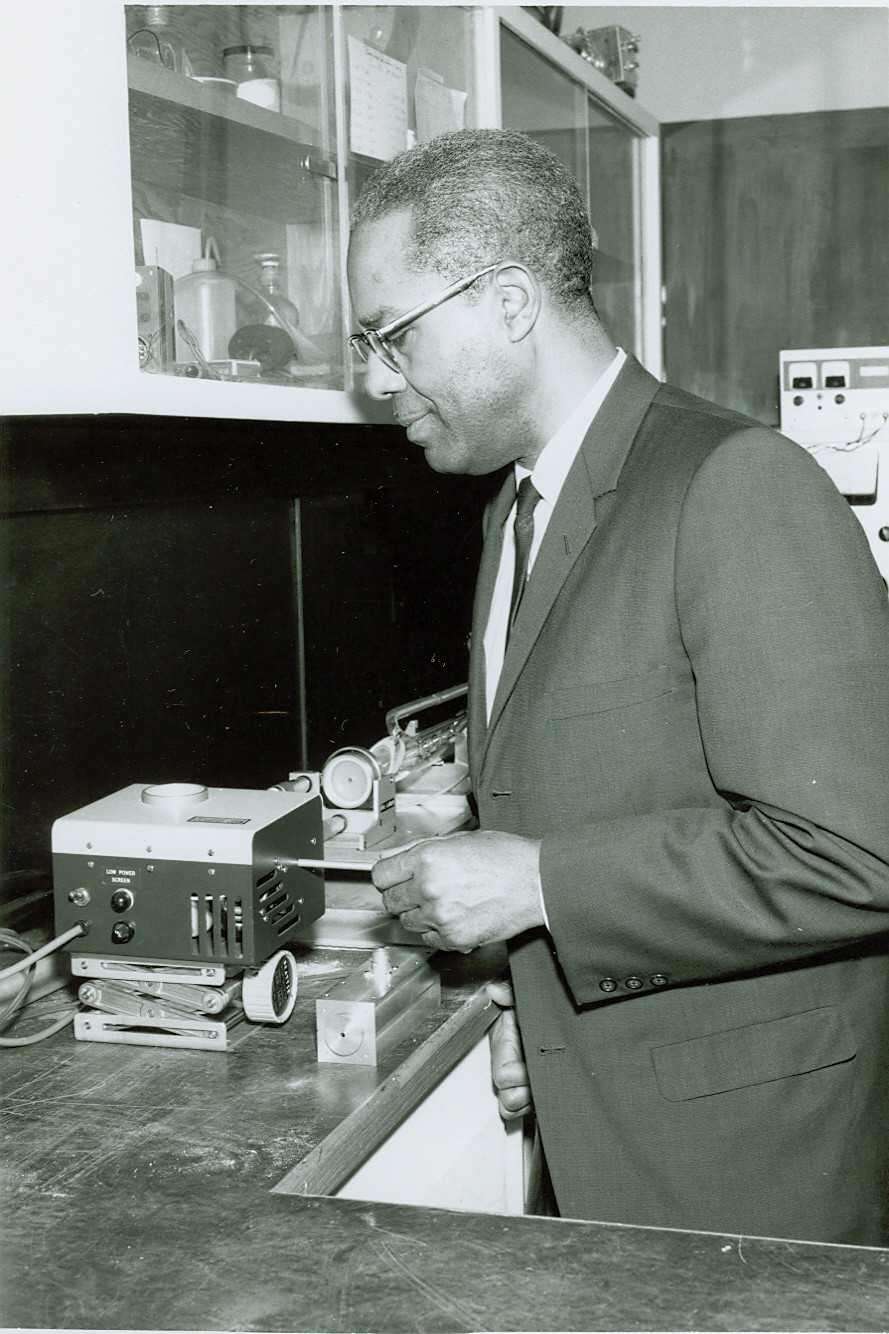
Dr. Walter S. McAfee served the Fort Monmouth community for 42 years, as a scientist, educator, supervisor and mentor. From 1942 until his retirement in 1985, Dr. McAfee helped to create a vigorous, inclusive scientific community that was dedicated to advancing communications and electronics research, as well as paving the way for the advancement of minorities in the Federal workplace. In 1971, Dr. McAfee was the first African American employee of the U.S. Army to be promoted to GS-16, a “super-grade” civilian position, with his appointment as Scientific Adviser to the Deputy for Laboratories, Army Electronics Command (ECOM). The final position before his retirement was as Scientific Advisor to the U.S. Army Electronics Research and Development Command (ERADCOM), a position he held from 1978 to 1985.
Dr. McAfee had a long and varied professional career. After earning his master’s degree, he taught general science and math in secondary schools of Columbus, Ohio from 1937-42. He joined the Army Signal Corps Radar Laboratory at Camp Evans in 1942, where he was employed as a physicist in the theoretical studies unit of the Engineering Laboratories, Army Electronics Research Command. He gained special recognition in 1946 while with Project Diana at the Evans Signal Laboratory. This small team of scientists helped put man’s imprint on the moon for the first time with radar. This experiment made headlines on January 10, 1946, when the first contact occurred between earth and its satellite. Project Diana bounced an electronic echo from the moon’s surface back to an antenna at the Evans Signal Laboratory. McAfee’s theoretical calculations determined the feasibility of this original radar “moon bounce.”
Dr. McAfee held a number of supervisory positions during his 42 years at Fort Monmouth, where he guided the development of both new technologies and the scientists who worked on them. He believed in cross-training, and helped develop and teach Internal Training Program classes available to anyone who was interested. He also continued to serve his community, both during and after his professional career, focusing on education and creating opportunities. He taught senior and first-year graduate courses in physics and electronics engineering at Monmouth University, and supervised master’s thesis work through 1975. Dr. McAfee’s community service included membership on the Boards of Brookdale College, the Monmouth County Museum, Jersey Shore Medical Center, and the Monmouth County Chapter of the Alcoholism Council. He was selected to the Board of Directors of the First Jersey National Corporation and the First Jersey National Bank. He also served on the Curriculum
Advisory Council of the Electronics Engineering Department, Monmouth College. His long dedication to both the Army and his communities continues to provide a sterling example of how Army professionals can embrace the ideas of service, not only on MLK Day, but throughout the year.
Social Sharing