1 / 13Show Caption +Hide Caption –
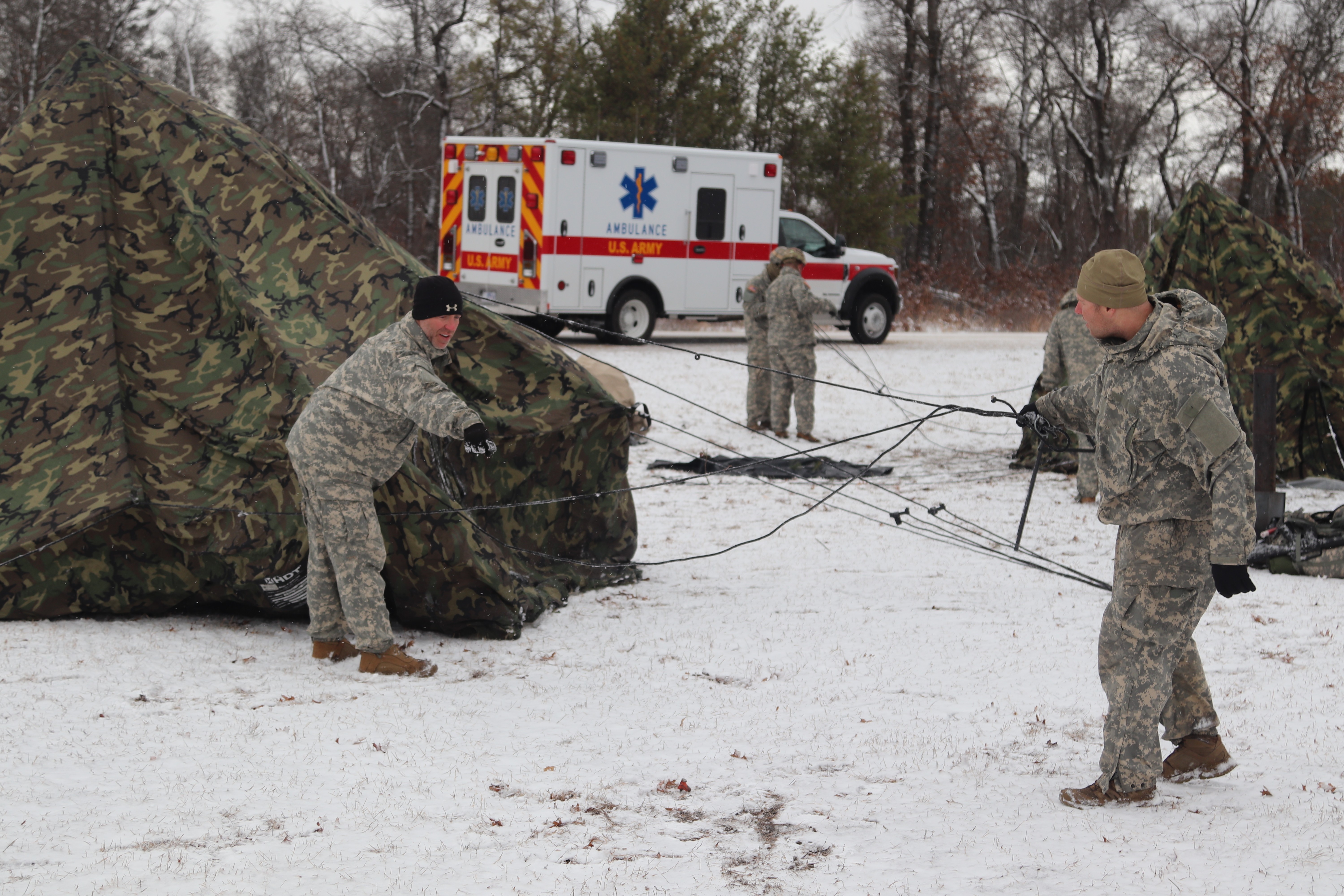
Fort McCoy Cold-Weather Operations Course (CWOC) Class 20-05 students set up an Arctic 10-person tent March 20, 2020, at a South Post training area at Fort McCoy, Wis. CWOC students are trained on a variety of cold-weather subjects, including snowshoe training and skiing as well as how to use ahkio sleds and other gear. Training also focuses on terrain and weather analysis, risk management, cold-weather clothing, developing winter fighting positions in the field, camouflage and concealment, and numerous other areas that are important to know in order to survive and operate in a cold-weather environment. The training is coordinated through the Directorate of Plans, Training, Mobilization and Security at Fort McCoy. (U.S. Army Photo by Scott T. Sturkol, Public Affairs Office, Fort McCoy, Wis.)
(Photo Credit: Scott Sturkol)VIEW ORIGINAL2 / 13Show Caption +Hide Caption –
Fort McCoy Cold-Weather Operations Course (CWOC) Class 20-05 students set up an Arctic 10-person tent March 20, 2020, at a South Post training area at Fort McCoy, Wis. CWOC students are trained on a variety of cold-weather subjects, including snowshoe training and skiing as well as how to use ahkio sleds and other gear. Training also focuses on terrain and weather analysis, risk management, cold-weather clothing, developing winter fighting positions in the field, camouflage and concealment, and numerous other areas that are important to know in order to survive and operate in a cold-weather environment. The training is coordinated through the Directorate of Plans, Training, Mobilization and Security at Fort McCoy. (U.S. Army Photo by Scott T. Sturkol, Public Affairs Office, Fort McCoy, Wis.)
(Photo Credit: Scott Sturkol)VIEW ORIGINAL3 / 13Show Caption +Hide Caption –
Fort McCoy Cold-Weather Operations Course (CWOC) Class 20-05 students walk in formation together March 20, 2020, at a South Post training area at Fort McCoy, Wis. CWOC students are trained on a variety of cold-weather subjects, including snowshoe training and skiing as well as how to use ahkio sleds and other gear. Training also focuses on terrain and weather analysis, risk management, cold-weather clothing, developing winter fighting positions in the field, camouflage and concealment, and numerous other areas that are important to know in order to survive and operate in a cold-weather environment. The training is coordinated through the Directorate of Plans, Training, Mobilization and Security at Fort McCoy. (U.S. Army Photo by Scott T. Sturkol, Public Affairs Office, Fort McCoy, Wis.)
(Photo Credit: Scott Sturkol)VIEW ORIGINAL4 / 13Show Caption +Hide Caption –
Fort McCoy Cold-Weather Operations Course (CWOC) Class 20-05 students participate in cold-water immersion training March 20, 2020, at a South Post training area at Fort McCoy, Wis. CWOC students are trained on a variety of cold-weather subjects, including snowshoe training and skiing as well as how to use ahkio sleds and other gear. Training also focuses on terrain and weather analysis, risk management, cold-weather clothing, developing winter fighting positions in the field, camouflage and concealment, and numerous other areas that are important to know in order to survive and operate in a cold-weather environment. The training is coordinated through the Directorate of Plans, Training, Mobilization and Security at Fort McCoy. (U.S. Army Photo by Scott T. Sturkol, Public Affairs Office, Fort McCoy, Wis.)
(Photo Credit: Scott Sturkol)VIEW ORIGINAL5 / 13Show Caption +Hide Caption –
Fort McCoy Cold-Weather Operations Course (CWOC) Class 20-05 students participate in cold-water immersion training March 20, 2020, at a South Post training area at Fort McCoy, Wis. CWOC students are trained on a variety of cold-weather subjects, including snowshoe training and skiing as well as how to use ahkio sleds and other gear. Training also focuses on terrain and weather analysis, risk management, cold-weather clothing, developing winter fighting positions in the field, camouflage and concealment, and numerous other areas that are important to know in order to survive and operate in a cold-weather environment. The training is coordinated through the Directorate of Plans, Training, Mobilization and Security at Fort McCoy. (U.S. Army Photo by Scott T. Sturkol, Public Affairs Office, Fort McCoy, Wis.)
(Photo Credit: Scott Sturkol)VIEW ORIGINAL6 / 13Show Caption +Hide Caption –
A Fort McCoy Cold-Weather Operations Course (CWOC) Class 20-05 student participates in cold-water immersion training March 20, 2020, at a South Post training area at Fort McCoy, Wis. CWOC students are trained on a variety of cold-weather subjects, including snowshoe training and skiing as well as how to use ahkio sleds and other gear. Training also focuses on terrain and weather analysis, risk management, cold-weather clothing, developing winter fighting positions in the field, camouflage and concealment, and numerous other areas that are important to know in order to survive and operate in a cold-weather environment. The training is coordinated through the Directorate of Plans, Training, Mobilization and Security at Fort McCoy. (U.S. Army Photo by Scott T. Sturkol, Public Affairs Office, Fort McCoy, Wis.)
(Photo Credit: Scott Sturkol)VIEW ORIGINAL7 / 13Show Caption +Hide Caption –
Fort McCoy Cold-Weather Operations Course (CWOC) Class 20-05 students participate in cold-water immersion training March 20, 2020, at a South Post training area at Fort McCoy, Wis. CWOC students are trained on a variety of cold-weather subjects, including snowshoe training and skiing as well as how to use ahkio sleds and other gear. Training also focuses on terrain and weather analysis, risk management, cold-weather clothing, developing winter fighting positions in the field, camouflage and concealment, and numerous other areas that are important to know in order to survive and operate in a cold-weather environment. The training is coordinated through the Directorate of Plans, Training, Mobilization and Security at Fort McCoy. (U.S. Army Photo by Scott T. Sturkol, Public Affairs Office, Fort McCoy, Wis.)
(Photo Credit: Scott Sturkol)VIEW ORIGINAL8 / 13Show Caption +Hide Caption –
Fort McCoy Cold-Weather Operations Course (CWOC) Class 20-05 students participate in cold-water immersion training March 20, 2020, at a South Post training area at Fort McCoy, Wis. CWOC students are trained on a variety of cold-weather subjects, including snowshoe training and skiing as well as how to use ahkio sleds and other gear. Training also focuses on terrain and weather analysis, risk management, cold-weather clothing, developing winter fighting positions in the field, camouflage and concealment, and numerous other areas that are important to know in order to survive and operate in a cold-weather environment. The training is coordinated through the Directorate of Plans, Training, Mobilization and Security at Fort McCoy. (U.S. Army Photo by Scott T. Sturkol, Public Affairs Office, Fort McCoy, Wis.)
(Photo Credit: Scott Sturkol)VIEW ORIGINAL9 / 13Show Caption +Hide Caption –
Fort McCoy Cold-Weather Operations Course (CWOC) Class 20-05 students set up an Arctic 10-person tent March 20, 2020, at a South Post training area at Fort McCoy, Wis. CWOC students are trained on a variety of cold-weather subjects, including snowshoe training and skiing as well as how to use ahkio sleds and other gear. Training also focuses on terrain and weather analysis, risk management, cold-weather clothing, developing winter fighting positions in the field, camouflage and concealment, and numerous other areas that are important to know in order to survive and operate in a cold-weather environment. The training is coordinated through the Directorate of Plans, Training, Mobilization and Security at Fort McCoy. (U.S. Army Photo by Scott T. Sturkol, Public Affairs Office, Fort McCoy, Wis.)
(Photo Credit: Scott Sturkol)VIEW ORIGINAL10 / 13Show Caption +Hide Caption –
Fort McCoy Cold-Weather Operations Course (CWOC) Class 20-05 students set up an Arctic 10-person tent March 20, 2020, at a South Post training area at Fort McCoy, Wis. CWOC students are trained on a variety of cold-weather subjects, including snowshoe training and skiing as well as how to use ahkio sleds and other gear. Training also focuses on terrain and weather analysis, risk management, cold-weather clothing, developing winter fighting positions in the field, camouflage and concealment, and numerous other areas that are important to know in order to survive and operate in a cold-weather environment. The training is coordinated through the Directorate of Plans, Training, Mobilization and Security at Fort McCoy. (U.S. Army Photo by Scott T. Sturkol, Public Affairs Office, Fort McCoy, Wis.)
(Photo Credit: Scott Sturkol)VIEW ORIGINAL11 / 13Show Caption +Hide Caption –
Fort McCoy Cold-Weather Operations Course (CWOC) Class 20-05 students set up an Arctic 10-person tent March 20, 2020, at a South Post training area at Fort McCoy, Wis. CWOC students are trained on a variety of cold-weather subjects, including snowshoe training and skiing as well as how to use ahkio sleds and other gear. Training also focuses on terrain and weather analysis, risk management, cold-weather clothing, developing winter fighting positions in the field, camouflage and concealment, and numerous other areas that are important to know in order to survive and operate in a cold-weather environment. The training is coordinated through the Directorate of Plans, Training, Mobilization and Security at Fort McCoy. (U.S. Army Photo by Scott T. Sturkol, Public Affairs Office, Fort McCoy, Wis.)
(Photo Credit: Scott Sturkol)VIEW ORIGINAL12 / 13Show Caption +Hide Caption –
Fort McCoy Cold-Weather Operations Course (CWOC) Class 20-05 students set up an Arctic 10-person tent March 20, 2020, at a South Post training area at Fort McCoy, Wis. CWOC students are trained on a variety of cold-weather subjects, including snowshoe training and skiing as well as how to use ahkio sleds and other gear. Training also focuses on terrain and weather analysis, risk management, cold-weather clothing, developing winter fighting positions in the field, camouflage and concealment, and numerous other areas that are important to know in order to survive and operate in a cold-weather environment. The training is coordinated through the Directorate of Plans, Training, Mobilization and Security at Fort McCoy. (U.S. Army Photo by Scott T. Sturkol, Public Affairs Office, Fort McCoy, Wis.)
(Photo Credit: Scott Sturkol)VIEW ORIGINAL13 / 13Show Caption +Hide Caption –
Fort McCoy Cold-Weather Operations Course (CWOC) Class 20-05 students participate in cold-water immersion training March 20, 2020, at a South Post training area at Fort McCoy, Wis. CWOC students are trained on a variety of cold-weather subjects, including snowshoe training and skiing as well as how to use ahkio sleds and other gear. Training also focuses on terrain and weather analysis, risk management, cold-weather clothing, developing winter fighting positions in the field, camouflage and concealment, and numerous other areas that are important to know in order to survive and operate in a cold-weather environment. The training is coordinated through the Directorate of Plans, Training, Mobilization and Security at Fort McCoy. (U.S. Army Photo by Scott T. Sturkol, Public Affairs Office, Fort McCoy, Wis.)
(Photo Credit: Scott Sturkol)VIEW ORIGINAL
Fifteen students in Fort McCoy Cold-Weather Operations Course Class (CWOC) 20-05 completed training March 20 amid several challenges, yet many of those students said they learned a great deal during the course.
Those challenges included a Department of Defense-wide and Armywide response to the global COVID-19 pandemic as well as warming temperatures and melting snow.
“The changing conditions of our operating environment required us to change up some of the training,” said CWOC instructor Hunter Heard. “But the students did well responding to the changes and completed their training successfully.”
After completing the course, many students said they learned a lot about cold-weather operations that will help them and their units be successful.
“The days and nights that were spent in the field going from location to location was the best part of the course,” said student Pfc. Bryce Hutton with the 950th Engineer Company at Superior, Wis. “Also, being taught the little things that can save you from freezing was also helpful.
“Additionally, learning fire starting and shelter building are the main skills I will take away from this training to bring back to my home station,” Hutton said.
For student Staff Sgt. Torrance Ludwick, who serves with Delta Company, 415th Civil Affairs Battalion at Kalamazoo, Mich., the course was very useful.
“This course has enhanced my cold-weather operations skills,” Ludwick said. “(At my unit) I’m looking forward to future extended training scenarios in cold weather. … This course also has great instructors who are very informative.”
Sgt. Jacob Larson, also a CWOC Class 20-05 student with the 950th, said he’ll be able to share what he has learned.
“I feel like I have learned a lot of skills I can take back to teach the Soldiers on my team,” Larson said. “I can help teach the proper way to wear the Army’s cold-weather gear as well as fire-starting tricks. … Also, completing this training at Fort McCoy was excellent.”
The course’s training also may have an even larger impact through U.S. Northern Command (USNORTHCOM). Maj. Tristan Boddicker with the 478th Civil Affairs Battalion of Miami, who also works with USNORTHCOM, said the training has helped him with cold-weather operations planning.
“This course helped me develop personal field craft (skills) related to the cold-weather environment, and the training provided a great opportunity to use what I learned in planning future missions in northern Canada in support of USNORTHCOM,” Boddicker said. “Overall, it is a great course. I will also bring back this training to assist our unit’s Soldiers from Miami prior to any northern Canada mission support.”
CWOC students normally complete snowshoe training and skiing as well as how to use ahkio sleds, but class 20-05 only learned the basics of those skills because of the lack of snow. They did, however, learn extensively about the Arctic 10-person cold-weather tent, how to build improvised shelters with materials found in the forest, and more.
“This was a really great group of students,” Heard said. “They all had a great attitude and were eager to learn everything we presented. It was great, again, how they worked with us through the changing conditions.”
Students also learned terrain and weather analysis, risk management, developing winter fighting positions, camouflage and concealment in a cold-weather environment, cold-water immersion reaction and treatment, and injury prevention.
Heard taught the course with fellow instructors Manny Ortiz, Joe Ernst, and Brian Seeman. All are with contractor Veterans Range Solutions, which works with Fort McCoy’s Directorate of Plans, Training, Mobilization, and Security to complete the training.
Located in the heart of the upper Midwest, Fort McCoy is the only U.S. Army installation in Wisconsin.
The installation has provided support and facilities for the field and classroom training of more than 100,000 military personnel from all services each year since 1984.




Social Sharing