


WASHINGTON -- It's one thing to train at home station or a combat training center. It's another to train on an extended, high operations tempo deployment with partner nations, said Lt. Col. Christopher L'Heureux.
Partnering with coalition armies on large collective tasks takes training to a whole new level, he emphasized.
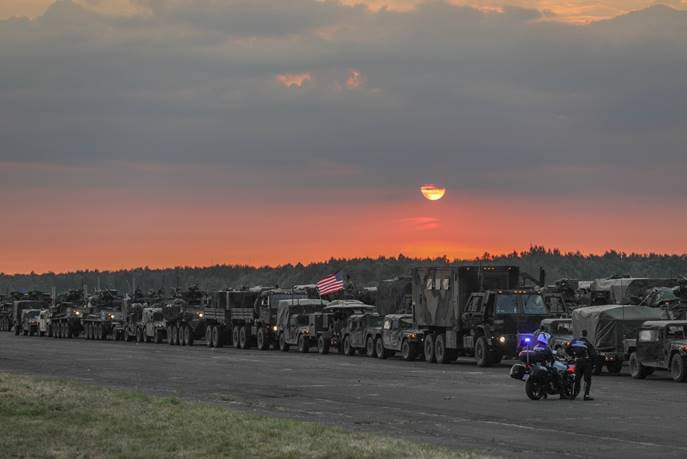
L'Heureux, commander of 2nd Squadron, 2nd Cavalry Regiment, trained with his unit in northeast Poland from April - October 2017. His unit was composed of 700 Soldiers, 80 Stryker combat vehicles, a battery of six 155mm artillery pieces and an assortment of mortars, stingers and other weapons.
The purpose of this NATO-led Enhanced Forward Presence, or eFP, was to assure allies, deter adversaries, and if necessary, defend NATO against outside aggression, said L'Heureux, who was one of four eFP battle group commanders.
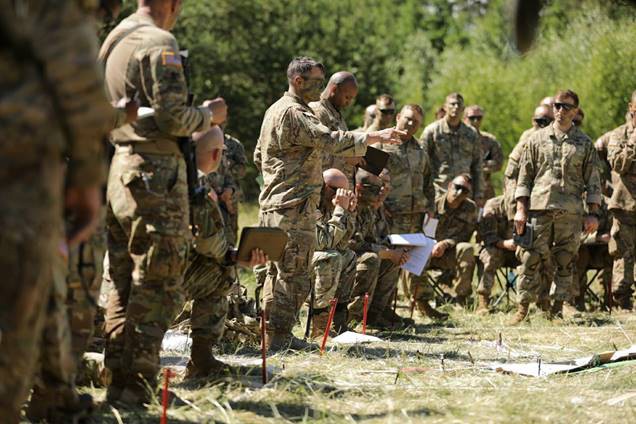
Soldiers from four nations eventually became fully integrated from the battalion level down to the platoon, he said.
The training, which included live-fire exercises, had Romanians manning air defense radar, which linked to a mixed Polish and Romanian air defense network, he said. Additionally the Croatians brought four rocket launcher batteries, the United Kingdom had light reconnaissance vehicles and the U.S. had its artillery, unmanned aerial vehicles, Stinger missiles and Strykers. A mix of Polish and U.K. infantry participated as well. Staff from all four nations coordinated all this activity.
Putting all the pieces together to make it work required a lot of communications and initiative, from the lowest to highest-ranking soldiers of all armies, L'Heureux said.
For instance, each nation had different safety rules for the live-fire engagements: fuel types for vehicles were different, network connectivity --problematic at first -- had to be established, and each nation had its own types of vehicles, weapons, tactics and procedures, all of which had to be factored in the decision calculus.
All of this training didn't occur in a single, defined area such as is the case at a combat training center. Tactical movements occurred throughout northeast Poland, with convoys moving through towns, villages, and fields just as they would be if called upon to defend the area in wartime, he said.
After this rotation, 2nd Squadron was replaced by 3rd Squadron, 2nd Cavalry Regiment, which stayed on the eFP mission until March. 1st Squadron, 2nd Cavalry Regiment is currently in Poland.
In January and February, 2nd Squadron participated in training at the Joint Multinational Readiness Center, Hohenfels, Germany.
Following the JMRC rotation, the squadron participated in Saber Strike, a 3,000-kilometer road march from Germany, through Czechia and Poland to Lithuania.
Saber Strike also involved two river crossings, an air assault and an attack. 19 nations participated in the exercise, which concluded last month.
"We're still riding the readiness wave we first built on the eFP last year," L'Heureux said.
Besides bringing the squadron to a high level of readiness, the training also resulted in establishing lasting relationships with allies and with communities where the training occurred, he added.
Capt. Gabriel Montoya, former commander of Eagle Troop, 2nd Squadron, said he was in awe of his Soldiers and how well they performed during the exercise. "The reason I stay in Army is I see what Soldiers do for each other every day, executing mission command with amazing initiative and surprising you at what they can accomplish," he said.
Sgt. 1st Class Rob Petry, a platoon sergeant with 2nd Squadron, said soldiers from each of the armies learned from each other about different ways of warfighting.
For instance, the Poles are experts at camouflaging their vehicles. Instead of using camouflage netting like the U.S. uses, they rely totally on natural vegetation like tree branches for concealment.
You could walk up to one of their vehicles and almost not see it, Petry said. As a result, U.S. Soldiers started adding natural vegetation to their camo nets to more effectively screen their Strykers.
Soldiers from each army also got to fire weapons from the other army, which was an awesome experience, he said.
Petry, who has served 14 years in the Army, noted another benefit of the multi-national training is the difference in how even mundane tasks like maintenance are accomplished. During his past deployments to Iraq and Afghanistan, if something went wrong on a Stryker or other vehicle, Soldiers simply dropped the vehicles off at a forward operating base where a bevy of contractors executed repairs.
Contractors were absent at the eFP, however. Instead, "each Stryker operator had a personal relationship with his vehicle and knew its operating characteristics and condition by heart. They know everything wrong with their vehicle and how to keep it running and what it's capable of," Petry said.
Similarly, "the gunners know every little quirk about their guns," he continued. "We're getting back to basics and it's a change in the Army for the better."
1st Lt. Nickole Kaple, Forward Support Troop executive officer with 3rd Squadron, which followed 2nd Squadron's rotation, echoed Petry's comments about Soldiers becoming skilled at maintaining their equipment and anticipating problems and parts that would be needed.
Operators have "a deep knowledge and expertise regarding their vehicles," she said. "They're able to identify issues, troubleshoot them and work around them or solve them themselves. This allowed our maintainers to work on larger-scale problems."
Staff Sgt. Adam Nuckols, also in the 3rd Squadron rotation, said he was attached the entire time to the U.K.'s Balaklava Squadron.
One of the most exciting times in Poland, was convoying through towns and watching as throngs of waving and smiling people greeted them, he said. "It was like riding on a float in a victory parade. The people genuinely love us and understand the value of our mission."
Social Sharing