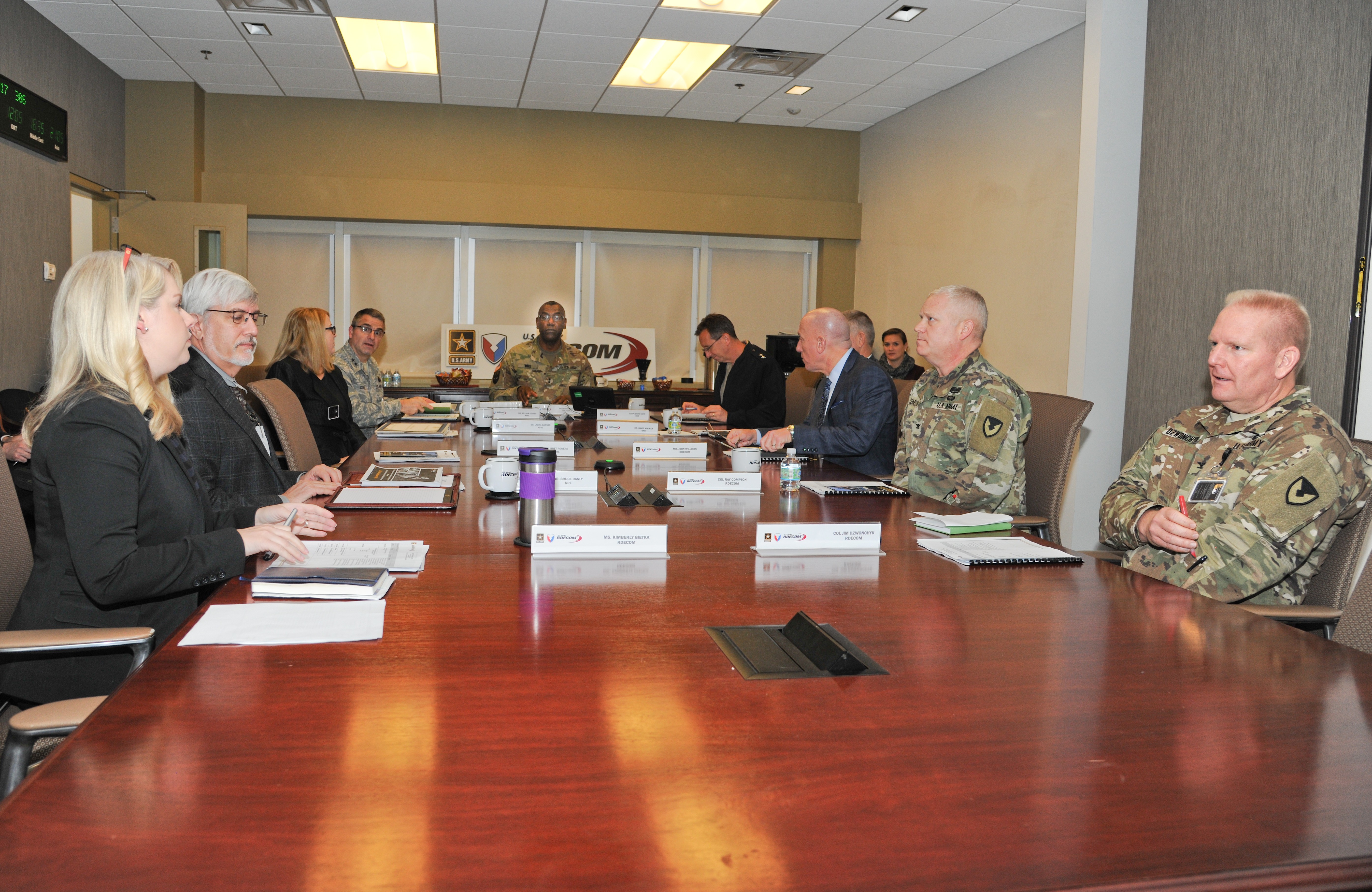
ABERDEEN PROVING GROUND, Md. -- Leaders of three Department of Defense service laboratories met here Nov. 2, looking for ways to increase collaboration on their shared mission of delivering capabilities to the nation's Warfighters and discussing the challenges they face doing that.
Maj. Gen. Cedric Wins, commanding general, U.S. Army Research, Development and Engineering Command, hosted Rear Adm. David J. Hahn, chief of Naval Research and director, Innovation Technology Requirements, and Test and Evaluation; and Maj. Gen. William T. Cooley, commander, Air Force Research Laboratory, for round table discussions at RDECOM headquarters.
Also in attendance were: William Nelson, Elizabeth Fleming and Dr. George Ludwig, representing the U.S. Army Space and Missile Defense Command, U.S. Army Corps of Engineers Engineer Research and Development Center and the U.S. Army Medical Command, respectively.
Participants agreed that they have a shared destiny as their organizations face uncertain funding in a quickly evolving technology landscape and global security environment.
"That should lead us, naturally, to increased cooperation," Wins said.
"DOD labs all exist to deliver capabilities that keep our joint Warfighters ahead of any adversary. We all face the same issues, such as the emergence of near-peer potential adversaries and the increasing speed and spread of technology. That means we all want to get the most bang for our buck, and one way to get there is through increased partnership," Wins said.
"We already collaborate on a range of projects, but in the face of resource challenges and how the world is changing, what we're doing is not good enough anymore," he added.
Hahn agreed, saying the service labs need to move from simply partnering to creating inter-locking dependencies that will allow them to share the burden of common needs and eliminate similar research efforts that will free resources for other priorities.
Cooley led a discussion to define shared strategic priorities the service labs can collaborate on to move the ball forward. Hypersonic and directed energy research, autonomy and artificial intelligence and additive manufacturing has quickly emerged as areas that will be vital to each of the services, areas of natural collaboration.
"We agreed there are some mega-trends that are going to be important to all of us," Wins said. "We also clearly see that we, the federal government, is no longer research leader in all of these fields. So we have to collaborate within DPD, and we have to collaborate with industry because they will continue to lead in many areas. Our job is to identify ways to leverage what industry does and adapt it for military use, and identify areas where the services have an interest in something with military application and industry may not."
The group also identified challenges in transitioning technologies into programs of record, as well as telling their stories to those who don't understand the role the service labs play in the development of capabilities for Warfighters.
Each service organizes and manages their labs differently. That means digging into the details in order to pursue shared challenges and research and development priorities.
"I went into the meeting with a desire for a defined set of next steps so we can achieve some of the things on the agenda," Wins said. "It was gratifying to hear everyone agree that we have to collaborate more deeply. We need to get after it soon and not let everyone's long list of other priorities keep us from making this happen," he added.
---
The U.S. Army Research, Development and Engineering Command has the mission to provide innovative research, development and engineering to produce capabilities for decisive overmatch to the Army against the complexities of the current and future operating environments in support of the Joint Warfighter and the Nation. RDECOM is a major subordinate command of the U.S. Army Materiel Command.
Social Sharing