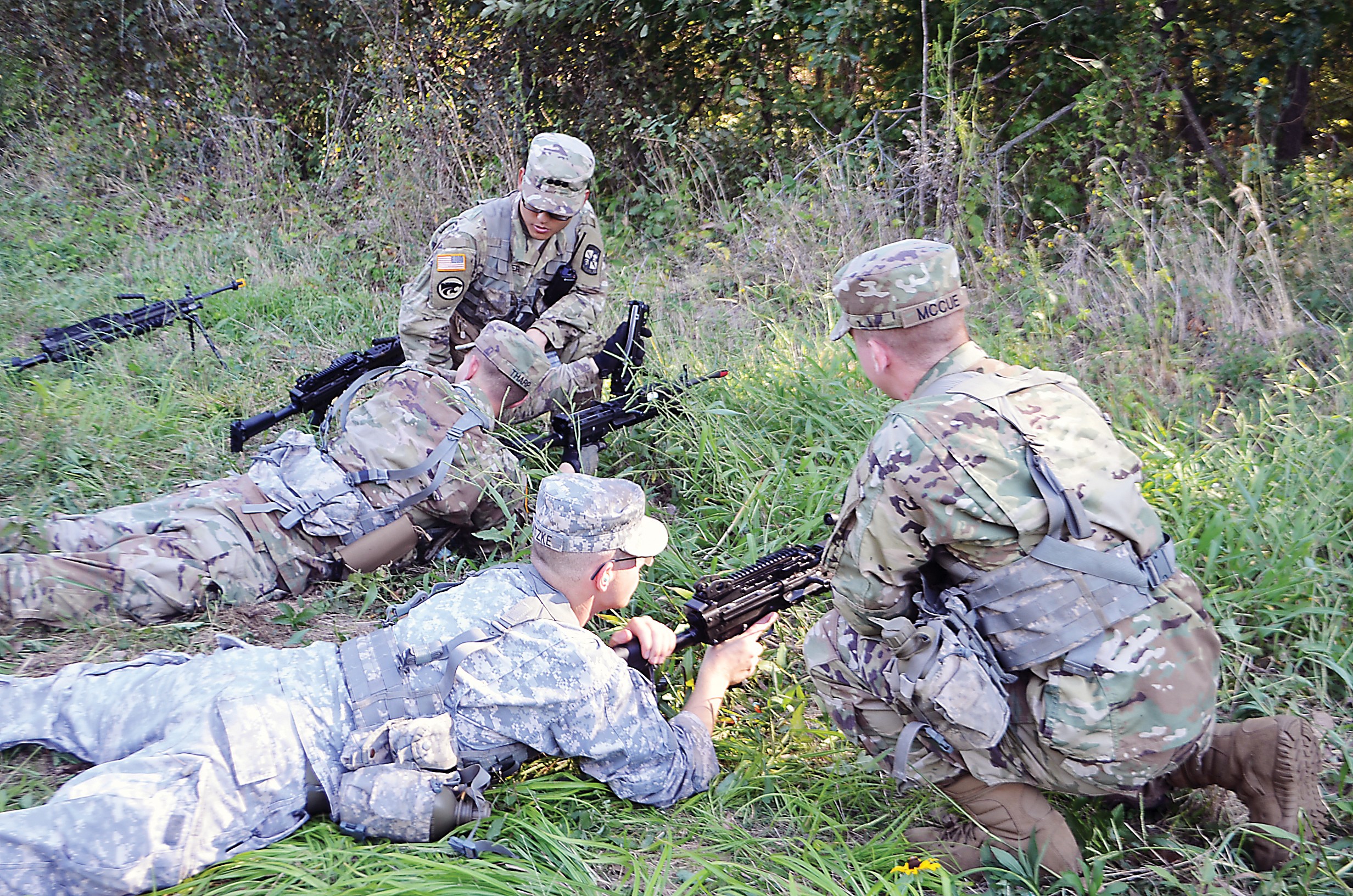
FORT RILEY, Kan. -- About 140 ROTC cadets from Kansas State University Wildcat Battalion conducted their annual fall field training exercise at Fort Riley Sept. 22 to 23. The mission of the FTX was to build confidence, teamwork, tactical knowledge and leadership within cadets.
Led by Lt. Col. Pete Gray, professor of military science at K-State, and seven-member team of cadre, the cadets carried out exercises in land navigation, tactical training consisting of hand-arm signals and movement techniques, patrol base operations, weapons familiarization and tactical communications.
Gray said having Fort Riley as a training ground is crucial to his cadets. The installation's support from leaders and the Directorate of Plans, Training, Mobilization and Security help enhance the cadets' learning experience.
"I think that's a key component in how well our cadets do when they get evaluated," he said. "The leadership here at Fort Riley makes everything available to us. DPTMS basically, if we can dream it up, they can find a way to help my (operations) guys execute the training. Just in the last 24 hours we have planned to use one of their digital systems for some land navigation training, and it just so happened that they had some other digital system available. So our younger cadets, who were really trying to get interested in what the Army has to offer, got to do flight simulators, and convoy live fires on the digital system."
The close relationship between the K-State ROTC program and Fort Riley is symbiotic. The installation makes training resources available to the Wildcat Battalion, and, in return, cadets volunteer at post events.
"We have a very close relationship with the leadership, who is supportive and expects us to be out here, which we appreciate and we try to pay it back," he said. "We participated in (Fall Apple Day). The facilities that they make available and when we say we want to do X type of training, those guys are right there to say, 'have you thought about this? This is what we have available.'"
The cadets travel to Fort Riley semiannually to perform their FTX. The fall session aims to groom cadets on basic individual soldiering skills, while the spring training aims to develop them on a larger level.
"We do both our spring and our fall FTXs out here," Gray said. "Our spring FTX is a lot larger and we bring in multiple schools, multiple universities from the area, into Fort Riley. Just because the environment is perfect for it, wide open spaces, the area you can train that maybe you can't do on a campus environment. We try to focus, in the fall, on individual Soldier skills. And in the spring, trying to do collective skills, platoon level operations, that sort of thing."
According to Cadet Cal Ballou, Military Science Level IV, Wildcat Battalion at K-State, the college ROTC program and installation have a unique relationship cadets from other colleges do not have access to.
"K-State ROTC and Fort Riley have a great relationship that I don't think very many other schools can offer," Ballou said. "We have a very unique program in that aspect we are able to PT with the 'Big Red One' usually once a year, if not more than that. And we are out here at least twice a year. And the MS III usually get to come out here to do some special training as well. So having it right, not only just the location, but the relationship that we can ask for a favor to come use the training area is just helpful for us as cadets to further our development."
For Cadet Max Curtis, MS II, Wildcat Battalion at K-State, he had the opportunity to be introduced to digital systems and weapons early as a sophomore instead of a junior.
"We just got done being introduced to a different weapon system that we will encounter at our advance camp after our junior year," Curtis said.
The proximity of training sites and facilities Fort Riley provides to the Wildcat Battalion makes the K-State ROTC cadets stand out when they become lieutenants.
"The relationship has been in place so long that we found some good ways to take advantage of it," Gray said. "We are trying to give our cadets, and everyone is trying to do this, the best possible training. Fort Riley and their support is what makes the difference … The end result, I think it showed this last year at camp, is the support Fort Riley and the support of leadership and the training that we're able to do here helps accelerate our cadet's progression, so that they stand out when they compare to peers from other universities, who may don't have the same opportunities."
Social Sharing