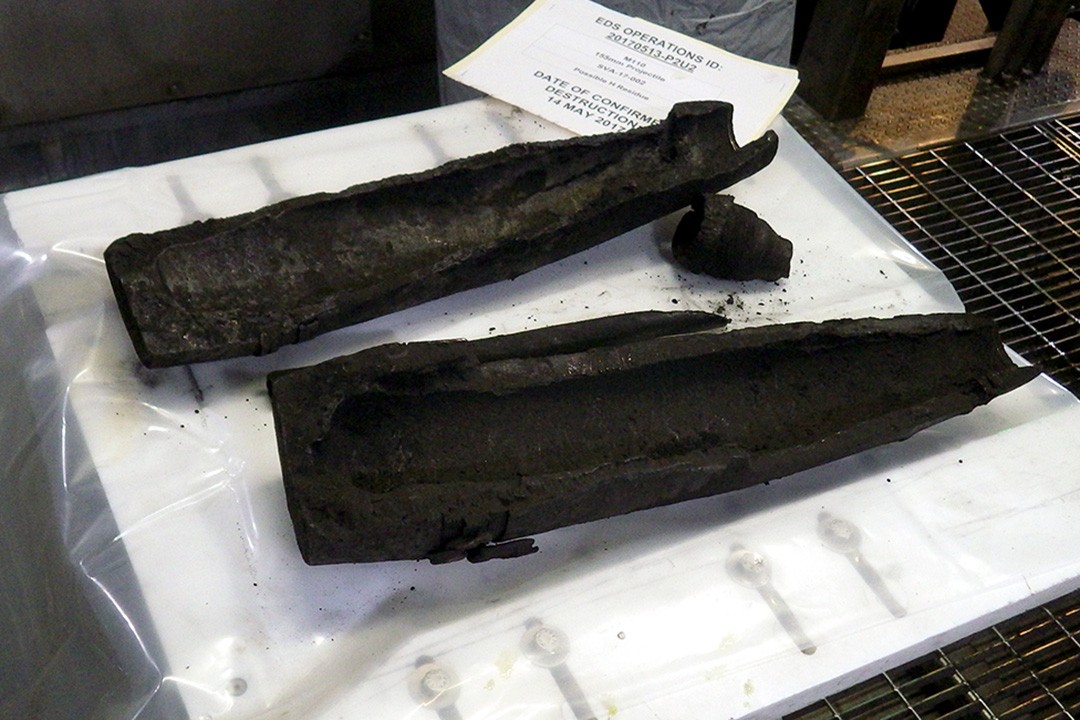

ABERDEEN PROVING GROUND, Md. -- The Edgewood Chemical Biological Center's Chemical Biological Application and Risk Reduction, or CBARR, unit completed field operations this spring at two former military installations in Illinois.
A destruction operation was performed at the former Savanna Army Depot, a follow-up action to a previous phase of remediation that occurred last year. Also, there was an environmental investigation concluded at the former Chanute Air Force Base. Both projects are part of remediation plans by the U.S. Army Corps of Engineers to environmentally restore and repurpose the unused facilities.
Savanna EDS
In mid-May, a 155mm mustard round was destroyed at the former Savanna Army Depot with an explosive destruction system, or EDS, operated by a crew from CBARR. The munition was recovered during an environmental investigation in December 2016.
ECBC's CBARR unit supported the U.S. Army Engineer Support Center Huntsville, known as USAESCH, in the investigation of three mustard burn areas at the former Army depot in 2016. CBARR's team provided continuous air monitoring during intrusive operations at the site. During the initial investigation, two items were found. It was determined that the first item contained no chemical agent and was disposed in accordance with local policies and procedures.
But when this second item was discovered during the investigation, said Project Manager Laura Graham, an indication from the Miniature Continuous Air Monitoring Systems, known as MINICAMS, alerted workers to the potential of a chemical-filled munition. After thorough assessment, it was determined that the munition contained the chemical agent HD, better know as mustard gas.
"We used the field investigation data, along with the assessment results, and decided to treat it as a 'leaking' munition," Graham said. "This determination was critical in the development of the plans and procedures required to conduct the destruction operation safely."
Although further analysis determined that the munition was not leaking, ECBC's CBARR team developed its operational plan as if the item was leaking to ensure additional safety measures were included.
"The CBARR team of operators, engineers and safety professionals use all information available but sometimes is best to take the most conservative path for an operation," Graham said. "In this case, we all felt that we would be assured of no surprises if we planned to handle the munition as if it were leaking."
The destruction was conducted using the P2U2 EDS owned by the U.S. Army Chemical Materials Activity, which had overall responsibility for the operations. CBARR personnel serve as operators and maintainers for all of the EDS systems.
The P2U2 is one of the original EDS units and unlike its updated versions, it uses electric heater bands to heat the vessel. This is a slower process, Graham said. As a result, the operation takes two days to process the chemical munition.
The initial site visit for the EDS team was held in January 2017. CBARR's first crew arrived for site setup on April 17. A preoperational survey took place May 9-11. Destruction operations occurred May 13-14, and the site was closed by May 25.
Savanna is located in northern Illinois on the Iowa border. On the banks of the Mississippi River, remediated portions of the depot have been turned into public wildlands.
Chanute Air Force Base
A project team of U.S. Air Force and U.S. Army, including ECBC, conducted the second phase of an environmental investigation at the former Chanute Air Force Base in Rantoul, Illinois, earlier this year to determine whether past chemical agent training activities have impacted the environment.
The first phase of the investigation was completed in November 2016 when the project team used ground scanning equipment to identify anomalies buried in the ground, initially suspected to be containers once used to ship and store training materials.
The project team evaluated the data collected and selected 100 anomalies for further investigation in the second phase of the project conducted in early May. This included soil sample analysis performed by ECBC laboratories, said Project Manager Satchell Doyle Jr. It was determined that the metal was construction materials, such as metal rebar. This is likely associated with buildings constructed for training activities and then demolished, according to information provided by the Air Force Civil Engineer Center, or AFCEC.
However, no items related to former training activities were found and no contamination is present, the AFCEC said.
---
The Edgewood Chemical Biological Center is a part of the U.S. Army Research, Development and Engineering Command, which has the mission to provide innovative research, development and engineering to produce capabilities for decisive overmatch to the Army against the complexities of the current and future operating environments in support of the Joint Warfighter and the Nation. RDECOM is a major subordinate command of the U.S. Army Materiel Command.
Social Sharing