
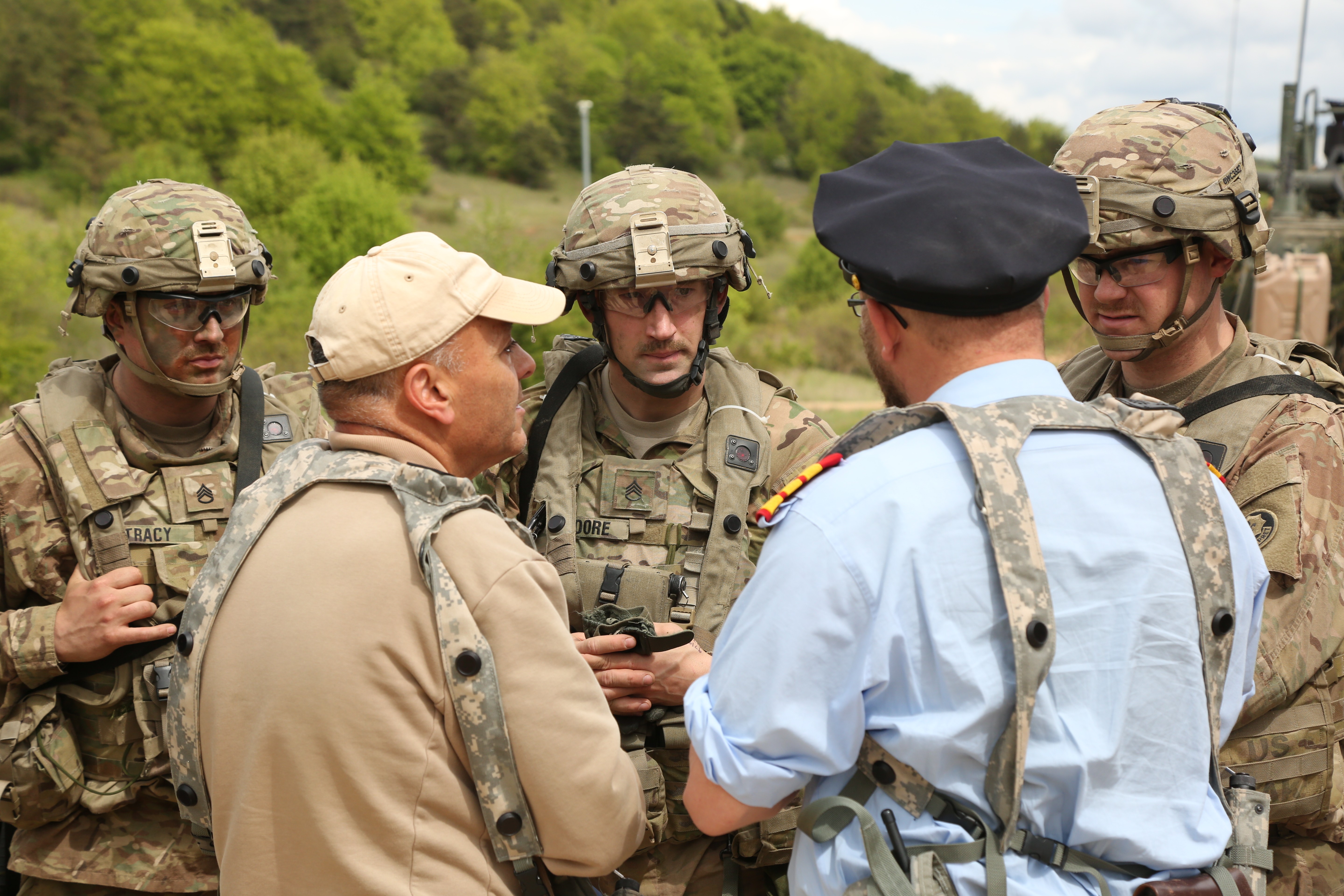
HOHENFELS, Germany--On a sunny afternoon in Kittensee, a town quietly tucked away in the rolling hills of Bavaria, Germany, residents seem to be celebrating. Upbeat music emanates from the patio of a quaint restaurant while several patrons play a board game at the bar. Down the road, a woman is applying a fresh coat of white paint to a small building. Across the street, a man is selling fresh vegetables behind a farmer's stand.
From outward appearances this seems to be a vibrant town. However, the restaurant serves no food. The buildings are empty and made of particle board. And upon closer inspection, the vegetables at the farmer's stand are just pieces of green foam.
Kittensee isn't a real place; it's one of five urban operations training sites that have been constructed, complete with actors and a fictitious history, for Saber Junction 17. The exercise, with more than 4,500 participants from 13 NATO and European partner countries, is hosted by the Joint Multinational Readiness Center in Hohenfels, Germany from April 25 to May 19.
The training objectives for SJ17 were for units to perform offensive, defensive and stability operations within a unified land operations scenario. As fights were on the battlefield, a complex war for information dominance was being fought in the towns with civilians caught in the crossfire. When the tide of battle began to favor allied forces, JMRC introduced various challenges ranging from internally displaced persons to destroyed infrastructure to spur the training unit to begin stabilizing the area.
"You have to understand the operational environment. Too often we win the battle and not the war," said Dr. James Derleth, the Senior Interagency Advisor at JMRC. Derleth and his team work with military leaders and outside agencies, including the State Department, USAID, and Bavarian Red Cross, to create and implement complex scenarios for units to react to on the simulated battlefield.
"You can spend two days reading the whole back story and dynamics of this area," said a Naval Special Warfare operator from U.S. Special Operations Command camped out in Kittensee to protect the town and engage with the local populace. "They get in depth with it. It seems that each one of these role players has their own specific story and background. It's been a cool aspect to the exercise that we hadn't seen before."
Another SOF operator expressed that some unit members were hesitant to trust the townspeople based on their experience during previous training scenarios.
"It's been getting more social here. This is new for us. Any role player we've encountered, up until this point, has either been a bad guy trying to kill us, or a crazy lady we need to escort off an objective. It's never been in such a civil environment," he said.
Over 150 role players were tasked with learning their roles and back stories prior to the start of the exercise. In addition to a 64-page operational environment overview describing the political, economic, social, information and infrastructure variables in their respective of the towns. Three media channels, multiple websites and simulated social media platforms and were also created. The tone for each outlet, just like in the real world, ranged from pro, neutral or anti-allied forces running multiple radio, TV and print stories throughout each training day.
Every morning, the JMRC manager for the town briefed the role players on the latest news stories. How the units handled various scenarios had either a positive or negative effect on public opinion.
"The Naval Special Warfare operators did everything a conventional unit should do to form some sort of bond with the town," said Pedro Herrera, an operations specialist assigned to Kittensee. "They met with the mayor, they promised security, interacted with the people, and gathered intelligence. They did a very good job."
Herrera explained that units moving through the towns need to meet with key leaders, including the mayor and the police chief, to explain their mission and intent.
However, not all units were able to win the people over as in Kittensee. Just a few kilometers away, in Raversdorf, role players protested against the allies, forcing soldiers occupying the town to work hard with key leaders to alleviate hostility.
"Some units come in, surround the town, and don't explain what they're doing there -- then the locals come out to demonstrate, and block a main supply route," said Derleth. "We make it so they have to react. If they do the right thing, then they won't have these challenges."
Derleth stressed the importance of training units to understand the operating environment and stability operations, which prepares them for real world conflicts.
"We don't go to places to make them unstable. Instability allows extremists to come in. At the end of the day, the mission is to stabilize the area," he said. "But if you've never trained with stability operations, you're going to focus on what you're comfortable with, which is offense and defense. And then you miss the end state, which is usually stability."
After the exercise concludes, units have an opportunity to analyze how well they accomplished NATO's goals of preserving the countries territorial integrity, facilitate government legitimacy and foster internal stability in the region.
"If you don't complete all those things, they won't matter. It's a jigsaw puzzle--if you miss one piece on the edge, you'll never finish the puzzle," he added.
Social Sharing