FORT LEAVENWORTH, Kan. -- Imagine this:
During a training exercise, Soldiers maneuver in a Hawaiian jungle to attack a position.
Overhead helicopters hover to provide support, but they are virtual ones flown by pilots at Fort Campbell, Ky.
An artillery battery stands ready to support the attack, but these virtual cannons are on Soldiers' laptops at Fort Sill, Okla.
As the attack progresses, all of the action appears live to the commander who directs the battle from his mission command systems at Fort Drum, N.Y.
This scenario may sound like science fiction, but the Army envisions making this training a reality.
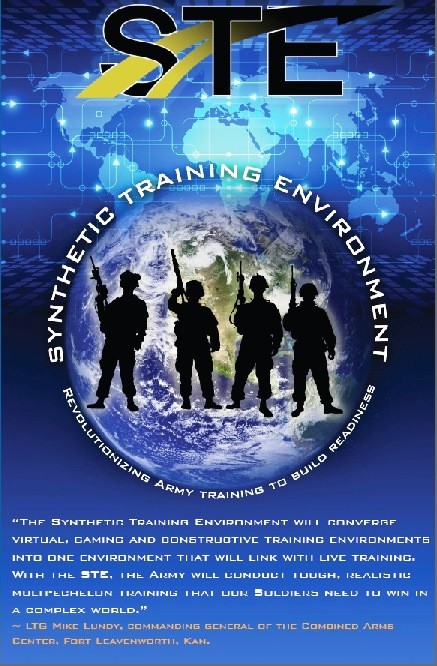
The Army will do so by creating the Synthetic Training Environment (STE).
"The STE will revolutionize Army training to build readiness," said Lt. Gen. Mike Lundy, commanding general of the Combined Arms Center. "The STE will allow the Army to conduct the tough, realistic multi-echelon training that our Soldiers will need to win in a complex world."
Although the STE is just a concept now, Army organizations are performing the initial analysis to create the STE by the middle of the next decade.
The STE will represent a significant change in how the Army uses the live, virtual, gaming and constructive training systems.
These systems' simulators, simulations and other training devices were never meant to work together. The STE aims to replace these stovepipe systems.
"The STE will converge virtual, gaming and constructive training environments into one environment that will link with live training," Lundy said.
In recent years, the Army has used special computer software and hardware to make live, virtual, constructive and gaming systems work together. However, the effort is expensive and has technical limitations.
That's just one of the reasons to build the STE.
Many simulators use obsolete 1980s technology, are costly to update and often are housed in fixed locations. Experts say improvements in commercial technology will enable the Army to replace those simulators with more mobile and less costly systems.
Brig. Gen. Maria Gervais, deputy commanding general of the Combined Arms Center -- Training, explained the benefits of the new technology.
"With the STE, we will be able to take training to the Soldiers whether it's at home station, a Combat Training Center, a National Guard armory or a deployed location," she said.
The STE aims to address other issues.
To allow units at different locations to train together, the STE will use a one world terrain database.
"The terrain database will provide the virtual dirt to replicate any operational environment -- deserts, jungles or megacities," Gervais said. "The STE will allow the Army to train as we fight and where we fight. It will enhance live training -- which is our best training environment."
The STE will operate over the Army Network and stimulate mission command systems to give commanders and their staffs training that replicates the operational environment.
The new training environment could result in cost savings.
For example, the single terrain database would eliminate the need for multiple terrain databases. Using cloud technology would reduce the need for some computer servers, and making the system open to new technologies would lower upgrade costs.
While the Army is developing the STE, it will continue to make improvements to existing training systems.
The STE will be one of the Warriors Corner presentations at the annual Association of the United States Army convention in Washington. Gervais will explain the STE from 2:30 p.m. to 3:10 p.m. on Oct. 4 at the Army exhibit on the convention floor.
CAC-T develops training requirements, fields training systems, delivers leader training and sustains training capabilities to support Army.
CAC-T's web site is: http://usacac.army.mil/organizations/cact/. Its Facebook page is: http://www.facebook.com/usacactraining and its Twitter handle is: @usacactraining.
Social Sharing