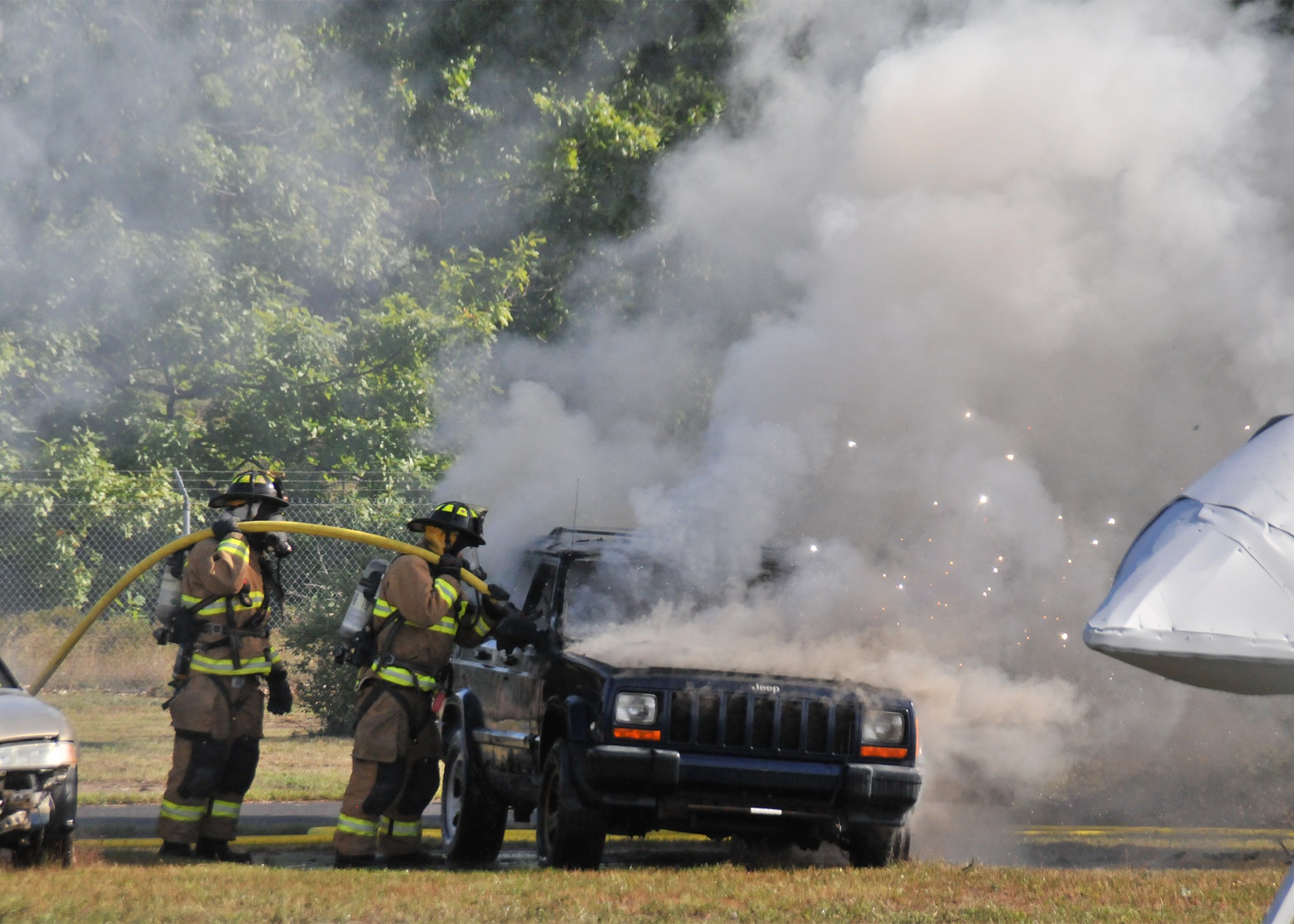
FORT DRUM, N.Y. -- Fort Drum's emergency response plan was put to the test Aug. 16-17 during a full-scale mass casualty exercise held at the Fire and Emergency Service's training site inside Wheeler-Sack Army Airfield.
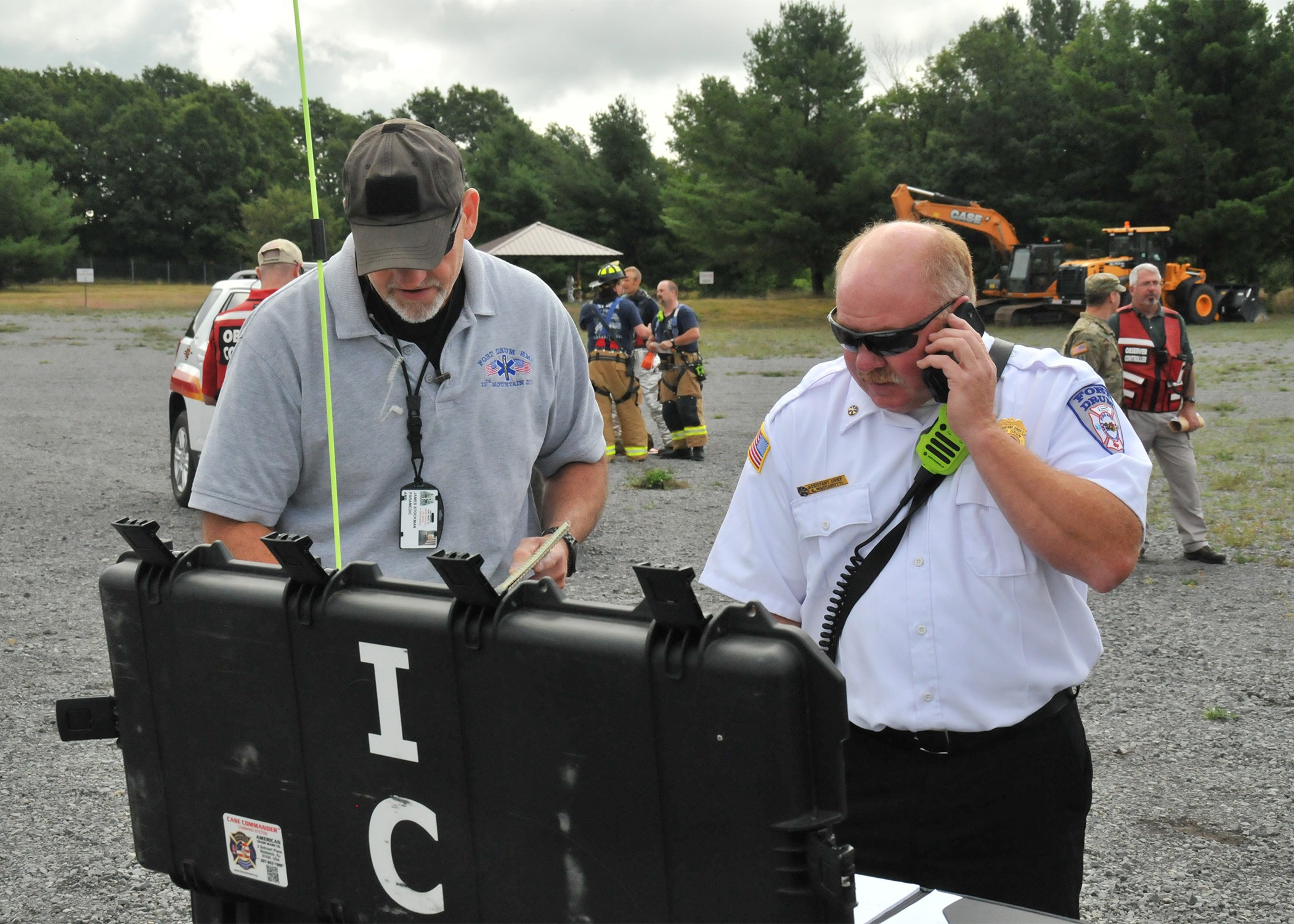
The exercise, dubbed Operation Gray Shield, involved a simulated aircraft crash that damaged facilities and resulted in injuries and fatalities to Soldiers who were conducting training in the area. As chaos ensued, Fort Drum's first responders and emergency personnel arrived with Assistant Fire Chief George Massarotti assuming the role as incident commander to establish command and control of the site.
Additional support was provided by community partners, to include Jefferson County Emergency Medical Services, Indian River Ambulance Service, Car-thage Area Hospital and Samaritan Medical Center.
"The biggest reason we conduct this exercise every year is to hone our skills and make sure those relationships between our firefighters, our law enforcement and our operations center are on point," said John Simard, Fort Drum antiterrorism officer. "The exercise tests all of our systems and makes sure everything is functional."
Simard, who was in charge of the planning for this year's exercise, observed the coordinated response at the site.
"It went exceptionally well," he said. "It's always extremely difficult when you have a mass casualty incident. ... (It's pure) chaos on the ground, because you've got people injured all over the place and they need help. It really taxes our first responders, and it was a challenge for them, to say the least."
Simard said that there were a few details in the scenario that required additional layers of coordination. For one, 10th Mountain Division (LI) Soldiers role-played as a National Guard unit from the 42nd Infantry Division, based in Queens.
"It causes the Emergency Operations Center personnel to have to dig a bit to get information on this unit, find out who is the commander and how do we contact everyone who needs to be informed of the situation," Simard said. "Then there's going to be Families who will want to come to Fort Drum and see their Soldiers. There's a lot more coordination involved than if they were our 10th Mountain Division Soldiers."
Terry Byard, Fort Drum emergency management officer, added that the scenario used an Air Force aircraft, just to deepen the coordination required.
"We had an Air Force officer who was in the exercise to provide us with all kinds of information about the aircraft and their procedures," he said. "Since Fort Drum has all of these missions and works with aircraft every day, it helped us unify that relationship between us and the Air Force. We were able to meld their requirements in the event of a crash and our requirements so that we're talking the same language and doing our best effort to expediently recover from this situation."
Byard said that they have been working diligently on medevac procedures, particularly as it applies to the training ranges. To that end, the 3rd General Support Aviation Battalion, 10th Combat Aviation Brigade was employed during the exercise as Fort Drum's air medical evacuation support.
Three flights from the incident scene to Samaritan Medical Center in Watertown transported several simulated casualties with critical trauma.
Simard said all of this coordination was done through the incident commander and the hos-
pitals, and it's the standard operating procedure they have practiced many times before.
"The Black Hawk is a very heavy helicopter and most hospitals around here don't have the landing pad that can handle it, and so they would meet at a nearby field or parking lot to exchange the patients," he said.
The exercise also allowed Army Community Services personnel to assess their readiness.
"If an incident like this were ever to occur, you would naturally have a lot of concerned community members, spouses and Families," Simard said. "ACS has a family assistance center established for this, and it actually is operational every day. We took a handful of role-players simulated as victims' family members and sent them to ACS where the personnel are there to counsel and care for them."
Byard added that the installation chaplain services is also available to provide spiritual support at the center, as well as key agencies such as Army Emergency Relief.
The day before the incident, personnel in the emergency operations center were responsible for conducting mission analysis, and they developed courses of action, which Simard said would help guide the commander to make good decisions.
"In that mission analysis, we wanted to exercise our sheltering plan, so we made sure one of our courses of action was to evacuate personnel that were under the flight path," he said. "In this case, the sheltering location was Monti Gym, and we set up 126 cots along with blankets, pillows and everything a person would need to be comfortable."
Byard said he recently attended the New York State Emergency Managers Conference in Syracuse, where the medical emergency manager for the Boston Marathon spoke at one of the briefings.
"In Boston, they do the same kind of operations exercise we do," Byard said. "Two years prior to the bombing at the marathon, they had conducted a full-scale exercise for a medical response at the marathon."
Byard said that because of their training, every person injured at the marathon had received medical treatment within 30 minutes of the attack.
"The emergency managers in charge credit 100 percent of their success in that to their exercise," Byard said. "That kind of spells out why we do mass casualty exercises here."
Social Sharing