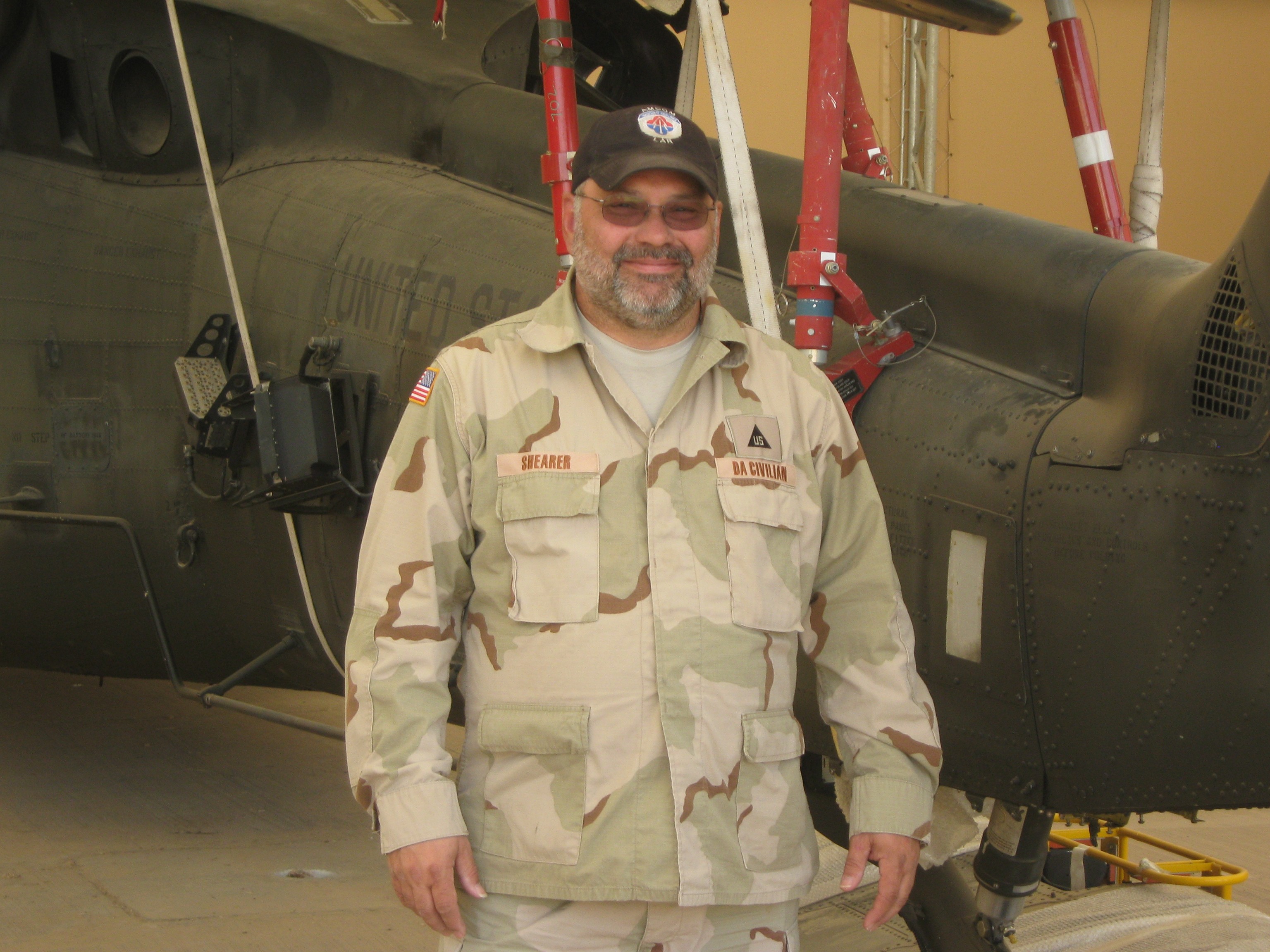
Becoming an Aviation and Missile Command logistics assistance representative seems to have always been in the cards for Wayne Shearer.
First, as a Soldier and a UH-60 Black Hawk mechanic deployed to Bosnia in 1996, Shearer was recruited by the LAR supporting his unit. But, with four more years until retirement, Shearer put off any thoughts about the type of civilian employment he would pursue after the Army.
Then, in 2008, after retirement and while working as an aircraft mechanic contractor at Fort Polk, La., Shearer was once again asked if he wanted to be an AMCOM LAR.
"Two LARs telling me the same thing 12 years apart, I figured they knew I could do the job. So I polished the resume and submitted it, and a few months later I got the call that I had been selected," Shearer said.
Since then, Shearer has been one of the go-to aviation LARs at Fort Polk, where he is part of a three-man LAR team -- including Gil Minor and Dan Guzman -- that provides technical and logistical support to several different combat aviation brigades that train annually at the installation's Joint Readiness Training Center. His work with those units has won him recognition as AMCOM's 2015 Logistics Assistance Representative. He will be recognized Aug. 17 during the AMCOM 101 for Aviation at Redstone Arsenal.
"The LAR office at Ft. Polk is a place where we constantly search out each other's advice and direction,' Shearer said of his teammates. "I can say that many of my accomplishments, which led to my selection as AMCOM LAR of the Year, would not have been possible without the help of my fellow LARs."
Shearer has supported units from every active duty combat aviation brigade with the exception of those stationed in Europe, Korea and Joint Base Lewis McChord (Wash.). He provides support to combat aviation brigades from the 10th Mountain Division (Fort Drum, NY), 82nd Airborne Division (Fort Bragg, N.C.) and the 101st Airborne Division (Fort Campbell, Ky.) that frequently train at JRTC. He just recently supported two National Guard CABs on back-to-back rotations at JRTC, and provides support to the tenant aviation unit at JRTC, the 5th Aviation Battalion.
"I work with aviation units providing instructions to make unique repairs to equipment -- mostly aircraft -- with the approval of the Aviation and Missile Research, Development and Engineering Center engineers. Those repairs are for issues not addressed in the tech manuals for the particular aircraft involved," Shearer said.
"I also assist units with troubleshooting aircraft actions in order to speed up the process to return the aircraft to a flyable condition. When the action requires a part that is not readily available locally, I assist the unit in locating parts. When the unit has established a valid request in the supply system, I can reach out to different agencies to get the part moving quicker through the supply system. I will monitor that movement and report my findings to the supported unit. I also provide training to Soldiers on AMCOM equipment or on a technical task that may be outside of the Soldier's expertise or comfort level."
Shearer knows it's his background as an Army Black Hawk mechanic that qualified him for his civilian career.
"I was hired basically as a Black Hawk LAR because of my several years of experience working on Black Hawks in the Army," he said. "I also had the opportunity between my retirement and my being hired as a LAR to work in several different positions as a contractor providing maintenance support to the 5th Aviation Battalion at Fort Polk.
"The different duties I had as a quality assurance lead and, at times, as the shift maintenance supervisor, I think really rounded out my qualifications for the LAR job. I have knowledge of what it really takes to keep aircraft flying beyond what wrench to use on a particular nut."
But being successful as a LAR involves more than previous experience. It also requires the ability to work though issues and to consider different solutions.
"I like solving problems, whether it's a hard-to-diagnose electrical or mechanical problem," Shearer said. "I also like doing research. When a unit comes to me with an issue and they can't find any information or guidance on how to move forward, I get to dig and search through all the tools and references AMCOM provides. I call that doing the "Dick Tracy" work.
"When I go back to the unit with the answer, their first response is usually 'Where did you find that?' I readily share my process and resources if allowed to by regulations."
The reward for Shearer is found in the sharing of information and the improvement of Soldier skills.
"It's when I see a Soldier who has come to me in the past that needed some assistance on an issue and I have provided him or her with the tools they need to accomplish their mission. And, then, a few months later, I see that same Soldier using that tool and also sharing their knowledge with someone else," he said.
Shearer has deployed three times as a LAR. His first deployment in November 2009 to April 2010 to Forward Operating Base Wolverine in Afghanistan built on his aircraft mechanic knowledge in a surprising way.
"When I got to the FOB, I found out I was also supporting eight AH-64D Apaches, besides 10 Black Hawks" he said. "At the time, I had very little experience with the Apache. But, I followed the advice I had gotten from others -- don't hesitate to call someone who does know and use the LAR network because somewhere out there is someone who will call you for Black Hawk assistance. By the end of the deployment, with the assistance of other LARS and the unit's quality control shop, I had a good understanding of the Apache."
He also deployed July 2011 to January 2012 to Combat Operating Base Basra, Iraq, and Camp Behring, Kuwait in support of three units assigned to the 29th Combat Aviation Brigade, and May to September 2014 to Forward Operating Base Shindand, Afghanistan in support of the 2-158th Aviation Battalion.
Whether deployed or at Fort Polk, Shearer measures a LAR's value by the quality of support they provide to the mission.
"It begins with a good work ethic, which I chalk up to my Midwest upbringing," he said. "I think a good LAR has to be willing to put forth the extra effort to help the unit or the Soldier get the mission done, whether it's getting the aircraft up in time to make mission or teaching that one Soldier how to properly use a special tool, navigate an electronic manual or search for information on a Defense Logistics Agency web site."
Shearer highly recommends the LAR experience to anyone who has the technical experience to support the Army mission.
"Jump on in. The water is fine," he said. "Expect to continue your quest for knowledge, you're going to get training on subjects you would have thought never existed. I didn't know what went on in the acquisition and support processes that are required for Army equipment. It's been a learning experience and a very rewarding way to continue to serve Soldiers and Army aviation."
Social Sharing