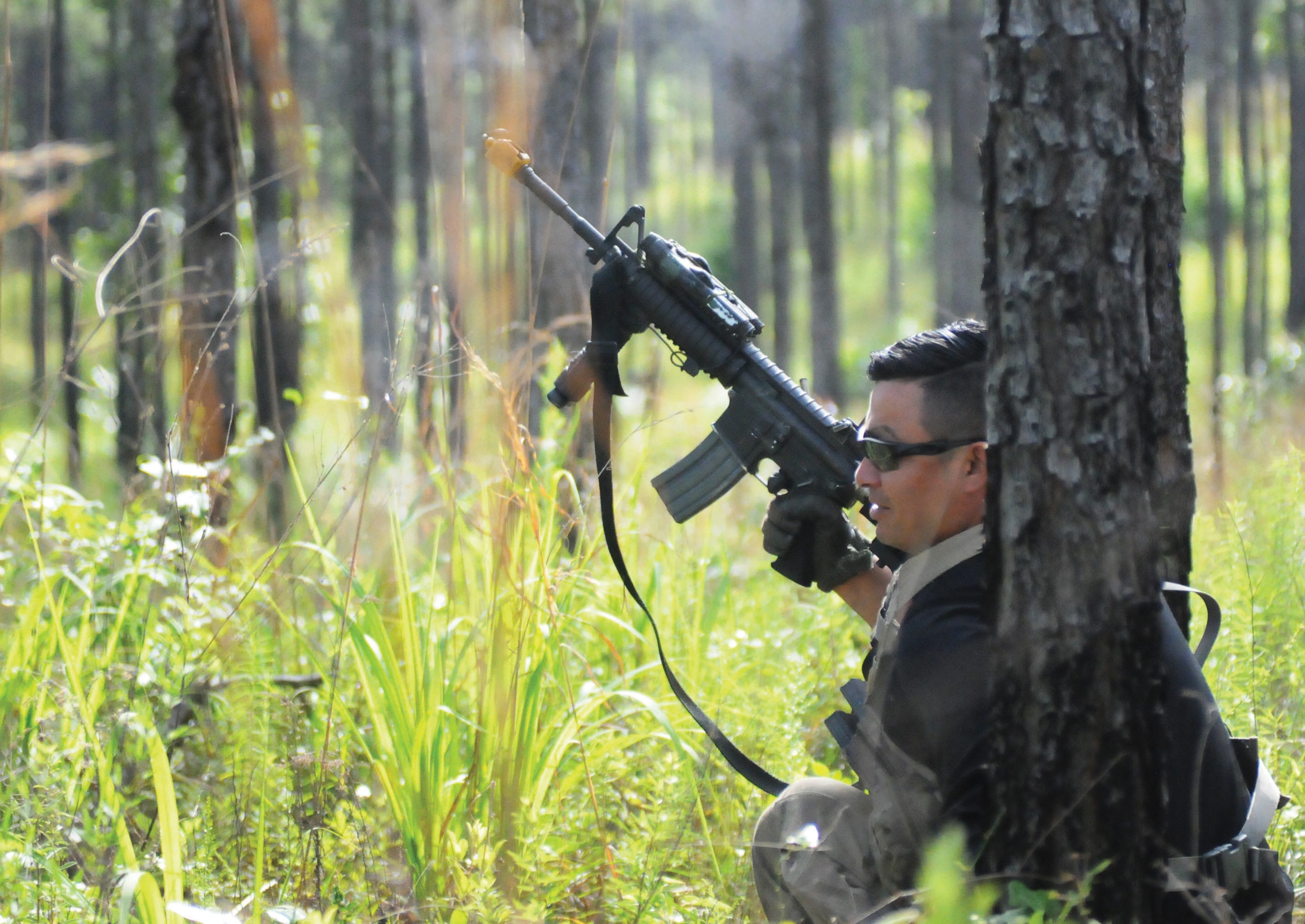
FORT BENNING, Ga., (June 15, 2016) -- The Maneuver Captain's Career Course is designed to give captains the chance to experience field command by bringing their classroom lessons to life in simulated combat scenarios.
Running for 22 weeks, the Career Course engages its students in tactical planning at the company and battalion level, and prepares them for leading their own company. MCCC graduates will be able to effectively communicate in combat operations and quickly adapt to changing factors in the field.
The MCCC team three students participated in a field training exercise June 9 in the woods near Selby range. The exercise objective was for the friendly force to leave from Selby military operations in urban terrain to seize and clear the objective.
Capt. Daniel Yanes and 1st Lt. Harold Shorter were part of the opposing force, or OPFOR. It was their mission to try and prevent the friendly force from completing their objective.
"We try to anticipate where the friendly force is approaching from and try to stop them," said Shorter.
To aid in their mission, the opposing force used an unmanned aerial vehicle to scout the surrounding area. Understanding how to deal with UAVs is something that small group leader Capt. Brandon Pasko stressed.
"UAVs are absolutely accessible," said Pasko. "Anyone can get them."
Pasko recalled a story where an entire platoon was annihilated in Ukraine because of a UAV.
"It is important to identify UAVs and confirm if it's friendly, enemy or a nongovernmental organization," said Pasko.
Even though the opposing force had a UAV, the friendly force succeeded in clearing and seizing the objective.
The small group leaders, which included Pasko and Capt. Chris Baker, highlighted what went well during the exercise and what the MCCC students could improve on.
Time management and managing tempo were two points that the friendly force did well with during the exercise. Pasko and Baker warned students not to rely too much on technology like GPS as an important step for improvement.
"Relying on technology can hurt field skills. Use your map and compass," said Baker. "Trust but verify with the GPS."
The MCCC field training exercises serve as both a means of evaluation as well as a learning experience for the Soldiers.
"You are in a room for two to three months so you don't really get to go out to the field, and you do these elaborate operation orders, but this week is to see how that actually pans out," said Yanes. "Not just plan it, but plan it, execute it and identify friction points."
The next step for the MCCC team three students is the battalion level planning and missions.
Social Sharing