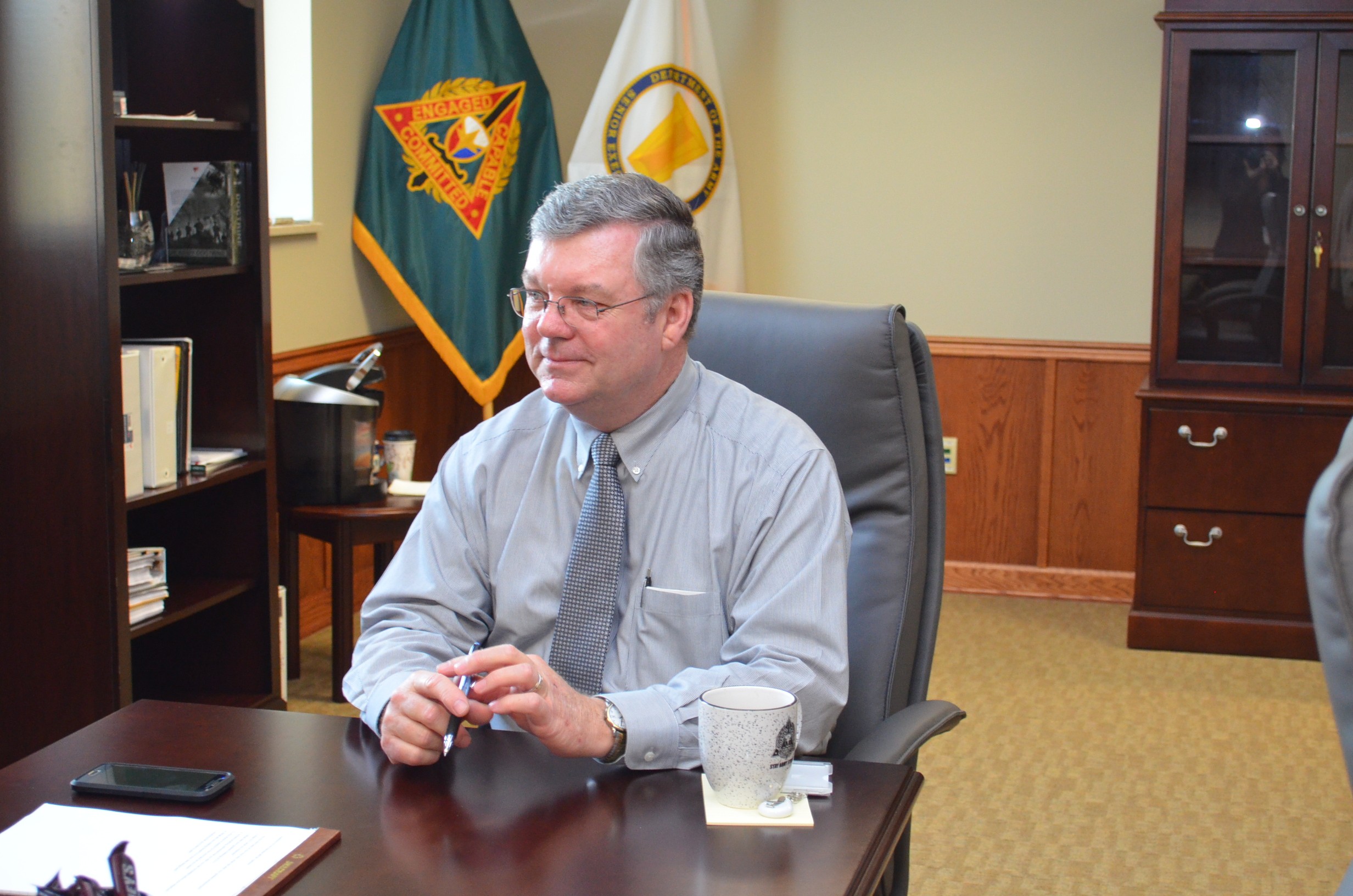
After nearly six years serving the Army Contracting Command and the Expeditionary Contracting Command, Bryan Samson said it's time to move on. However, his reason for moving may be a bit surprising.
"I could stay here and work with ACC and ECC forever," Samson, deputy to the ECC commander, said. "I am comfortable with it and I know all of the people and very much enjoy being around them every day. I know the initiatives and I know the history but I think it's important that a leader not encumber a position forever. That's not fair.
"You need to grow the bench. You need to allow the next generation of leaders to advance and have their opportunity to make their impact and bring their fresh ideas to the organization. It's time for me to go."
He has been named as the deputy to the commander, Surface Deployment and Distribution Command, Scott Air Force Base, Illinois. He will leave ECC in June.
Samson was the first civilian deputy hired in ACC, including ECC and ACC's other subordinate command, the Mission and Installation Contracting Command. He's held that position during his entire assignment here. However, Samson also served, on an acting basis, in several other positions during his assignment. He was the ECC executive director for nearly a year after Maj. Gen. Theodore Harrison was promoted to command ACC and before Brig. Gen. Michael Hoskin, the current ECC commander, arrived. He also spent a year leading contracting operations for the command, which he said was a lot of fun because it allowed him to get back to basic contracting.
His ECC assignment was a unique opportunity, according to Samson. ECC was a new organization when Samson arrived without set doctrine or history for guidance.
"We had to figure out what right looked like," he explained. "We had to design an effective organization that can execute and oversee compliant contracting programs -- at home station and in expeditionary environments -- for today and tomorrow's force."
ECC grew from the former Army Contracting Agency that had few military contracting officers and no general officers to an organization with battalions and brigades, senior uniformed leaders and a targeted end strength of more than 2,500 contracting professionals.
Samson said one of the toughest challenges he faced was reconfiguring the force structure to execute the mission sets the Army expects ECC to do but with far fewer Soldiers and civilians than were originally planned.
"We had to revisit, and keep revisiting, roles, missions and our core customer definition to make sure we cover down on the right mission priorities," he said. "The (fiscal year 2017) reduction of our current force structure drove us to really look hard at what we do and how we do it. In addition, we have to continue to build expeditionary contracting forces that include expanded participation from the Reserve component, sister services and defense agencies. The Army cannot be the Department of Defense's sole provider of contingency contracting support."
Samson mentioned a couple of areas he believes ECC still could improve on.
"We need to be better cheerleaders for our functions and units," he said. "We need to more actively advocate for our workforce and publicize how well we do our jobs and how we make a difference to our Soldiers and their families."
Samson explained that ECC needs to continually link what it does to readiness and show how contracting can deliver important effects in operational and expeditionary environments.
He also said it would be valuable to study in detail how the future Army will operate and identify what expeditionary contracting skills, structures and capabilities are going to be required to support that future force. Then, start to build the doctrine, training and formations that will be
required.
"We sometimes get caught up in today's fires and would benefit from looking out across a broader landscape," Samson said.
According to the SDDC website, it is the Army service component command of the U.S. Transportation Command and a major subordinate command to Army Materiel Command. SDDC is involved in planning and executing the surface delivery of equipment and supplies. The command also collaborates with the commercial transportation industry as the coordinating link between DOD surface transportation requirements and the capability industry provides.
Samson's replacement has not been announced.
Social Sharing