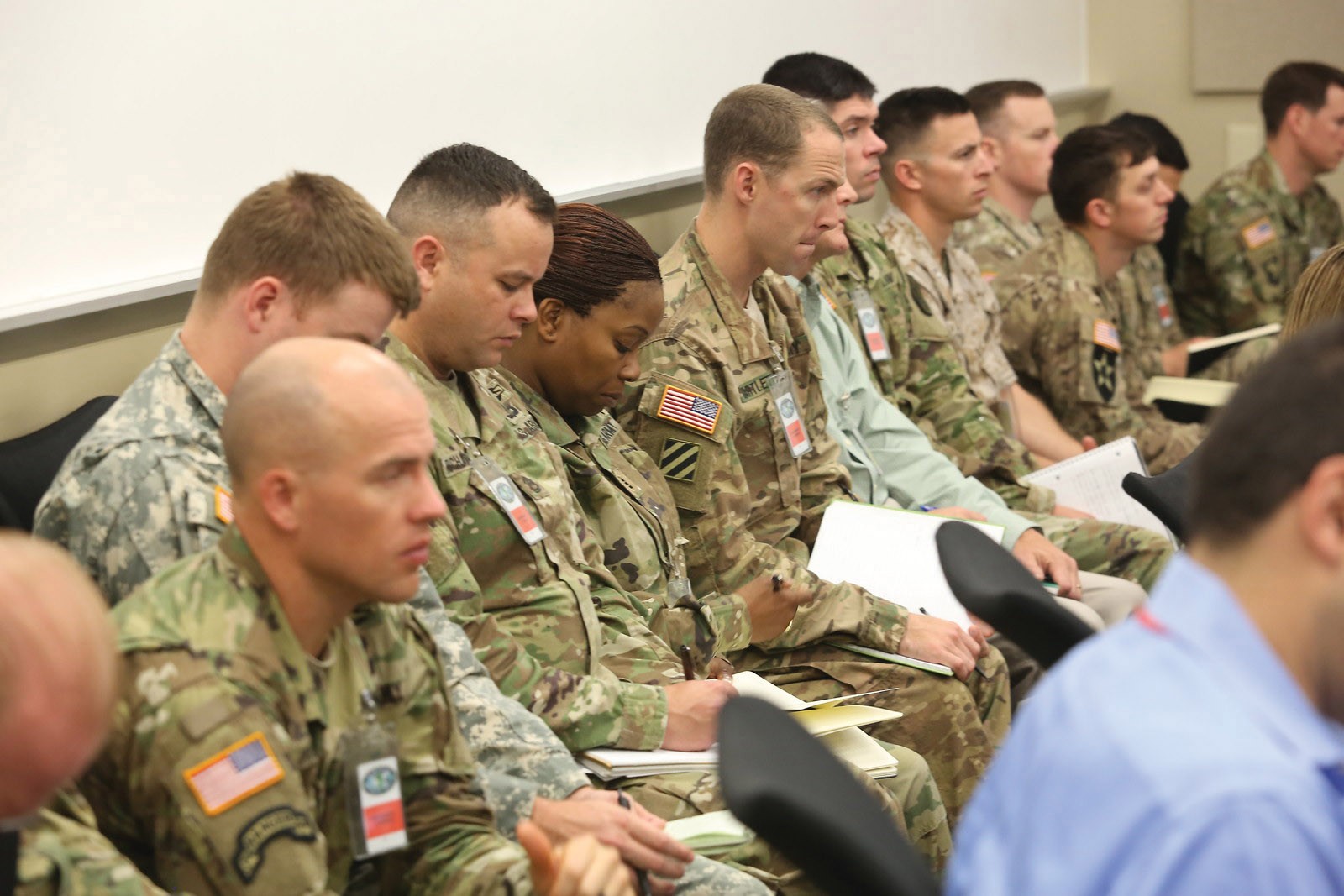
FORT BENNING, Ga., (April 6 2016) -- Civilian and Army leaders came together March 29 at Fort Benning to discuss challenges that megacities and dense urban areas present to the future operations of the maneuver force.
The goal of the seminar was to generate training innovations, doctrinal revisions and material to enhance the maneuver force operational capabilities in megacities and dense urban environments.
"Any future problem that we have is going to find itself migrating right in to the center of gravity of where people live, and that is this increasing rate of migration into cities," said Brig. Gen. Eric Wesley, emphasizing the importance of addressing the issue.
The Maneuver Center of Excellence was tasked with developing a pilot program for an urban training detachment in a megacity environment and an urban studies program, which was discussed during the seminar. The pilot program will launch in April when a select group of 10 Maneuver Captain Career Course students will visit New York City in order to increase their understanding of challenges in dense urban environments and learn from experts in megacities who routinely operate in those environments.
Col. Patrick Mahaney, CSA Strategic Studies Group director, said that even though the Army doesn't normally think of municipal police and fire departments as interagency partners, it should.
"We have experts who can help work us through this problem set, whether it's how to train better for it, how to educate better for it or how to develop material for it," said Mahaney.
Wesley pointed out that while the seminar looks forward and prepares for the future, it is still important to remember and learn from the past.
"Today is the 29th of March, and here in about nine days we will celebrate an anniversary. And it's an anniversary of when a single brigade took down the largest megacity in history, one might argue. I think it was probably the biggest takedown of a megacity since Jericho. In a matter of just a day or two, a city of six million people collapsed and the leadership melted; or did it?" asked Wesley, referring to the fall of Baghdad in 2003.
Wesley said that there are lessons to be learned from April 7, 2003, in terms of the application of power.
"I guess the question I want you to think about is, given all the problems that ensued, why did the outcome happen the way it did, because literally the regime collapsed. And then within 48 hours, one could argue that the dynamics of the challenges of megacities began to grow into a point where it put us in crisis as a nation over the course of the following years. So why did that happen?" asked Wesley.
Fort Benning will host a follow-up meeting in May to review the outcomes of the pilot program and seminar.
Social Sharing