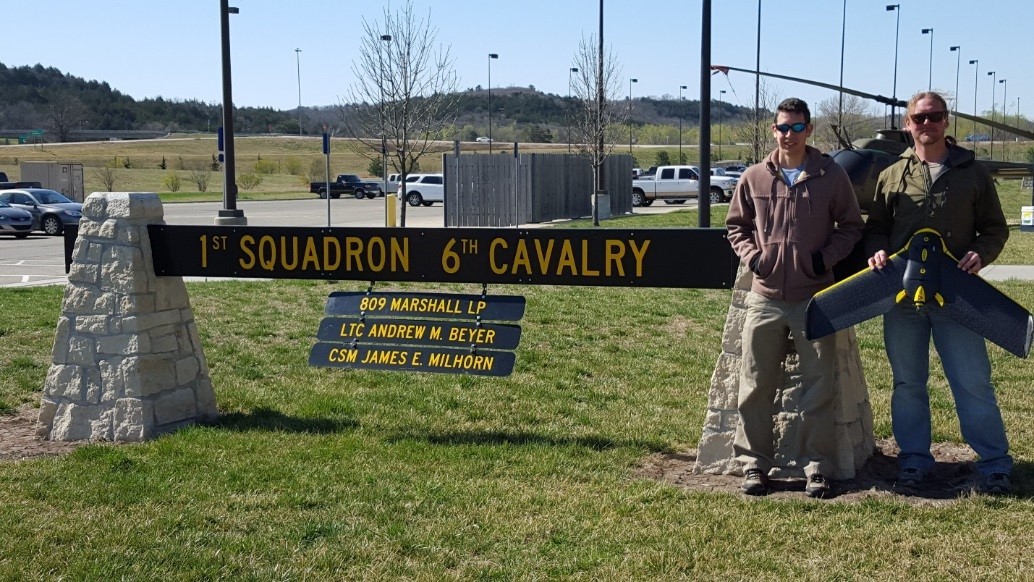
In preparation for March 22-23 Technology Demo event at Fort Leavenworth, the MCBL wanted to collect recent imagery. ... VIEW ORIGINAL
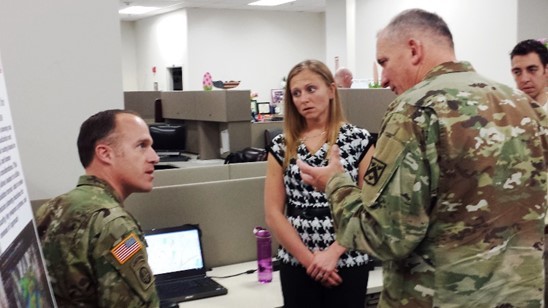
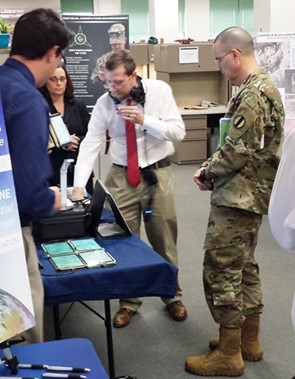
FORT LEAVENWORTH, Kan. (March 29, 2016) -- The Mission Command Battle Lab (MCBL) showcased emergent or developmental technologies and capabilities during their Technology Demonstration Days, March 22-23, 2016. The event was held in conjunction with the Unified Challenge (UC) 16.1 experiment, a Campaign of Learning event held by Army Capabilities Integration Center (ARCIC).
More than 100 people from across the Fort Leavenworth community, as well as nearly all UC 16.1 participants, attended the two-day event. The technologies exhibited at the event are linked with the Army Warfighting Challenges and address long-term capability gaps. They all have the potential to improve future forces' execution of the operations process.
Six different S&T development organizations participated in the event, including: 1. Communication Electronics Research and Development Engineering Center (CERDEC); 2. Engineer Research and Development Center (ERDC); 3. Army Research Laboratory (ARL); 4. Army Capabilities Integration Command (ARCIC) Joint Army Model and Simulation Division (JAMSD); 5. Intergraph Corp; and 6. Microsoft Corp.
CERDEC representatives presented two separate technologies --- the Tactical Computing Environment (TCE) and Commander's Virtual Staff (CVS). A two-year old collaborative project with MCBL, the TCE untethers leaders from command posts and vehicles by using tablets and portable devices with a consistent user interface across various computing environments. Even in an early developmental state, TCE has a functioning prototype and platform allowing participants to see the potential capability designed and built for commanders and leaders.
Brig. Gen. Quintas, Director of ARCIC Concept Development and Learning Division, said, "This is great; these capabilities are what we need at the tactical edge."
The CVS team briefed their concept of a capability to complement the TCE effort; it will work in the background to ensure commanders receive the right information, at the right time and in the right format. This project is already working with existing programs of record (PoR) to ensure successful transition. It will ultimately allow commanders to focus less on the science and more on the art of mission command.
Representatives from ERDC presented a suite of capabilities designed to bring geospatial analysis to the lowest echelons. To fully demonstrate the capability, ERDC personnel traveled to Fort Riley, Kansas and collected imagery the day prior to the Tech Demo event at Fort Leavenworth.
With the imagery collected, ERDC engineers were able to demonstrate how their tool can stitch two dimensional drone images into a 3D point cloud. Using this type of data, they can provide automated route planning recommendations, line of sight analysis, and range ring overlays to assist leaders in mission planning. The intent is to use software to allow Soldiers to collect, analyze, and exploit imagery with capabilities normally found at brigade and above.
The ARL Human Research and Engineering Directorate (HRED) team discussed initiatives to conduct sensor based soldier and team assessment. In line with the Army's Human Dimension (HD) strategy, their goal is to understand and later predict fluctuations in cognitive performance, situational awareness (individual and shared) and other factors that impact unit performance. Ultimately, these technologies will address the need for Army systems to better complement Soldiers to improve individual and team performance.
Lt. Gen. Robert B. Brown, commanding general of the Combined Arms Center, said, "People are our advantage, and we have typically adjusted to technology. Here, we are using technology to leverage people to operate in a complex world."
JAMSD demonstrated an early prototype of Early Synthetic Prototype (ESP) Higher Echelon. With an aim to "fail early and fail often," this software provides the Army with a prototyping, wargaming, and experimentation capability to engage Soldiers through early--fidelity game environments. By doing so, it is possible to gain insights and recommendations early in the development of future doctrine, organization and materiel solutions. The software is currently planned for implementation during Unified Challenge 16.2 in August, which will also be held at MCBL.
From the industry side, Intergraph and Microsoft demonstrated emergent capabilities. Intergraph, the maker of ERDAS-Imagine, showed their company's solution to cloud based geospatial analysis. The project's goal is to enable distributed operations by leveraging analysts, regardless of physical location, and push complex computing away from low bandwidth areas.
Microsoft, brought their yet-to-be released HoloLens for demonstration. The device itself is a self-contained computer running Windows and provides an augmented reality experience with holograms and avatars. In line with Lt. Gen. Brown's emphasis on Human Machine Interface, and HoloLens served to generate discourse between system developers, capability developers and concept writers about the potential that augmented reality can bring to Army operations, from training to education to mission rehearsals.
The event was very successful in highlighting MCBL's leading role to drive mission command-related developments and its key role in ARCIC's Campaign of Learning. Through events such as this, and through continued involvement in research and development across the Army, Academia, Defense Advanced Research Projects Agency (DARPA), and commercial firms, the MCBL will continue to highlight the importance of Mission Command as the lead integrator of all warfighting functions.
Lt. Gen. Brown summarized, "this is exactly what we need to be doing….more of these events."
Related Links:
U.S. Army Combined Arms Center (CAC)
Mission Command Center of Excellence (MC CoE)
Social Sharing