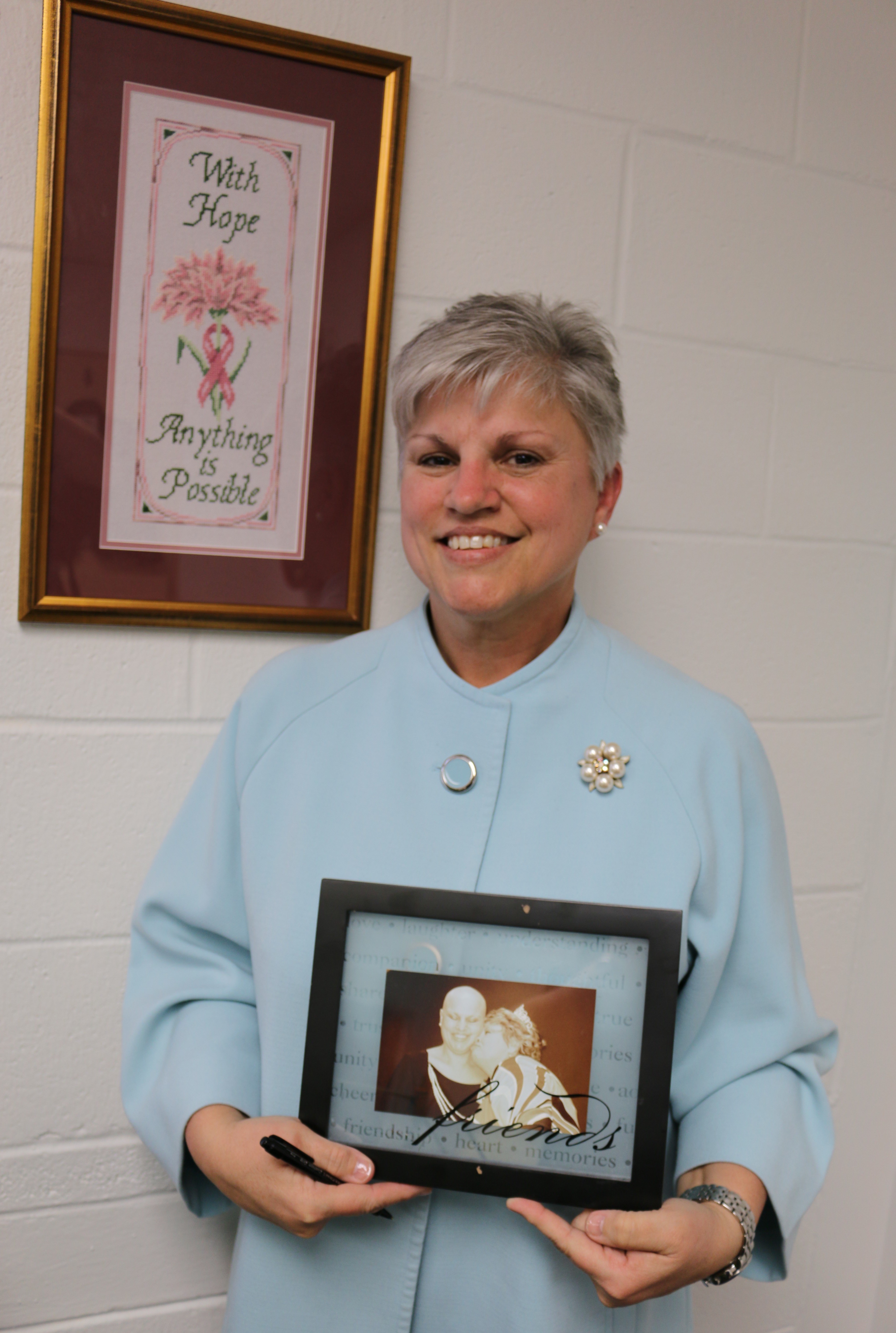
REDSTONE ARSENAL, Ala. -- Deborah Daniel didn't really mind when her hair fell out.
It was her eyebrows that got to her.
Fighting cancer with chemotherapy usually means losing your hair. So, Daniel expected the hair loss, even welcomed it as a sign that she was winning the battle for her life.
"I didn't mind about the hair because I wasn't ashamed of having cancer. I was proud that I knew I was going to be a survivor," Daniel said. "But, when I lost my eyebrows, that was the worst thing for me to accept emotionally. That seems like such a small thing, but it shows how emotional even the small things can be during treatment."
Daniel, an Aviation and Missile Command employee who is matrixed to the Program Executive Office for Missiles and Space as the Assistant Program Executive Officer for Logistics and the director of Missiles for the AMCOM Logistics Center, just celebrated five years of cancer remission. She spoke about her battle against non-Hodgkin's Lymphoma to bring attention to the American Cancer Society's annual walk-a-thon fundraiser -- the Huntsville Metro Relay for Life -- on May 14 at Huntsville Junior High School in Huntsville, Ala. Teams are now registering for this event at www.relayforlife.org/huntsvilleal.
"The American Cancer Society has made a tremendous difference for those who have faced a battle with cancer," said Daniel, who has shared her cancer story with several local groups. "I lost my mother to cancer in 2003. I am convinced that if she had been diagnosed today, she would have survived. The statistics on the survival rate from cancer have progressed by leaps and bounds, and much of that progress can be attributed to the American Cancer Society and the research they have funded.
"The Relay for Life is a great way for communities to come together and recognize cancer survivors, remember those lost to cancer, and raise funds that help with research and the social services provided by the American Cancer Society."
Daniel fought her battle against non-Hodgkin's Lymphoma not once, but twice -- first in 2008 and again in 2009-2010. The first bout was simple -- treatment with chemotherapy and radiation for a few months while also keeping up a hectic lifestyle of work and family responsibilities.
"It came up the first time like a swollen gland on my neck. But it was one of those that kept getting bigger," she said. "When I got the diagnosis, I decided to meet it head on. I'm a fighter. I went through treatment, knowing there was a high percentage of the cancer going into remission, and it did."
But in late 2009, the cancer came back and the second bout put her temporarily out of commission, with months spent at Vanderbilt University Hospital to receive a stem cell transplant.
"I had terrible pain, but my type of cancer doesn't cause pain. So, it took a couple months to confirm the diagnosis. The lymph nodes in my spine and all across my hips had cancer. The cancer had caused swelling and pressure, and that's what caused the pain," she said.
Non-Hodgkin's Lymphoma is a blood disease. For a stem cell transplant, Daniel underwent seven days of extreme chemotherapy. Then her stem cells were filtered from her blood, treated with chemotherapy and returned to her blood 30 days later to help kill any remaining cancer. She spent 100 days in outpatient treatment at Vanderbilt, with eight hours a day undergoing chemotherapy and blood transfusions.
"The American Cancer Society is a phenomenal source of information and support," she said. "They fund the Hope Lodge at Vanderbilt where families can stay when their loved one comes for treatment. We stayed there during my first visit to Vanderbilt to meet with the doctors. At that point, you are already dealing with emotional turmoil. So, any help you can get -- even with things as simple as having to find a place to stay -- makes it easier on the patient and the family."
Once she began her stem cell transplant, Daniel and her husband Terry stayed in an apartment complex nearby provided by the hospital. All of Daniel's surroundings had to be 100 percent sanitized during the transplant time period.
During her treatment, Daniel often referred to the American Cancer Society's web site and social media pages for information.
"That resource served like a stabilizer," she said. "Whenever I had a question or wanted to review information, I could go to the web site, and it would help to focus me on what I needed to do to win this battle. They have all the information on the latest research and clinical trials. The information prepares you to ask better questions and it helps you understand where you fit in to the plan to get well."
Daniel also kept a journal where she wrote down questions to ask her doctors and their answers.
"So often, people are passive in their relationship with their doctors. Even though they are the experts, you are in charge of your care and you have to understand what you are going through," she said.
Even with family and friends, and the American Cancer Society giving her the support she needed, Daniel said her battle was still difficult and exhausting.
"I looked like a prisoner of war. No hair, no eyebrows, thin. You get to a point where you have to concentrate on every step, on every breath, just to survive," she recalled.
"People hear the word 'cancer' and, I know, in its worst circumstance they may not make it. But, to me, the cup is always full. You have to stay positive and you have to surround yourself with positive."
Daniel also relied on the Caring Bridge, a web site where those fighting a medical diagnosis can post information on their progress, and receive words of encouragement from friends and family.
"It was like a free gift of support. You send a message to everyone at the same time, provide them all with the same information through Caring Bridge. And, then you receive all these positive notes back from people who care about you," Daniel said. "Cards, texts, emails -- they all seemed to come at the right time. I was on everyone's prayer lists. I was just so very humbled. It was an emotional time."
Once her cancer was in remission, it took Daniel several months to regain her strength and stamina. At one point, she lost 40 percent of her lung capacity.
her cancer battle, Daniel has lived through the loss of her number one supporter and caregiver. Her husband died of a massive heart attack in 2014. Her two grown daughters along with other family members, friends and co-workers make up a support network Daniel knows she can continue to rely on.
Through all this, I learned I'm probably stronger than I thought I was, and that the world is full of wonderful people," she said. "This has shown me that I need to do more to take care of the people around me. It's important that we let others know that we care for them. And, when you need help, ask for it. People want to help. On the days when you don't have strength, let others be strong for you."
Social Sharing