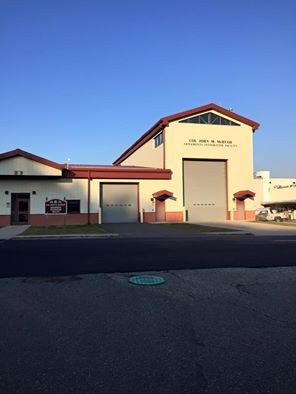
Picatinny's new Building 8 was named the Col. John M. McHugh Armaments Integration Facility in a dedication ceremony Sept. 6 in honor of a local hero who was one of the highest ranking officers to die in Afghanistan since the U.S. entered conflict there in 2001.
McHugh was a 1982 graduate of West Caldwell High school and graduated from the U.S. Military Academy in 1986. He became an Army aviator and helicopter pilot. HcHugh was one of five U.S. Soldiers killed along with a Canadian officer and a dozen Afghan civilians in a May 16, 2010 suicide bomb attack on a NATO convoy in Kabul.
The dedication ceremony was held to "provide a fitting tribute to a Soldier who gave his life for his country," remarked Installation Commanding General, Brig. Gen. Jonathan A. Maddux.
By placing a plaque with his name above the entrance to the building, "John's memory will live on," Maddux said.
Attending the ceremony were Col. McHugh's mother, Mary, and father, James. Speaking to the attendees, Col. McHugh's brother, James, said that his brother would have used a term familiar to those who knew him to describe having a building named in his honor: "Cool!"
Also speaking at the ceremony was McHugh's West Point classmate, Col. John Boulé II, district engineer and commander of the U.S. Army Corps of Engineers, New York District, which had responsibilities for the building's construction.
"McHugh lived by the West Point class motto, 'Courage Never Quits,'" said Boulé. "He was one of the kindest people God ever created. I'm proud to have known you. I miss you brother."
After the ceremony Boulé described his classmate as "a kind and gentle warrior, a great athlete and a friend to everyone he met. Also, he was a real family guy," he said of Connie McHugh's husband and father of five.
Engineers who work in the building will be supporting enhancements to the Common Remotely Operated Weapon Station and developing future remote weapons technologies. They will also use the facility to integrate small arms, medium caliber and remote weapons systems onto various ground, air and perhaps sea platforms.
The facility has computer workspace for engineers to design systems and equipment to create prototypes. The building also houses simulation platforms that allow the engineers to conduct initial shock and vibration tests.
SUPERCOMPUTING POWER
In addition, the structure features a supercomputer with a nearly 360-degree viewing screen that allows engineers, Soldiers or Marines to use the weapon in an immersive, simulated environment so that they can acquire immediate feedback. "This kind of immediate feedback is proven to be the most effective way to develop systems," said Dr. Gerardo Melendez, director of the Armament Research, Development and Engineering Center (ARDEC).
The McHugh building's bay has space to bring in the largest vehicles in the Army's inventory so that technology can be integrated into the vehicles. "The facility brings together the ability to design, build and test, equipment all under one roof," Melendez added.
After preliminary testing, the engineers can take the equipment next door to the Maj. Marie Rossi Clayton Armament Technology Facility for live fire testing. In combination, the two facilities speed the process of enhancing weapons and providing new capabilities to Soldiers, which makes ARDEC more responsive to the warfighter's needs, Melendez said.
The Clayton facility was named in honor of the first female officer to fly into combat. She was killed in a helicopter crash in 1991 during Operation Desert Storm. The McHugh building cost about $4.5 million to construct and it will contain about $3.2 million worth of specialized equipment.
"This facility was completed on time and on budget," said Boulé. "Everyone involved contributed countless hours to satisfy one common goal--complete success." Yet with all of its amenities and high technology equipment, the McHugh plaque will serve as a reminder to engineers of the dedicated people in uniform for whom they develop weapons.
"How then can they not be inspired to dedicate themselves completely in support of these warfighters?" Melendez asked during the ceremony. "How can they learn about Colonel McHugh and not be inspired by the type of people this country produces to defend it?"
Social Sharing