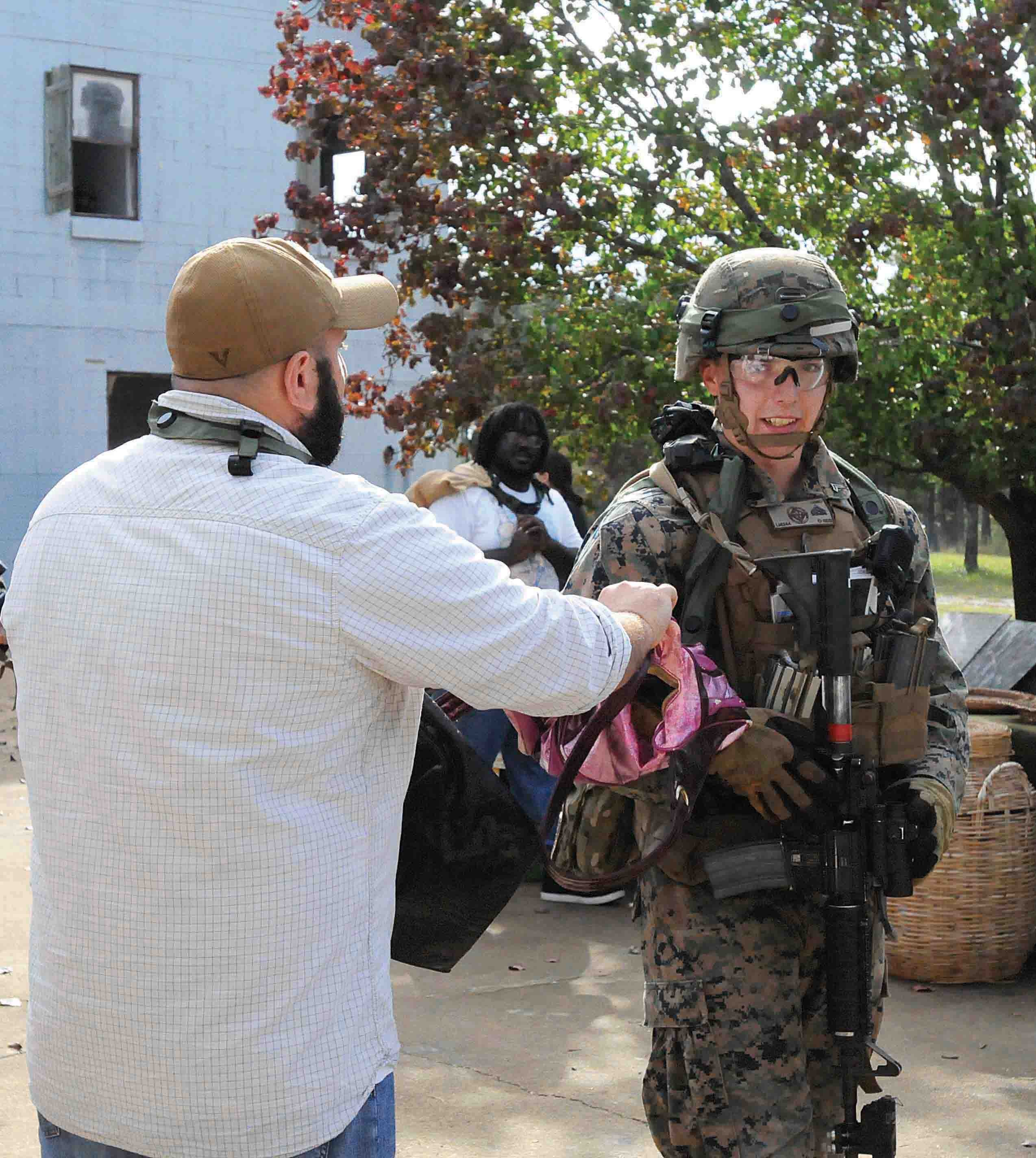
FORT BENNING, Ga., (Nov.11 2015) -- Seven squads - four Army and three Marine Corps - took part in a joint demonstration to improve tactical combat casualty care as part of the Army's second Program Executive Office for Simulation, Training and Instrumentation Squad Overmatch Study Oct. 14-Nov. 6 at Fort Benning.
The Squad Overmatch Study, which began in 2013 with a proposal submitted to the Army Studies Program by PEO STRI, evolved into an exercise focused on improving training, human performance and resilience in combat simulation situations where Soldiers and Marines are put in harm's way. The first study ended with the squads engaging the enemy immediately followed by an improvised explosive device event in the gaming, virtual and live environments.
"And that was it, the exercise stopped," said Rob Wolf, Squad Overmatch Study TC3 project director at PEO STRI. "Which we realized left a big hole in the training. When people get hurt, that's where the real stress begins for the squad and critical squad leader decision making begins."
"So this year we added and focused on TC3 - specifically, first responder field care under enemy fire and tactical field care," Wolf said. "We also focused on team development; working on communication skills by taking a team of experts and turning them into an expert and cohesive team, getting them to think as one system and one squad."
"About 80 percent of the initial treatment in combat situations is done by the Soldier next to him, rather than their medic," said Sgt. Maj. Alan Higgs, senior enlisted advisor to the program executive officer at PEO STRI. "And as such, training to respond immediately to combat injuries can be vital in saving a Soldier's life."
"The initial Squad Overmatch began as a way to investigate new simulation technologies that could enhance the realism of training and expose Soldiers to the types of traumatic events they would experience on the battlefield," said Jay Brimstin, acting director for the Directorate of Training and Doctrine at the Maneuver Center of Excellence.
"The design of the study was based on graduated stress exposure training, which the Army, Navy and Homeland Defense developed," explained Joan Johnston, senior scientist with Army Research Lab Human Research Engineering Directorate and one of the principle investigators with the project.
"It's a way of training people so they can develop resilience to stressors, and potentially combat or mitigate future psychological issues," she said.
The TC3 focus of the Squad Overmatch Study became a way for experts to look at the traumas of war and figure out how to better simulate them so Soldiers would have the chance to prepare in a more realistic setting.
It evolved into a three-day (per squad) exercise where Soldiers spent one day in a classroom, one day on virtual war-games and one day in live exercises putting everything they had learned into action.
•The classroom day included learning about advanced tactical combat casualty care, situational awareness, resilience and performance enhancement, team development and integrated after action reviews.
•The virtual game day gave the Soldiers a chance to put what they'd learned into action, where the pressure increased and their decisions counted.
•The live day pushed the Soldiers through a graduated stress environment where they were forced to use the skills they had learned, trying to navigate around civilian and military casualties as well as other distracting factors.
"This specific event is a pilot study where we are validating the methodology, data collection instruments, scenarios, curriculum and so forth," Brimstin said. "So that next year in June a full up experiment will occur which will result in a final written report as part of the Defense Health Programs funded research effort."
Moving forward, the next step for the program involves writing doctrine and creating support packages for units around the force.
"We are working with the Combined Arms Center Training to rapidly develop and field many of the capabilities that have been demonstrated as part of the study," Brimstin said. "Additionally, we will begin developing the training support packages that we can deliver to the operational force so that units will have the ability to create these scenarios and bring the simulation capabilities into their training events.
"We are also going to develop training support packages that we can bring into programs of instruction here at the MCoE, like the Infantry Basic Officer Leaders Course."
Social Sharing