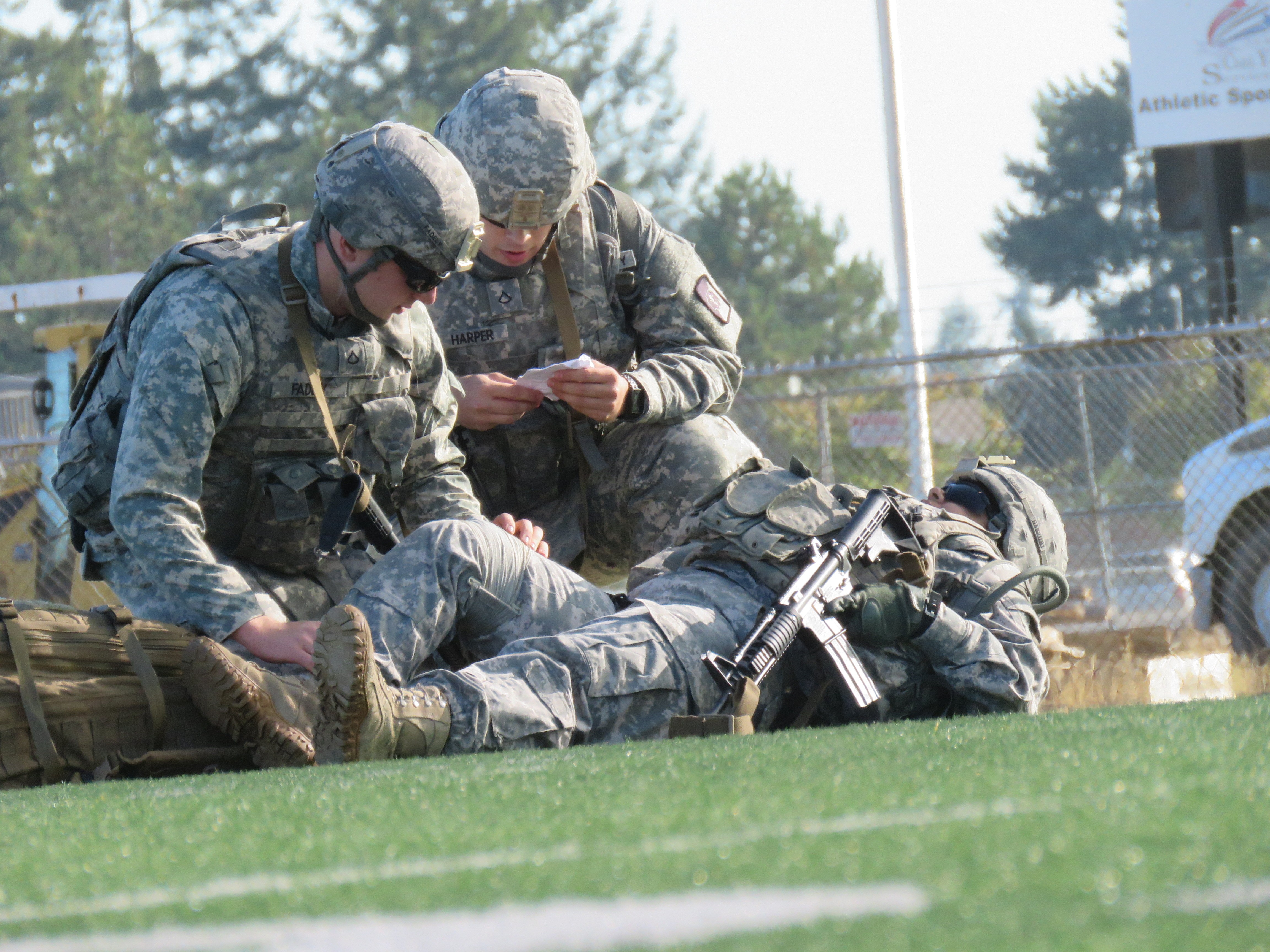
Forty-nine Madigan Army Medicine Center Soldiers went into the grinder that is Expert Field Medical Badge training; nine earned the right to wear the medal at closing ceremonies at Cowan Stadium on Joint Base Lewis-McChord Sept. 29.
"I'd done it once before and I failed out once and I needed to redeem myself to the challenge," said Staff Sgt. Santiago Hernandez, Madigan's Bravo Company operations noncommissioned officer who said he went in more than determined. "Yeah, guns blazing. It was scary because it's in the back of your mind that there's always a way to fail out, you know? I'd been through before and there's a reason I was there a second time."
Most years the number of Soldiers, sometimes joined by other services, who earn the badge is around 20 percent.
For Maj. John Stringer, Madigan Outpatient Pharmacy officer in charge, that challenge was exactly what drew him to compete for the badge.
"I like the challenge of these types of things," he said. "One of my reasons for just joining the Army is it's things that you don't get to do as a pharmacist. You got to actually do Soldier-type stuff. I think it was an opportunity to get a better feel for the other side of things. And I also knew it was a challenge. I knew the attrition rate is high. A lot of people aren't able to make it through it. So, that kind of challenge kind of calls me sometimes to see if I can do that."
The United States Army decoration was first created on June 18, 1965 -- well before most Soldiers trying to attain the honor were even born. The first day featured a 100-question written test. If someone fails, they get one more chance, but are sent packing if they cannot pass the second test.
According to 1st Lt. Michelle Thompson, a Madigan medical-surgical nurse, seeing people she watched give it their all only to fail out was a regular occurrence and it didn't make things any easier for her.
"It's really hard, because you develop a bond with these people," she said. "When you start to get to know people and you see the effort that they put in and you see that they're trying really hard. I was the last female standing in my platoon after the night land navigation, so that was hard. That was really hard. It added a little bit more pressure."
Hernandez and Stringer became regulars in the unit study group.
"The standards were hard enough and the tasks were hard enough to memorize, but then you add in that you were out there for 11 days and it's basically 12-hour, 14-hour, 16-hour days of non-stop -- you learn it, then you study it and then you repeat that and you're tested on it and you study for the next day," Santiago explained. "It's intense as far as you're constantly thinking. The physical part wasn't that crazy -- it's more the mental part, added in you're not getting much sleep."
Stringer agreed and pointed out that even though the results were based individually, it was teamwork that helped him the most.
"What I took away from it is like everything else I've done in the Army: you're given a challenge and you work together as a team," he said. "Even though it's an individual event, with the studying and the things that we did, it's how we got through it. Soldiers always make the best of what they have and they always come out better than they were. It's incredible. It's a good feeling to get through something like that and then have the people you went though it beside you."
Thompson said women who've ever considered going for their EFMB should prepare and go for it.
"Just because you're small doesn't mean you can't do it," she said. "I'm a very small woman. That's probably why rucking was so hard for me. But, all the women who passed were all very petite women, so don't let size or being a woman stop you from doing anything. Just have confidence and you can do it."
Thompson said every Soldier should try it if they would like to be among the few medical Soldiers who wear the EFMB.
"Just go for it," she said. "Have the confidence that you can do it. If you want to do it and you put in the time, you can do it. Your body can handle a lot more than you think."
Social Sharing