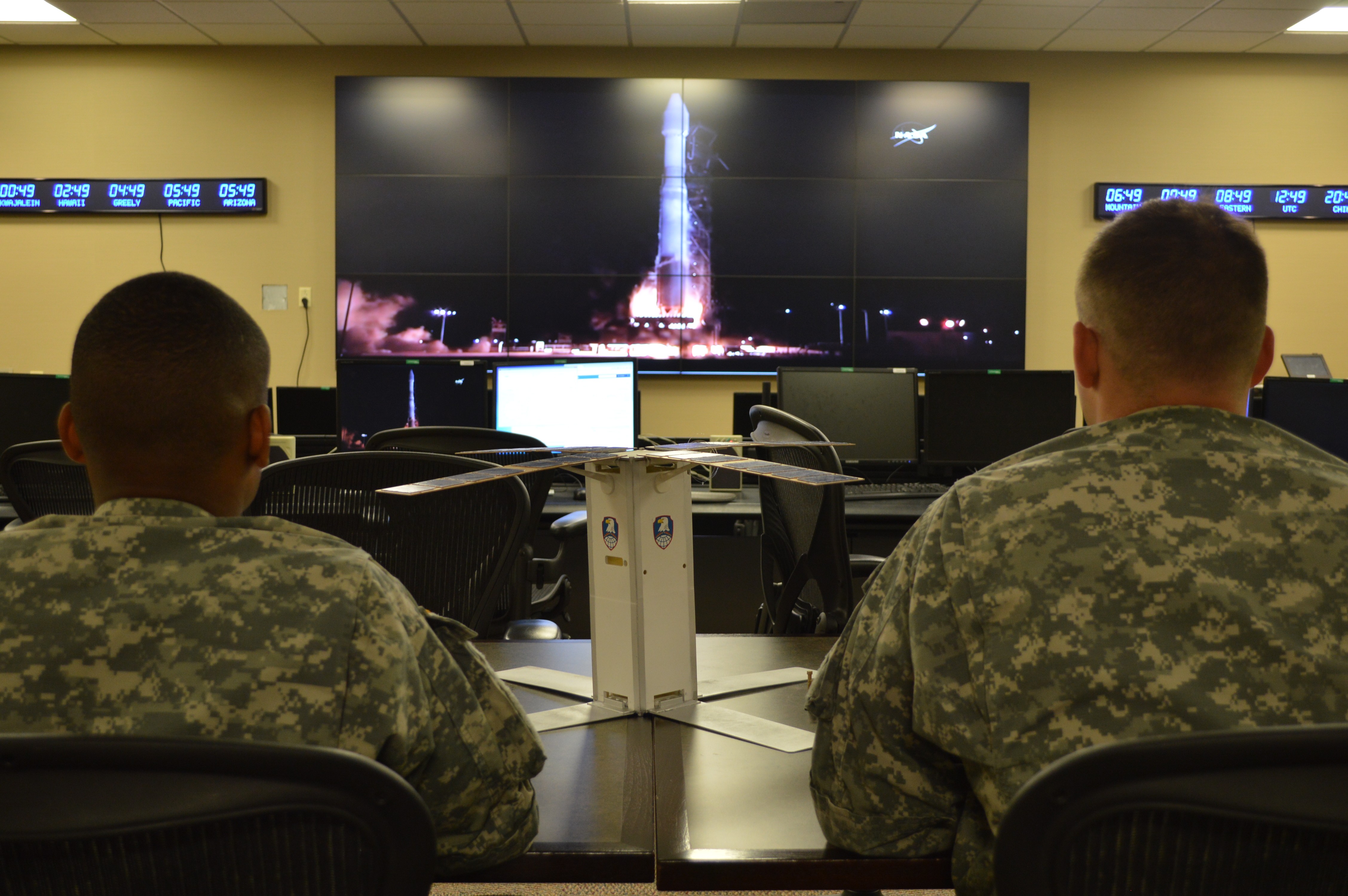
REDSTONE ARSENAL, Alabama -- Launching satellites for the U.S. Army Space and Missile Defense Command/Army Forces Strategic Command is becoming a SNaP for the Air Force.
The 30th Space Wing at Vandenberg Air Force Base, California, successfully launched a United Launch Alliance Atlas V rocket carrying a National Reconnaissance Office payload, which included three Army nanosatellites from the SMDC/ARSTRAT Nanosatellite Program, or SNaP, from Vandenberg Space Launch Complex-3 Oct. 8.
"This launch was a great achievement for Team Vandenberg, ULA, NRO and our launch partners," said Air Force Col. J. Christopher Moss, 30th Space Wing commander. "Their outstanding professionalism and team work ensured a fantastic launch, and I am proud to work with this team of experts in support of national defense."
SNaP is a small satellite communications, or SATCOM, constellation. This will allow communication across great distances using existing UHF tactical radios making the future of satellite communications more responsive to Soldiers' needs.
The objective of the SNaP mission is to reduce tactical surprise and achieve overmatch at the squad level by demonstrating operational prototype nanosatellites that enable mission command on the move and allow tactical leaders to synchronize action, seize the initiative and maintain situational awareness.
"The launch was extremely successful," said Jon Dodson, SMDC Technical Center SNaP chief engineer. "We are extremely pleased that the NRO allows us to be a ride share on their Atlas V. It is a great savings to the Army to be able to do that.
"When the satellites pass over Redstone Arsenal, we will be doing ground station operations and communicating with the satellites," he added. "We will be downloading data from them and getting the 'health' and status from SNaP for the first few days before we start going into more mission operations."
The ULA Atlas V rocket launched from Vandenberg has four solid rocket boosters and a main engine providing enough thrust to launch the primary payload and the ride share secondary payloads to their designated orbits. During launch and until deployment, the nanosatellites are stored in a square container at the outer side of the main launch vehicle once in space.
After being released from the main rocket body, the three SNaP satellites will be diagnosed for the next 20 days for status and functionality. Ground stations at SMDC will track and monitor the satellites during orbits.
"The launch went absolutely perfect," Dodson said. "The satellites were deployed into orbit in a flawless manner and we are really pleased. We are excited about the future of what these small satellites can do."
SNaP is a 5-kg mass cube satellite, or CubeSat, which costs about $500,000 and is about the size of a loaf of bread. The body dimensions are 10cm x 10cm x 34cm. The nanosatellite has four deployable solar panels and four deployable RF antennas.
SNaP uses deployable solar arrays to increase power generation. SNaP also has a propulsion capability for station keeping to maintain constellation spacing. On previous SMDC nanosatellites, solar panels were attached to the sides of the satellite. At any one time, only two panels would be pointed at the sun. With deployable arrays, operators can orient all four toward the sun.
"This is very exciting," said Tamara Cottam, SMDC Technical Center SNaP operator. "We have launched eight satellites in the past five years. The launch today makes it nine, 10 and 11, and with each satellite generation, we learn more and more and the technology gets better and better."
Social Sharing