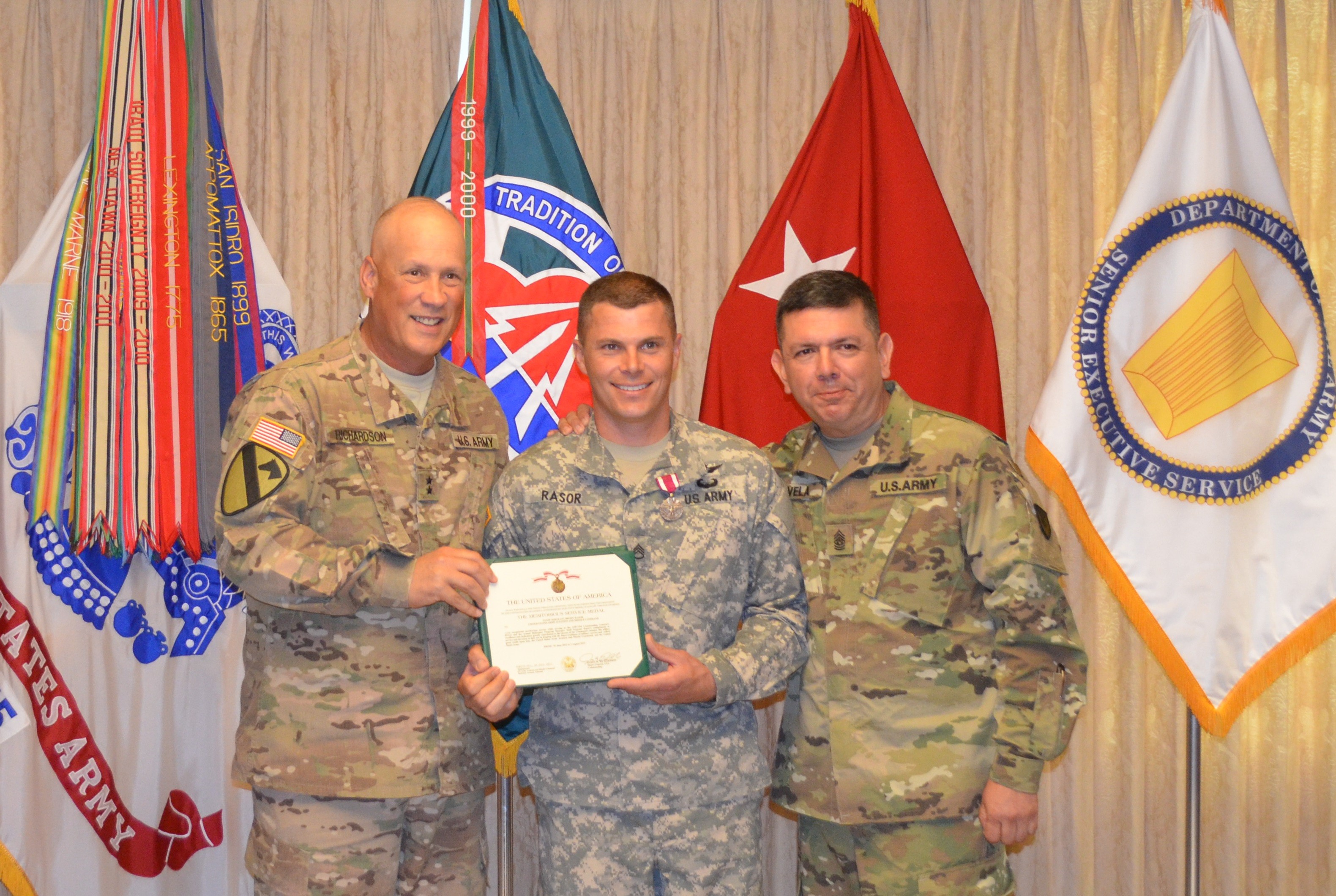
REDSTONE ARSENAL, Ala. -- A shift in Army aviation strategy has led Staff Sgt. Brody Rasor to make a change in his military occupational specialty mid-way through his career.
With 12 years experience as an Army OH-58 Kiowa Warrior helicopter technician, Rasor is now setting his sights on becoming an unmanned aircraft vehicle operator. He made the career change after Army leadership decided to discontinue use of the Kiowa Warrior. The end of Kiowa helicopters comes as part of an Armywide shift in its helicopter fleet to cut costs and reduce the various types of helicopters in service.
"The new strategy will be to pair Apache helicopters with unmanned aircraft systems," Rasor said. "Once the first Kiowa unit retired, I knew I would need to change my MOS."
Rasor has been stationed at Redstone Arsenal since 2012. He first worked in the Armed South Helicopter Program Management Office for the Program Executive Office for Aviation, reviewing mission requirement upgrades from a maintenance aspect and working with Soldiers in the field to ensure that maintenance requirements could be met.
In 2014, he was assigned to serve as the executive driver for Aviation and Missile Command commander Maj. Gen. Jim Richardson and as an aide to Command Sgt. Maj. Glen Vela until receiving orders to report to Fort Huachuca, Ariz., for six months of UAV operator training.
Even though he is looking forward to the challenges of his new MOS, Rasor will always remember his Kiowa days fondly.
"I have a lot of pride in what we did with the Kiowa. It's awesome to take something to combat, and watch it do its mission over and over again, and know that you helped make that happen," Rasor said. "We kept Kiowas flying in the fight through three deployments."
Kiowa Warriors first entered the Army fleet in 1969. The single-engine, single-rotor military helicopter flew observation, utility and direct flew for the first time in Vietnam. Over the years, the helicopter has gone through several modifications to bring it up-to-date with new technologies. Kiowa is primarily operated in an armed reconnaissance role in support of ground troops.
When he enlisted in the Army, Rasor wasn't too familiar with the MOS he ended up with -- armament, avionics and electrical technician.
"I wanted to be a helicopter engine mechanic. But the needs of the Army gave me something a little different. It panned out. I learned how to maintain weapons, and about all the computers and wiring on the Kiowa," Rasor said. "My career moved forward faster as a Kiowa armament, avionics and electrical technician than it would have if I had been a helicopter engine mechanic."
Rasor enlisted in 2003, about two years after graduating from high school in Fort Worth, Texas.
As a teen, he had often thought about enlisting, but a good job in housing construction, marrying his high school sweetheart and starting a family kept him at home in those first years after graduation.
"We bought a house and settled down. Everything was going great. But then when we started thinking about our future. No matter how well I did in construction, there were no benefits and no retirement. My wife grew up in a military family. So, the idea of joining the Army came back up and it sounded like a good idea," he said.
He went through basic training at Fort Benning, Ga., and then advanced individual training at Fort Eustis, Va. For the next eight years, Rasor and his family were stationed at Fort Campbell, Ky. While stationed there, Rasor deployed once to Iraq and twice to Afghanistan.
"We stayed busy. If there was a wiring break or if a Kiowa got shot in combat, then we had to run a new line," Rasor said. "Depending the age of the aircraft, we would have different built-in wiring systems to work with. I really enjoyed the challenge."
There are about 330 Kiowa helicopters in the Army fleet today. The Kiowa units will be phased out over the next few years as the Apache attack helicopter teams up with UAVs -- the Shadow and the Gray Eagle -- to take on the Kiowa mission.
No matter the new technologies, Rasor will always remember the Kiowa Warrior as a symbol of U.S. military strength in the Global War Against Terrorism.
"No matter what, it always flew," Rasor said. "To me, it always made it home after the flight. It flew low on most of its missions. It would take a beating and always make it back. When it needed fixing, it didn't take much to fix it."
During repairs, Rasor said the Army used a system of checks to ensure a Kiowa always flew ready to fight.
"I was never the only person who touched a Kiowa's electronics. Someone always checked out work behind us. There was also quality control who inspected the Kiowas after we finished working on them. Several steps were always taken to keep Kiowas safe," he said.
Rasor did get the opportunity to fly in the two-seater helicopter a few times. Once was when he was in Afghanistan.
"We had an anomaly that couldn't be duplicated on the ground," he said. "I got to fly in the Kiowa to see what it was doing and to narrow the anomaly down."
On the ground, Rasor enjoyed the camaraderie of the Kiowa crews he worked with.
"I grew up in a career where the mentality was get out there and get it done," he said. "We were a different breed. We took the mission and we hit it every time. The Kiowas never stopped flying. We had the ability to do our mission with practically nothing. We knew how to make due with what we had and how to fix things so that our Kiowas always flew."
Rasor could have transitioned from his Kiowa MOS to a similar job with Apache. But, instead he chose to learn a skill that is new to the Army and represents the Army's future.
"In terms of career progression, taking on something new to the Army comes with a lot of potential," he said. "I believe there are a lot of unrealized potentials for various platforms for UAV systems. It's the future for the Army."
He is also looking forward to similar experiences with the UAV operators he will come to know as part of his new mission. Although he is slated to fly the Shadow UAV after his training, Rasor said he could be shifted to the longer range and weaponized Gray Eagle depending on the Army's mission needs.
"The UAV mission really appeals to me," Rasor said. "I was so glad to be selected for this mission. I'm dedicated to it and I want to learn everything about being a UAV operator. I'm committed to the Army mission. Wherever the Army tells me to go, I will do it and make the most of it."
Rasor believes his experience at PEO-Aviation and AMCOM will be an asset in his new mission.
"The knowledge base that I've gained and being able to meet the civilians behind the scenes that make things happen will really be helpful to me," he said. "I believe that will help me be successful."
Social Sharing