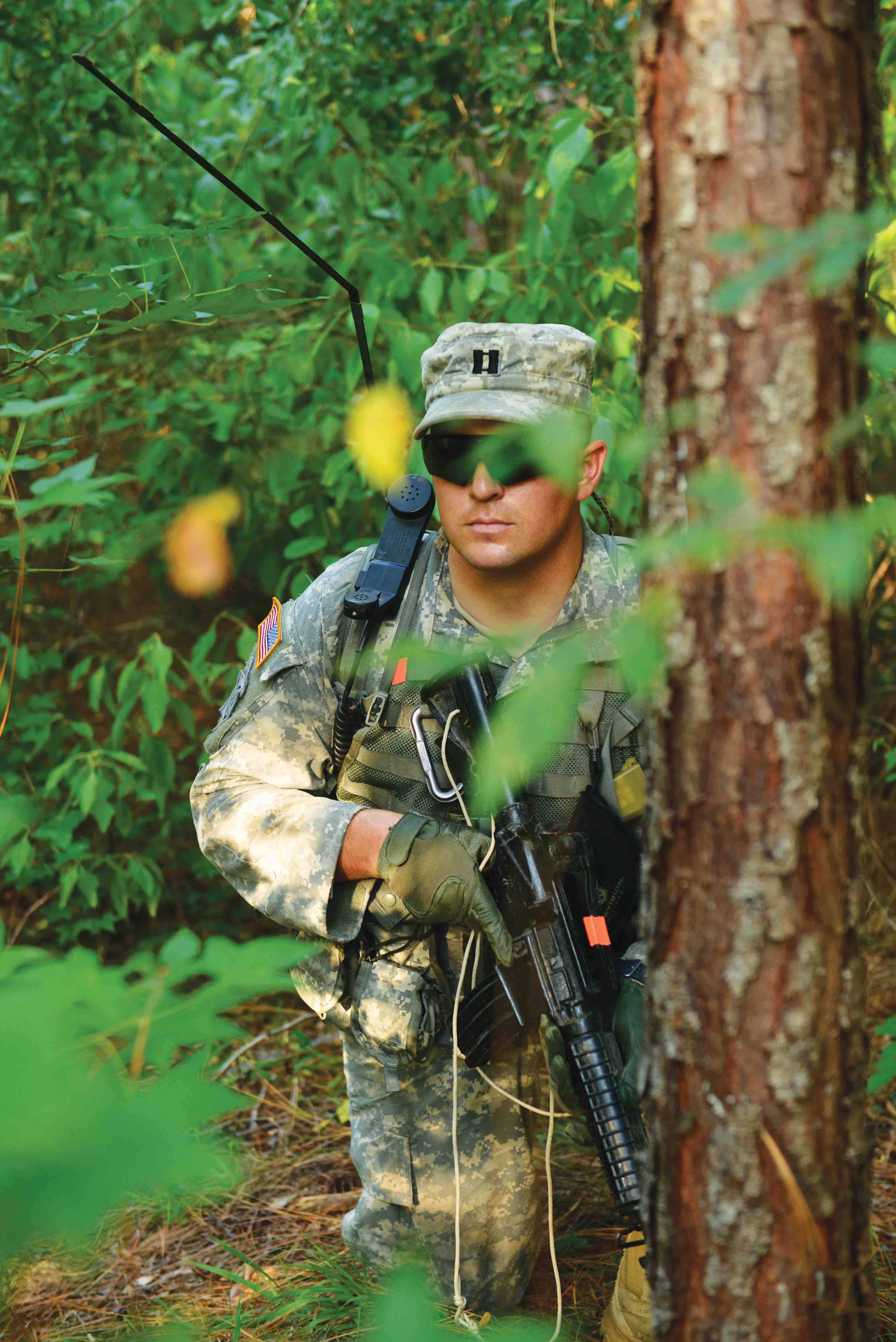
FORT BENNING, Ga., (July 22, 2015) -- Captains of the Maneuver Captains Career Course found that learning doesn't stop at the final page of their textbooks, as they stepped foot outside the classroom July 13-15 to participate in a field training exercise.
Capt. Blake Richter, MCCC Team 1 chief, said it was the first time the course has taken students to the field in more than a decade. The exercise replicated a situation where commanders would lead Soldiers and included three different lanes - a defense lane, a raid lane and a maneuver to contact lane.
"The training provides a very different perspective than the classroom," said Capt. Alex Pytlar, MCCC student and acting second squad leader for the assault platoon in the raid lane.
Students performed certain roles throughout the training, from company commander and executive officer to fire support officer and first sergeant.
The different roles allowed the Soldiers to see what was effective or ineffective in the leadership positions and apply the knowledge to their own leadership development, said Sgt. 1st Class Michael Foster, Maneuver Center of Excellence fire support instructor.
The hands-on application of the knowledge was meant to fill a gap that previously existed in the MCCC, Foster said.
In the classroom, the operation order needed to be perfect with a lot of detail. Whereas, in the field the plan was kept simple because of variables, Pytlar said.
The advantage of the field training was that students get to see how the plan works in a real-world situation, Pytlar said.
Capt. Gary Klein, MCCC small group leader, acted as a scout in the raid lane and gave the students negotiating the raid lane new information - the presence of indirect fire, which they didn't know about during their planning phase. As a result, the students had to adjust their plan.
"We tried to inject variables into their mission," Klein said. "That's one of the things the FTX allows us to do, to simulate conditions where we can force them to adjust their plan midstride," Klein said. "Those are things that, as commanders, we have to do on the battlefield."
Pytlar said battalion scouts were spotted on their reconnaissance mission, which called for a change to their plan.
"We didn't let the 'enemy' dictate how we were going to execute, we fought back to the original plan, but it did change the tempo with which we ... (executed)," Pytlar said.
The objective in another lane was to retain the hill as the enemy attempted to seize the hill. Students used battle positions - primary, alternate, supplementary and subsequent, said Capt. Nathan Osborne, MCCC student and acting company commander of the defense lane. They also had a reserve unit for a counterattack.
Rehearsals are extremely important in executing a mission, Osborne said, and communication during the defense is critical in order to properly integrate alternate battle positions.
Following execution of the mission, there was an after action review where the acting opposing force and the students executing the mission provided input on strengths and weaknesses of the plan and execution.
The AAR included focus items to sustain and improve on as a unit and what the unit thought of the actions of those in leadership as well as a self-assessment for the executive officer, first sergeant and company commander to determine what to sustain and what to improve on.
"That's the only way you're going to improve, collectively as an organization, is to actually reach that self realization, reflect upon those things and actually designate and improve," Klein said to students in the AAR.
Strengths included communication from the executive officer, indirect fire by the fire support officer and a common operating plan by the executive officer. Some weaknesses included the company's lack of anticipating the next move by the opposing forces, as they were blind sighted by a secondary attack as they began to secure the objective.
"I think the field environment provides those commanders ... with a little bit of extra stress and some contingency planning that they don't necessarily think of during the operation," Pytlar said. "It gets you that reputation that helps bring a little more experience to your next position."
Social Sharing