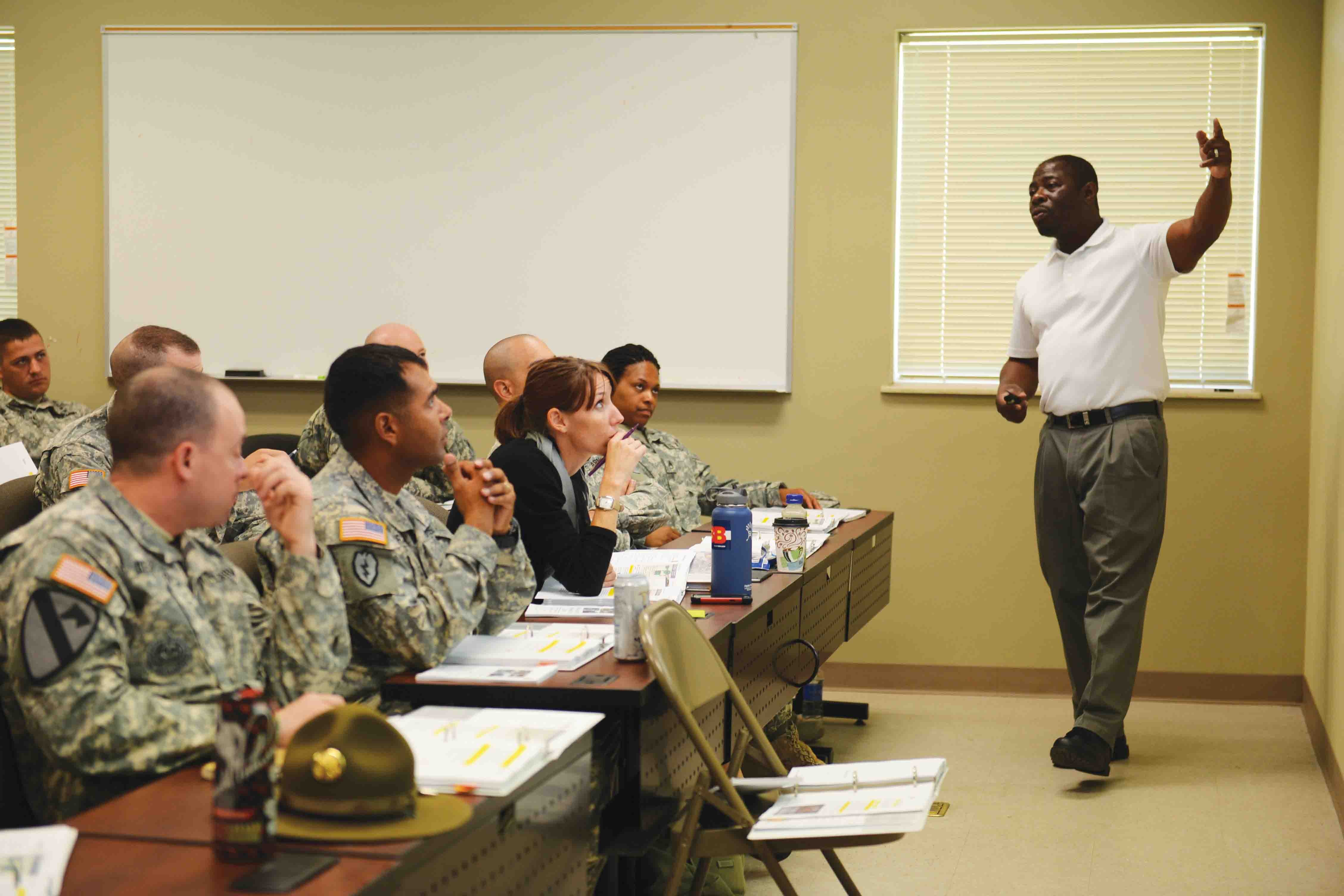
FORT BENNING, Ga., (June 24, 2015) -- "How do you deal with stress?"
Master Resilience Trainer Performance Expert Antonio Best asked this of 194th Armored Brigade and 198th Infantry Brigade drill sergeants and Comprehensive Soldier and Family Fitness Training Center personnel.
Answers included listening to music, video games, going to the mall and hugging their mom.
Best told them, as they acted as privates through the first part of the workshop, that in basic training, they won't be able to use the coping mechanisms they relied on before. Instead the Resilience Training for Soldiers would replace those coping mechanisms with some new skills they were about to learn.
The question was the impetus of the workshop the drill sergeants and CSF2-TC personnel were part of to help their BCT and OSUT Soldiers use mental toughness and skills to get through their training.
"It's for someone thinking 'I've never done this before, do I even have it in me?' and we come in to say 'Yes, you do have it in you, and this is how to get through it,'" said Lt. Cmdr. Robin Toblin, branch chief of the WRAIR.
A group of MRT-PEs from the Walter Reed Army Institute of Research trained the 198th Infantry Brigade and 194th Armored Brigade drill sergeants and CSF2-TC personnel so they could use the training to help their new Soldiers, Toblin said.
The training began when G3/5/7 asked WRAIR to assess whether the performance psychology based trained conducted by the Army Center for Enhanced Performance helped retain high-quality Soldiers in BCT and provided any performance boost in key events.
From there, the Mental Fitness Study was conducted with BCT Soldiers in Fort Jackson, where it was found Mental Skills Training resulted in improved performance.
Resilience training then became a mandatory part of all initial military training and professional military education. U.S. Army Training and Doctrine Command required that Soldiers in BCT receive two hours of classroom instruction on resilience training.
Through the pilot study of the Resilience Training workshop done on Fort Benning from October 2013 to January 2014, Toblin said it was found that:
• Soldier knowledge of resilience skills increased from before to after the main module
• Soldier resilience scores increased from before the main module to the end of the study
• Drill sergeants said the workshop prepared them to teach the new material
• Soldiers believed the mini-modules helped them perform well on key BCT events.
Based on the findings, and the recommendation from Lt. Gen. H.R. McMaster, the deputy commanding general for initial military training, and his staff approved the material.
Within the workshop, participants absorb the material as it is taught by an MRT-PE, and then teach the material back in small groups.
"It's just making sure the content is right, the way they are delivering it (is right) - they're not just reading from a book," Toblin said.
Before the teach-backs, Toblin said the CSF2-TC personnel and Drill Sergeants are expected to go home and prepare.
"They have to balance stuff going on at home and learning that, but that is our hope is they would come back and be ready to teach it," Toblin said. Resilience Training for BCT focuses on identifying different types of reactions and how to adjust those reactions, distinguishing between factors that can be controlled versus ones that cannot, and emphasizing how Soldiers take care of themselves and their battle buddies.
Within the course, there is a main module, and then mini modules. Toblin said the modules are designed to formally introduce resilience strategies and to encourage Soldiers to start thinking about how they cope with difficult experiences, such as letting a buddy down.
The modules are designed to teach Soldiers in two hours blocks when they first arrive to the unit, and the mini modules are specialized for instruction before events such as the Confidence Obstacle Course and the Chemical, Biological, Radiological and Nuclear training.
The trainers conducted the workshop for the first time here June 16 with drill sergeants and CSF2 personnel from the 198th Infantry Brigade, then the 194th Armored Brigade. The MRT-PEs will conduct the workshop at Fort Jackson, South Carolina; Fort Leonard Wood, Missouri; and Fort Sill, Oklahoma, next, Toblin said.
"We'll teach some drill sergeants and then they'll teach the rest of them at each of the posts," Toblin said.
Social Sharing