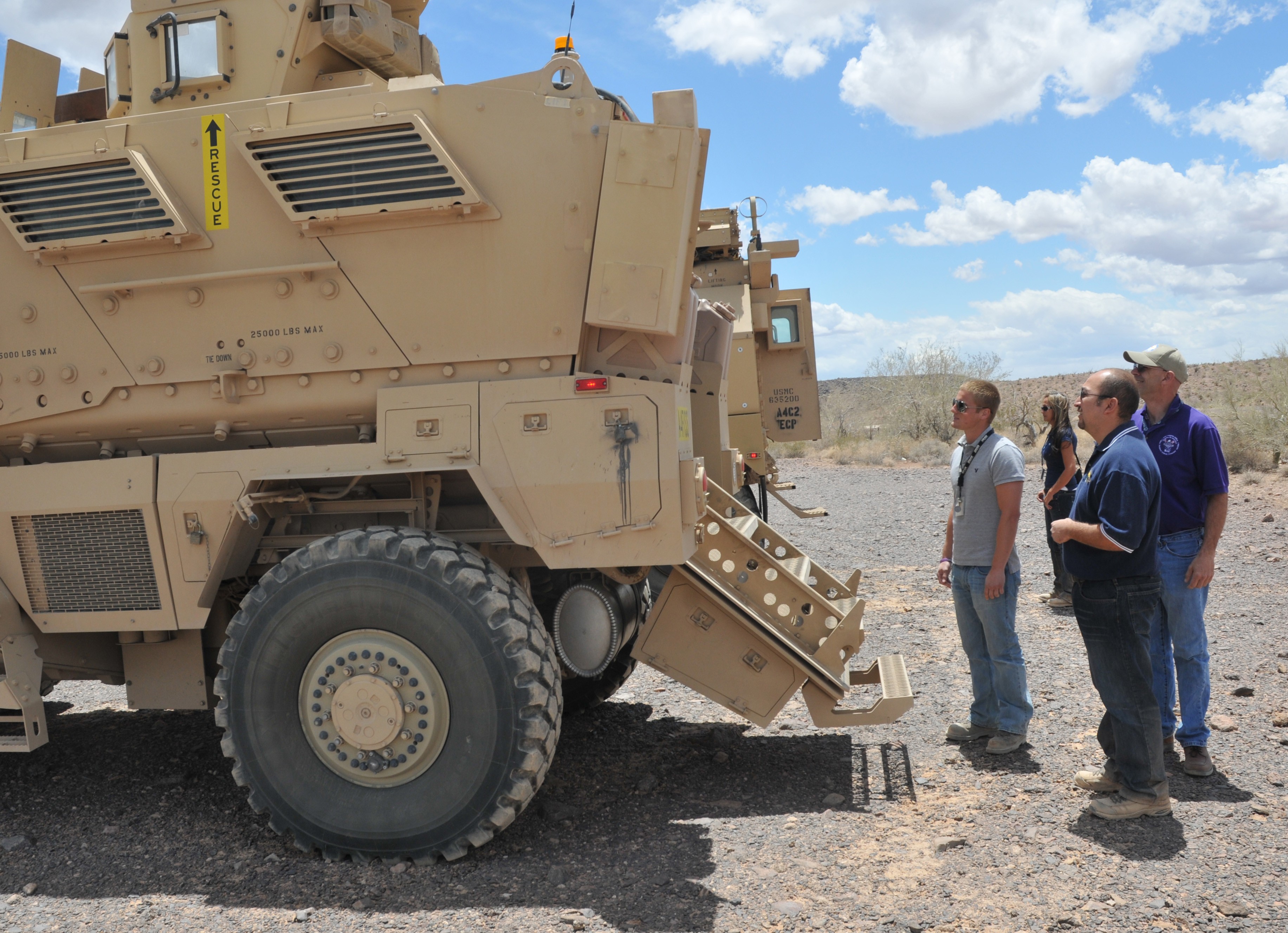
Proving ground and magnet.
U.S. Army Yuma Proving Ground's mission of testing nearly every piece of equipment in the ground combat arsenal requires the skill of hundreds of talented engineers who hail from all parts of the country. Many rise to distinction within the test community and spend entire careers here, even if they never imagined working and living in one of the world's most extreme desert environments.
An example of this is Isaac Rodriguez, who is earning plaudits for his work as team lead for the proving ground's evaluations of the Joint Lightweight Tactical Vehicle (JLTV), which will ultimately replace the High Mobility Multipurpose Wheeled Vehicle (HMMWV). The competition phase of the testing here evaluated three vehicles, and involved the efforts of about 150 workers who devoted in excess of 340,000 labor hours to the tests.
"He is very hard working and keeps his team informed," said Zach El-Ansari, combat automotive branch chief. "He is detail-oriented and calm, and always focused on providing a good, on-time product for his test customer."
The National Defense Industrial Association recognized Rodriguez and the JLTV effort when they recently named him government civilian tester of the year.
"This program was very demanding with an aggressive schedule, and we had to deal with sequestration and budget concerns," said Rodriguez. "I have to thank all the test officers and leads. They executed very well and did a top notch job."
Rodriguez, a native of El Paso, Texas, was always mechanically minded.
"I had a lot of interest working on cars when I was younger," said Rodriguez. "My dad is a really good mechanic and he always had me help him out working to maintain our cars. I really liked that."
An outreach program from the University of Texas at El Paso (UTEP) sparked his interest in engineering. He ended up earning a degree in mechanical engineering, but was slow to declare a major.
"I think the goal was to get started with basic classes and then hopefully figure it out," he said.
While a student at UTEP, he first learned about Yuma Proving Ground at a job fair recruiting booth, and his friend Juan Cuevas, now chief of YPG's simulation branch, ended up taking a job there. Meanwhile, Rodriguez worked his way through school as a draftsman for an electrical consulting firm in El Paso, then worked for a larger consulting firm that designed ventilation systems for commercial and industrial buildings. He was married and assumed he would stay in his hometown until Cuevas told him of YPG's intense need for automotive test officers given the robust test schedule during the most violent insurgent days of America's involvement in Iraq.
"By this time we had purchased a house and had our first child," he said. "When I pursued it, it was really for informational purposes."
The nature of the work deeply intrigued him, though.
"I like the variety. I definitely like to see new things and experience new technologies."
After deep deliberations with his wife, he took a position that was offered him in June 2006, relocating to Yuma. Prior to working on the JLTV program, Rodriguez tested such platforms as the all-terrain variant of the Mine Resistant Ambush Protected (MRAP) and mine-clearing vehicles.
"It would be nice to be a little more hands on, but I understand our role here. I understand it is to be sure we get the right product to the warfighter and make sure we test it in a safe manner here."
These days, Rodriguez is even busier than usual as part of the proving ground's aspiring leaders program, the major facet of which is earning a Master's degree in program management from the University of Arizona. Rodriguez plans on making the Army Test and Evaluation Command a career.
"I think I've grown a little here. I'm still learning a lot: I don't think I'll ever stop learning."
Social Sharing