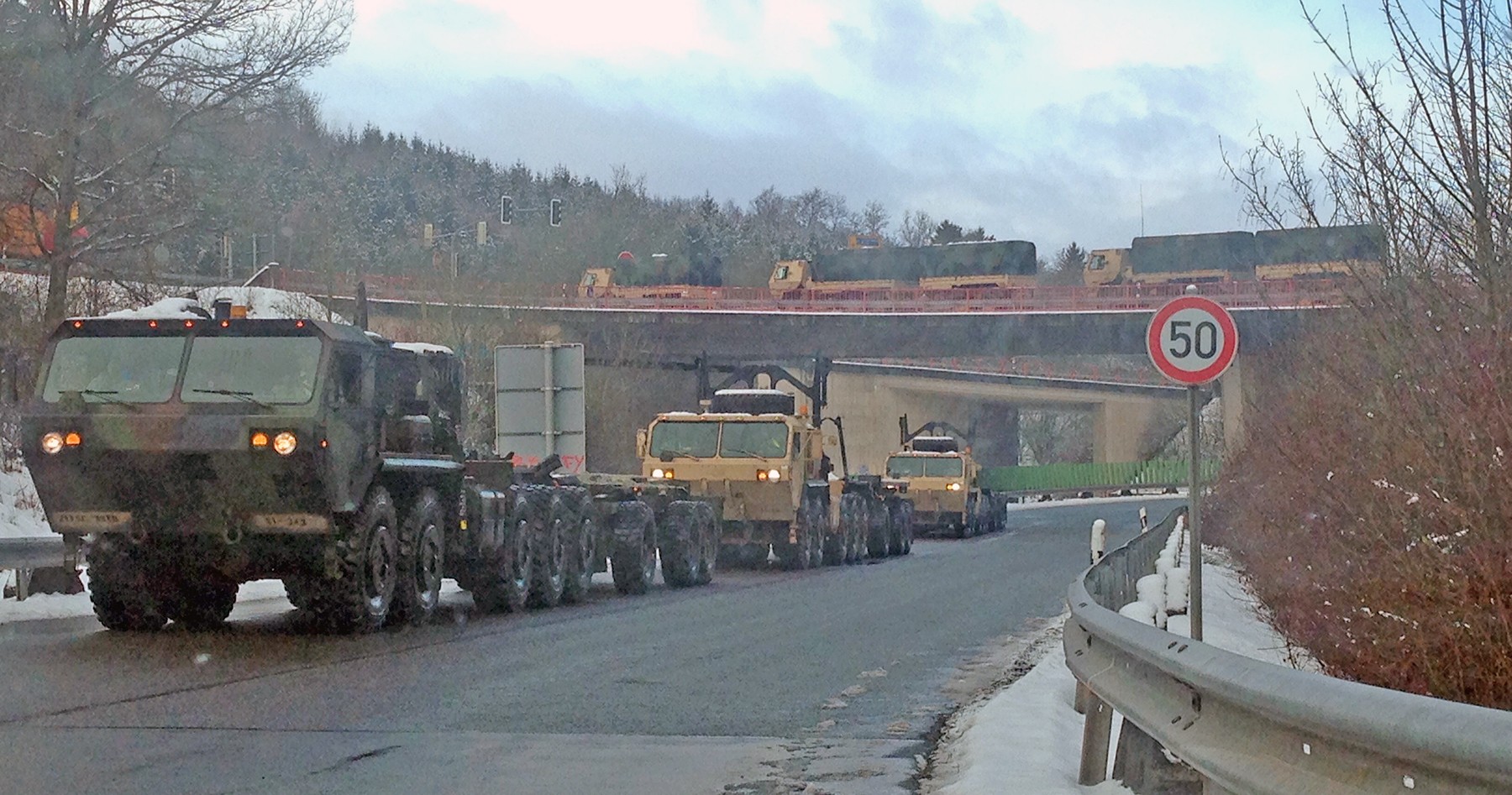
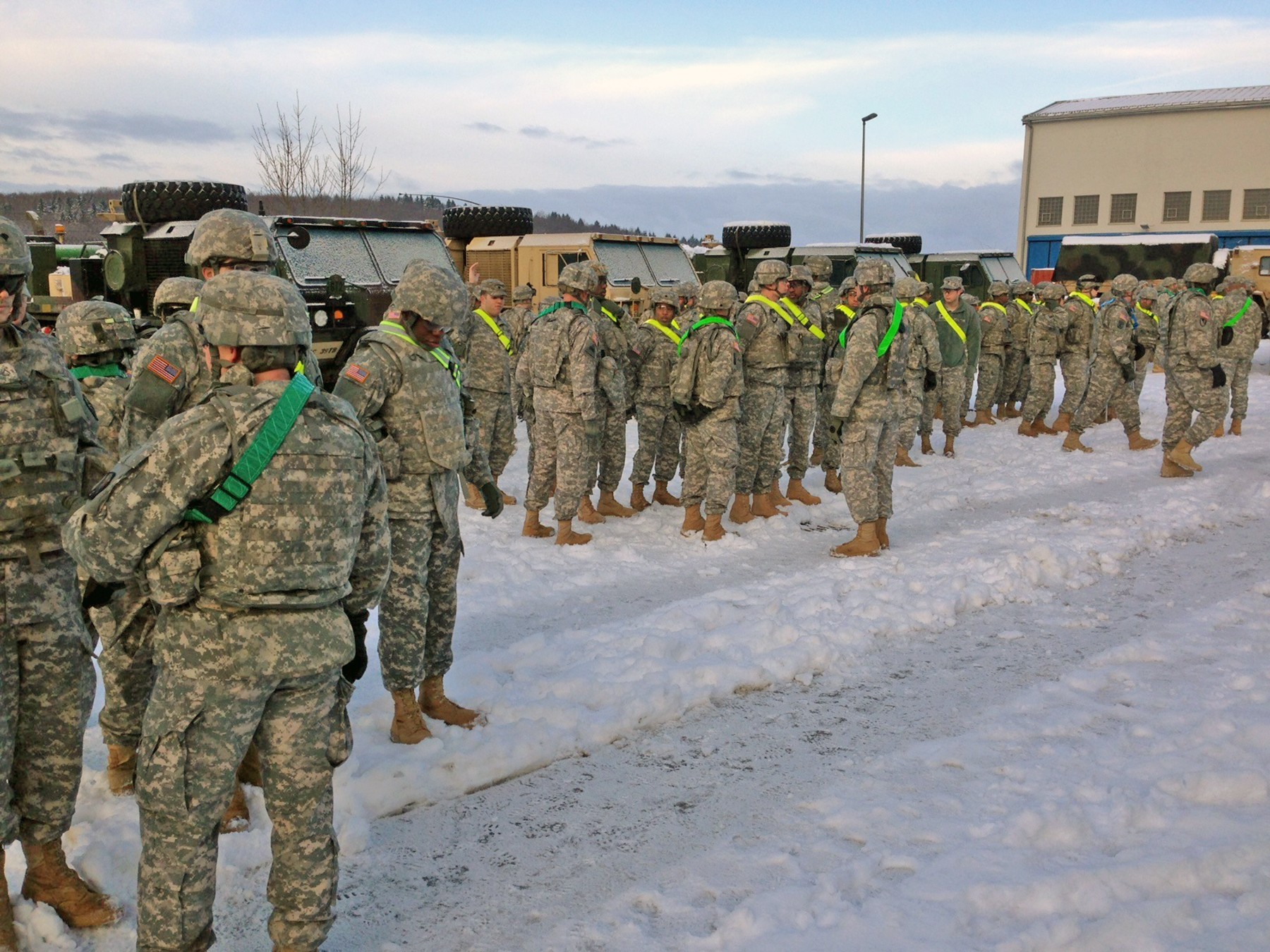
BAUMHOLDER, Germany (Feb. 6, 2015) -- In a thorough and demanding assessment of unit readiness and skill proficiency, Soldiers of the 51st Transportation Company were recently called upon at a moment's notice to dispatch nearly their entire fleet of vehicles in the execution of an Emergency Deployment Readiness Exercise, also known as a Freedom Shock.
The 51st Transportation Company conducted their Freedom Shock, Jan. 27, giving leaders in the company notice the prior night. The significant time constraints encompass the key intent of a Freedom Shock, which is to prepare to move the fleet in support of unified land operations at any time.
Under the guidance of Capt. Alex Brubaker, company commander, platoon officers and non-commissioned officers, or NCOs, prepared all available vehicles for immediate dispatch upon receipt of the commander's order. On the morning of Jan. 27, vehicles departed all company motor pools in multiple platoon-level serials.
Soldiers and vehicles left in their organic order of march, 1st Platoon through 4th Platoon, and a combination of maintenance and headquarters, at intervals of approximately 30 minutes between serials. The platoons merged onto Autobahn A62, traveled briefly down the Autobahn, and returned to Baumholder. While the execution spanned only a few hours, the experience gained and lessons learned from this exercise were monumental.
There is a great deal that can be said about the practicality of Freedom Shocks, especially in a critical theater of operations such as Europe. 1st Lt. Lauren Lybbert, platoon leader for 1st Platoon, affirmed the usefulness of conducting a Freedom Shock, claiming that "one of our most fundamental missions is to be prepared for anything, and that could mean sending out the whole fleet from our area of operations in a very short period of time."
By conducting a Freedom Shock, units can certainly put their skills and preparedness to the test, but there are other critical benefits attached to such an exercise. A Freedom Shock provides commanders with the clear answer to the question all commanders want to know, "which of my vehicles are actually ready to move out right now?" This exercise gives commanders the incontrovertible evidence that vehicles are operational.
Brubaker believes that Freedom Shocks are valuable for testing equipment, but he also believes that units can expand on that initial concept extensively. He advocates for many of the opportunities of Freedom Shocks, claiming that emergency deployment readiness exercises or Freedom Shocks, are invaluable tools in a commander's arsenal.
Conducting Freedom Shocks allows for commanders to test the readiness of equipment and personnel on short notice. It validates a unit's command readiness program testing equipment to ensure assets are fully mission capable. However, it can go much further than that, testing telephonic alert systems, medical readiness, equipment load outs, and that Soldiers have all the appropriate gear required for the mission.
Freedom Shocks also instill confidence in Soldiers and especially NCOs in regards to their leadership abilities. Soldiers can see the high magnitude of such an operation and also get to see first-hand what a critical element they are to the mission and success of the unit. Developing leaders is consistently a key priority for senior leaders. Any opportunity to help develop leader's abilities to command and control transportation elements can surely yield tremendous benefits to the unit.
As the 51st Transportation Company had concluded, a great plan is good, but having well-trained and well-developed leaders to execute that plan is an absolute essential to accomplish any mission.
Social Sharing