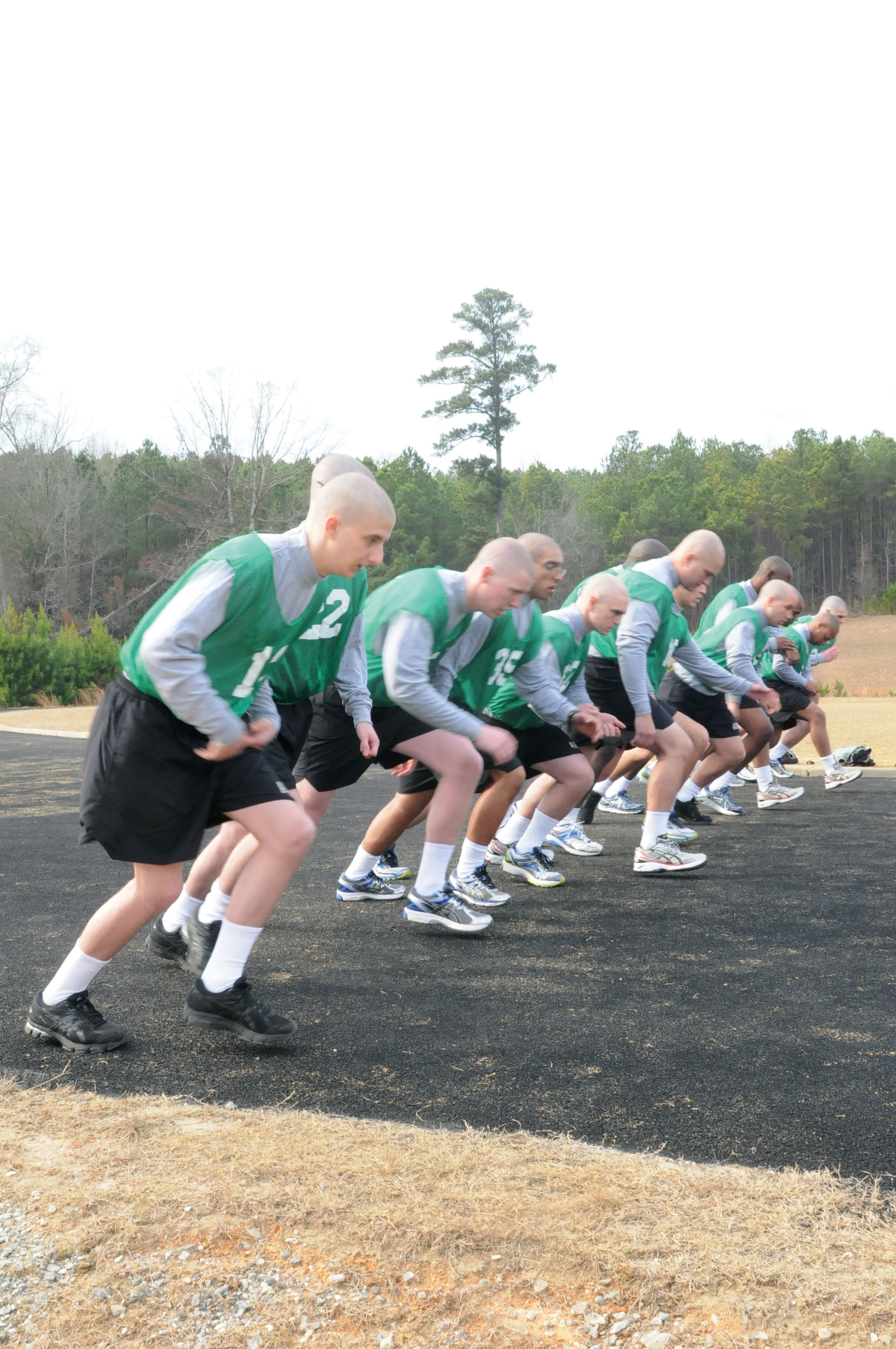
FORT BENNING, Ga., (Jan. 28, 2015) -- With thousands of Soldiers entering the Army each year, the 30th Adjutant General Reception Battalion plays a key role during inprocessing.
Since October, part of that process has included an initial entry training physical resilience enhancement program, which is an effort to reduce training injuries for new Soldiers.
The program begins with the I-PREP assessment, which consists of a one-mile run, a pullup, a deep squat, a trunk stability pushup and a series of pain provocation tests.
Capt. Benjamin Bower, the fitness training unit company commander for 30th AG, said early data shows the assessment is having a positive effect.
"With all the thought that's been put into this, we're doing the best we can to try and identify individuals who may be predisposed or have a higher propensity for injury than somebody else," he said. "There has been some preliminary data we've collected on some of the trainees, but they haven't gotten very far in their training. But, the initial data we've collected is favorable in that those we've identified ... have done better than a comparison group. But, only time will tell."
Participants in the assessment are expected to complete the one-mile run within eight minutes and 30 seconds, and are asked to complete one pullup.
"We wanted something to measure cardiovascular endurance," Bower said. "(The one-mile run is) something that's a very good predictor for somebody's overall level of fitness and their propensity for injury. ... The pullup is a good overall strength assessment. Do they have the upper body and core strength to pull their body weight up over a bar?"
With the functional movements, graders are looking for the way trainees' bodies react to the movements they are asked to do.
"With the deep squat, it's an overhead squat where they hold a dowel rod overhead with their elbows extended and their feet shoulderwidth apart," Bower said. "Their goal is to go down below the 90-degree mark at the knees. We want to see if they're able to maintain the dowel directly in line with their head, hips and feet. Are they able to break the 90 degrees at their knees? Are they able to keep their feet pointed straight forward like they're on rails? Is their weight bearing symmetrical?"
The trunk stability pushup, meanwhile, is intended to measure the quality of body movement rather than the number of pushups one is able to perform.
"The trunk stability pushup is more a measure of trunk stability than it is upper body strength," Bower said. "The hand placement is a little different than the traditional pushup. The hands should be placed shoulderwidth apart. The thumbs should be at the level of the temple with feet together. They're doing a pushup from that position, which has sort of a longer lever between the feet and the hands than a traditional pushup. It's more challenging on the core."
Trainees are graded on a scale from zero to three for the movements, with zeros assigned if trainees report pain during a movement and threes assigned if trainees execute the movement perfectly.
If a trainee does not receive a three, they are asked to repeat the movement from an alternate position. If the movement is executed adequately from the alternate position, the trainee receives a two. If the movement is still awkward, the trainee receives a one.
Low scores on the movement, reporting pain during the pain provocation tests, inability to perform a pullup and a poor time on the one-mile run could cause trainees to be entered into the I-PREP program, which is a three-week effort to get trainees at risk for injury prepared for basic training.
"Myself, our battalion commander, representatives from the Directorate of Training and Doctrine and Human Dimension, a physical therapist, musculoskeletal action team leaders from the 194th Armored Brigade and 198th Infantry Brigade and a Warrior Athletic Trainer sit in a room to go through the data we've collected," Bower said. "We start looking at run times that are around eight minutes and 30 seconds for the one-mile run to see if anybody had pain with any of the movements or a particularly low score on any of the movements, specifically the deep squat. We also take into account their past medical and surgical history as well. Have they lost a large amount of weight in a short period of time, say 35 pounds in six months or 70 pounds in a year? Those are all red flags that are going to cause us to have a discussion about that individual. We go name by name and look at their performance to determine if they need to come into the program."
Editor's note: This is the first in a two-part series on I-PREP. A story in next week's Bayonet & Saber will cover the program some trainees are entered into after the assessment is complete.
Social Sharing