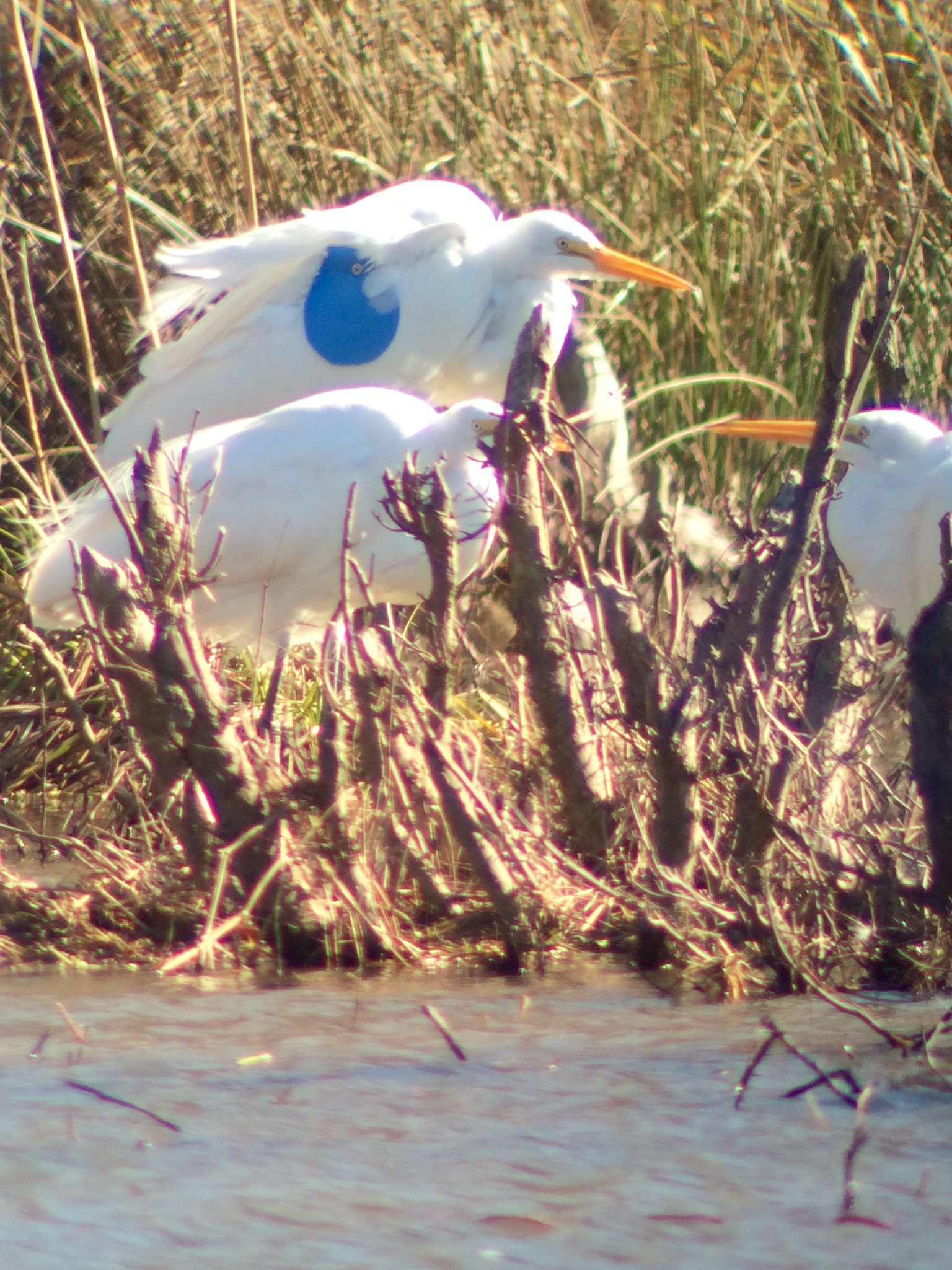
FORT JACKSON, S.C. (Jan. 22, 2015) -- Although it is common to see great egrets on Fort Jackson ponds and lakes, seeing a flock of 60 of these large, all-white, three-foot tall wading birds concentrated on Semmes Lake is unprecedented. This large concentration of egrets attracted the attention of Directorate of Public Works Wildlife Branch employees.
Wildlife Technician Josh Arrants was observing the birds in early January to count how many there were and determine on what they were feeding when one of the egrets caught his attention.
"As the bird turned, I could clearly see a large round blue tag on its right wing," Arrants said. "Usually, these tags have numbers or letters on them that allow the birds to be individually identified, but this tag was solid blue."
Returning to the office and conferring with biologists there, it was decided that an Internet search may help locate who was tagging great egrets. It did not take long to locate an article about, and a contact for, tagging of young flightless great egrets from the Great Lakes in Ontario, Canada, and in New York Harbor.
Dr. Chip Weseloh, formerly with the Canadian Wildlife Service; Dr. Susan Elbin, New York City Audubon; and colleagues have been tagging great egrets since 2001 with more than 2,000 egrets marked to date. The ornithologists are studying the species' migration patterns to learn in part where the birds are overwintering. Many have been seen and reported from Cuba, Jamaica, the Dominican Republic and the Lesser Antilles, in addition to sites in the eastern United States.
An email to Weseloh describing the Semmes Lake egret brought a quick response.
"It appears the bird you are reporting was tagged this year. In that case it was tagged either on June 19 or 26, 2014, at Nottawasaga Island, near Collingwood, Ontario, a 1.5-hour drive north northwest of Toronto at the south end of Georgian Bay, Lake Huron," Weseloh wrote.
It is speculated that the bird probably was inadvertently tagged with the blue tag placed inside outward so the number cannot be seen. Sometimes mistakes are made when tagging birds in a rookery, especially since young nestling egrets instinctively use their long pointed bills to stab at the eyes of researchers handling them.
Christy Hand, a wading bird biologist with the South Carolina Department of Natural Resources' Wildlife and Freshwater Fisheries Division, was also contacted about the Semmes Lake egret. She said that a Columbia photographer had photographed a blue-tagged great egret on the afternoon of Dec. 8 in Gills Creek near the Woodlake Drive Bridge. This location is just west of I-77 from Fort Jackson, and this bird is most probably the same egret that is now frequenting Semmes Lake.
In an effort to assist with research being done on great egret migration patterns, DPW Wildlife Branch employees will continue to periodically monitor the flock of birds on Semmes Lake and stay in touch with researchers. Information on how long the tagged bird stays on Fort Jackson and if the large concentration of egrets remains is important to researchers and contributes to the international knowledge of great egret migration and dispersal.
Social Sharing