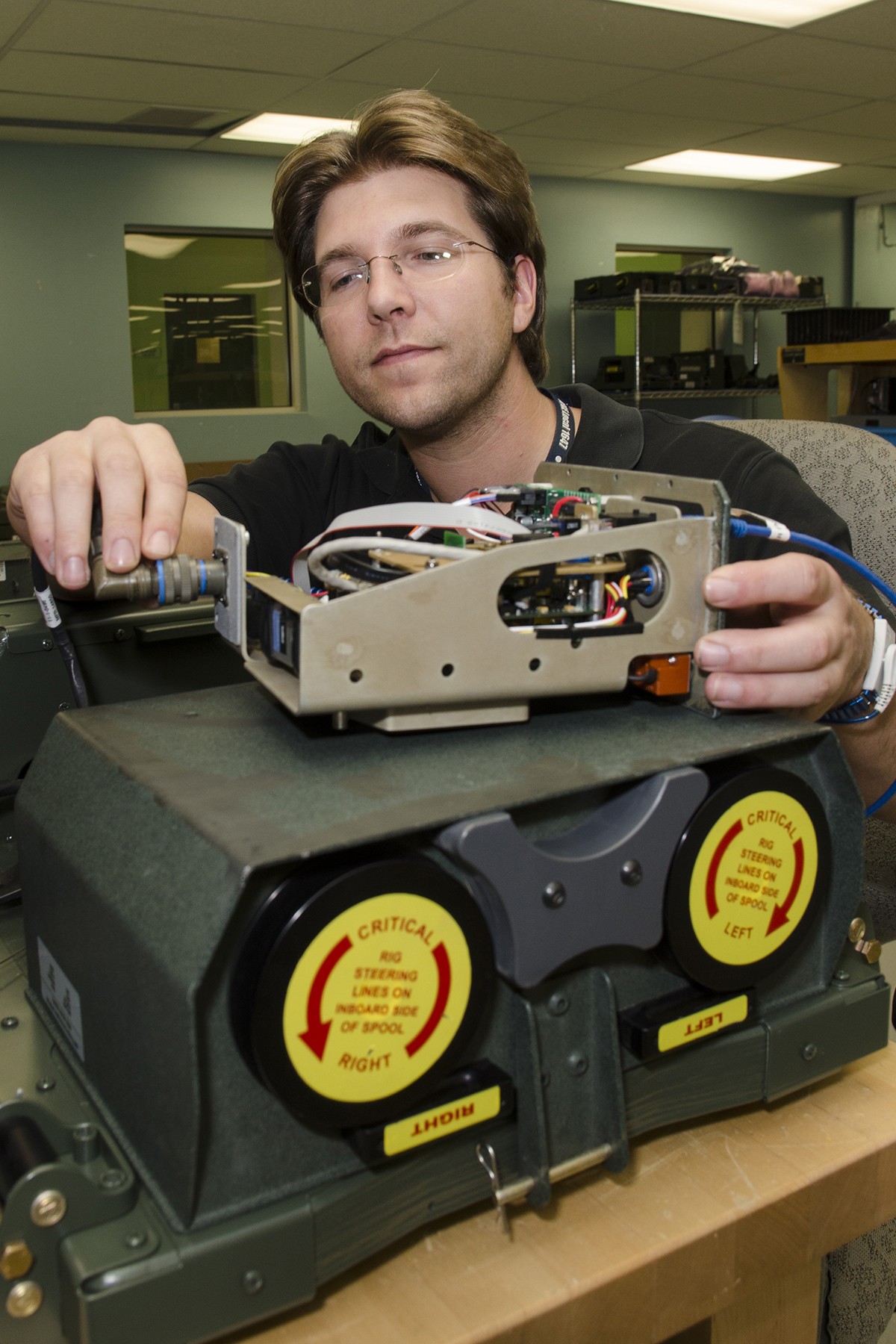

TOBYHANNA ARMY DEPOT, Pa. -- Personnel here, supporting U.S. Central Command (CENTCOM) overseas operations, upgraded and delivered more than 40 Modular Autonomous Guidance Units (MAGU) for the Joint Precision Air Drop System (JPADS) in less than 10 days.
CENTCOM needed MAGUs to address emergency resupply in its theater of operation, according to U.S. Army's Program Manager Force Sustainment Systems. Officials turned to Tobyhanna knowing quick turn-around and high-quality work was well within the depot's proven capabilities.
The JPAD system is designed to bring the same accuracy to the airlift community that strike pilots have enjoyed since the inception of GPS-guided weapons. The air drop systems are used by Air Force cargo aircraft to precisely deliver munitions and humanitarian supplies to restive areas across CENTCOM's area of responsibility.
"Our quick response with JPADS support to critical Combatant Commander frontline requirements is a prime example of the strength, relevance and warfighter focus of the organic industrial base," said Col. Gerhard P. R. Schröter, depot commander.
Team Tobyhanna technicians, logisticians, production expediters, quality inspectors and Defense Logistics Agency Distribution Tobyhanna (DLA) representatives worked closely with the product manager (PM) to identify, upgrade and ready the MAGUs for CENTCOM use.
"The team received the request from the PM in mid-October," said Tom Sweeney, logistics management specialist. "Management set the stage; technicians upgraded the software and avionics, tested the systems and had the units ready to go within seven days."
"Everyone pitched in," said Tom Yanochko, electronics mechanic. "Personnel from management to production to the technicians on the floor were involved and motivated to get the mission accomplished."
The brain of the system is a recoverable MAGU, which houses a battery, GPS, avionics and an actuator assembly. When dropped out of an aircraft from high altitude, the guidance system and actuators drive steerable parachutes -- turning them one direction or another -- to position the load over the desired point of impact. A high altitude release increases safety for troops on the ground and keeps aircraft well out of range of any threat from the ground.
Technicians from the Command, Control, Communication, Computer, Intelligence, Surveillance and Reconnaissance (C4ISR) Directorate's Flight Control and Navigation Systems Section repaired, tested and inspected the MAGU components, and upgraded system software, to ensure the parachute-laden provisions will arrive at the landing zone.
Sweeney added that the DLA supply chain played a significant role. Once they received word, the team pulled previously Reset MAGUs from stock and delivered them to the shop within six hours. "Nance Rice from DLA and Robbie Wynn from the depot made things happen very quickly," he said.
"The MAGUs have arrived in theater and are ready for use," he said. The team is readying a second set of upgraded MAGUs to respond to possible future requirements.
The depot began the JPADS Fleet Modernization program late in 2012 to fulfill an upgrade request and redesign effort from the product manager. This effort, apart from the JPADS Reset request from the Tank and Armament Command (TACOM), involves more than 1,300 Army systems that consist of a modular redesign with several directorates involved in fabricating brackets, mounts and enclosures, installing key original components and adding new electronics. The TACOM reset effort, which began in 2014, was established to reset units returning from overseas operations.
Tobyhanna Army Depot is a recognized leader in providing world-class logistics support for C4ISR Systems across the Department of Defense. Tobyhanna's Corporate Philosophy, dedicated work force and electronics expertise ensure the depot is the Joint C4ISR provider of choice for all branches of the Armed Forces and industry partners.
Tobyhanna's unparalleled capabilities include full-spectrum support for sustainment, overhaul and repair, fabrication and manufacturing, engineering design and development, systems integration, technology insertion, modification, and global field support to warfighters.
About 3,100 personnel are employed at Tobyhanna, which is located in the Pocono Mountains of northeastern Pennsylvania. Tobyhanna Army Depot is part of the U.S. Army Communications-Electronics Command. Headquartered at Aberdeen Proving Ground, Md., the command's mission is to research, develop, acquire, field and sustain communications, command, control computer, intelligence, electronic warfare and sensors capabilities for the Armed Forces.
Social Sharing