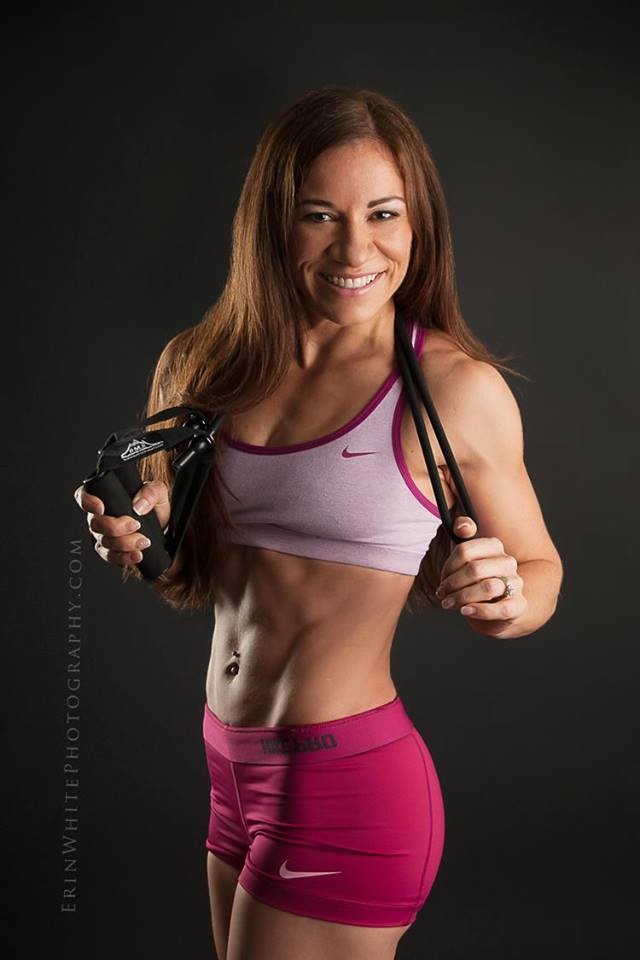
WIESBADEN, Germany -- In a sparkly pink bikini and Cinderella-like high heels, Carmen Diaz-Ortiz walked onstage, under bright lights, and presented her physique to a panel of figure competition judges.
As a self-described shy woman, Diaz-Ortiz never planned to enter a fitness competition. But last month, she competed in, and won, the figure category at her first show, the Fitness Universe Europe Championships in Barcelona, Spain.
It felt awesome to be onstage, said Diaz-Ortiz.
"I was so shy and nervous, but as soon as I stepped out there, everything changed," she said. "Everyone was cheering for me, and that gave me adrenaline."
When the judges announced Diaz-Ortiz as the figure category winner, she thought, "Oh my God, I did it!"
With the win, Diaz-Ortiz earned her International Federation of Bodybuilding and Fitness professional card, enabling her to compete in additional federations and future competitions.
Figure contests, introduced by the National Physique Committee in 2001, are relatively new. By comparison, traditional female bodybuilding has been around since 1985. The figure class was introduced when popularity of female bodybuilding began to decline, in terms of participants and fans, according to Amanda Kotel, a professional fitness model and trainer.
The figure category is one of four in female fitness competitions -- bikini, figure, physique and bodybuilding -- in that order, with regards to muscle size, said Jessica Isaacs, Diaz-Ortiz's coach and nutritionist.
"With figure, the athlete should bring an athletic, muscular, trained physique, but should not be massive and have bulging veins," she said. "Women are also expected to bring a polished appearance -- hair done, makeup done, nails done."
Isaacs, a Team Armed Forces Europe coach, started working with Diaz-Ortiz in April, after she joined the 24-person, all Department of Defense-affiliated fitness team. Diaz-Ortiz is a U.S. Army Corps of Engineers Europe District security assistant and military spouse.
Diaz-Ortiz was already fit when she auditioned for the team -- doing P90X, Insanity and CrossFit -- but she hadn't considered taking her training to a competitive level. A friend, Annett Rodriguez, urged Diaz-Ortiz, the 37-year-old native of Barranquitas, Puerto Rico, to try out for the team.
"I went to the casting and that was really nerve-wracking," Diaz-Ortiz said. "I had to go stand in front of all the teammates, there were about 20, and they looked at me and judged me.
"Then they voted and decided I was in."
There were many men and women at the casting call, but the team loved Diaz-Ortiz, Isaacs said.
"Her determination and pleasant attitude encouraged others," she said. "While this is a competitive sport, Team Armed Forces Europe is a family where everyone roots for one another's success."
Once Diaz-Ortiz joined, Isaacs developed training and nutritional plans for her.
Athletes are expected to spend a few hours a day in the gym, most days of the week, Isaacs said.
"Competition requires 10 to 12 weeks of preparation," she said.
For the first 10 weeks, Diaz-Ortiz spent an hour and a half weightlifting each afternoon. During the final two weeks leading up to the event, she switched to two workouts a day -- cardiovascular exercise in the morning and weight training in the afternoon.
While this may sound like a lot of gym time, the physical training is rarely the hard part for athletes, Isaacs said.
"The nutrition is crucial. While plans vary greatly, athletes eat five or more times a day, and meals are measured exactly to the ounce or gram. Timing of meals is also important," she said.
Diaz-Ortiz consumed six meals a day, including lots of lean protein -- turkey, chicken and fish -- and carbohydrates, like broccoli and spinach. A typical breakfast was oatmeal or egg whites, Diaz-Ortiz said.
"I ate those types of healthy foods anyway, and cutting sugar and salt was not tough for me," she said. "But if you like to have a glass of wine -- no, that is not OK."
Due to the demanding, regimented training and nutrition schedules, athletes frequently pass up social events, eating out and travel. Diaz-Ortiz was prepared to do this.
"She sucked it up and did the work. She never made excuses and just got it done," Isaacs said.
Occasionally, Diaz-Ortiz could join her friends for a night out, provided she brought her own food. But more frequently, she would decline invitations to social gatherings.
"It was hard when my friends would say, 'Let's go out to eat,' and I had to say, 'No, I have to go work out,'" Diaz-Ortiz said. "But it was worth it, and my friends understood my goal and supported me."
As competition day approached, Diaz-Ortiz kept her focus. Many athletes complain and make excuses toward the end of their training, but she was the exception to the rule, Isaacs said.
"She did everything I asked of her and still wanted to do more. When Carmen stepped onstage, she brought a world-class physique and set a high standard for the team," she added.
While figure competitions vary from federation to federation, generally, each competitor takes the stage individually to pose and show off her physique. Then, all line up onstage together and pose to display their fronts, sides and backs to the judges. Competitors are compared to one another, and ultimately, the athlete with the best symmetrical physique and presentation takes first place.
At the Fitness Universe Europe Championships 2014, that athlete was Diaz-Ortiz.
As her competition-ready spray tan and manicure begin to fade, she already has her eye on future competitions.
"I am going to do Fitness Helsinki in March and after that, I plan to go to the U.S. to compete in another show," she said.
"I hope I can inspire many other women by doing this. Sometimes, military spouses feel they have to just sit at home and do housework. No, there is other stuff you can do -- get out there and do it."
Social Sharing