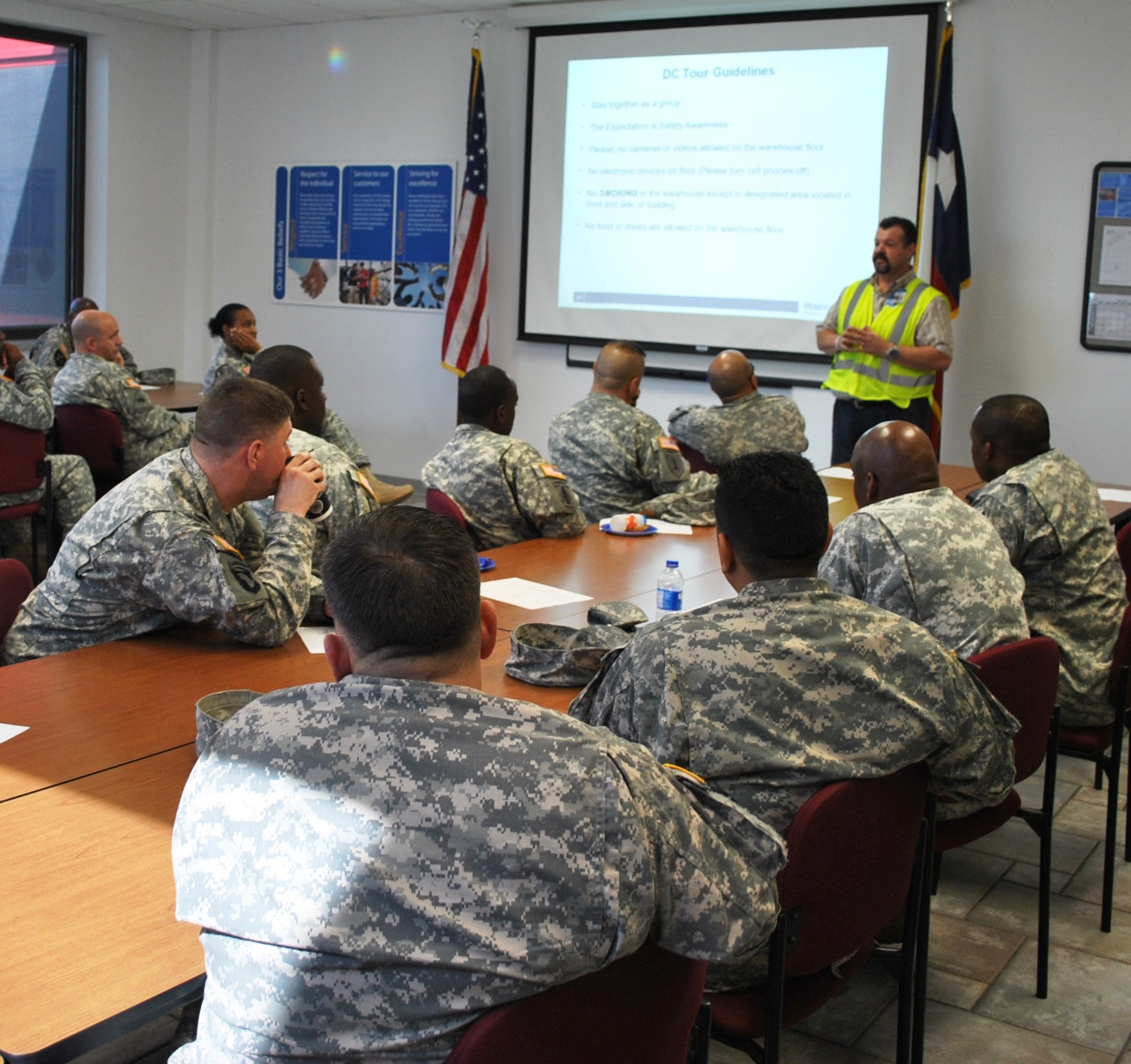
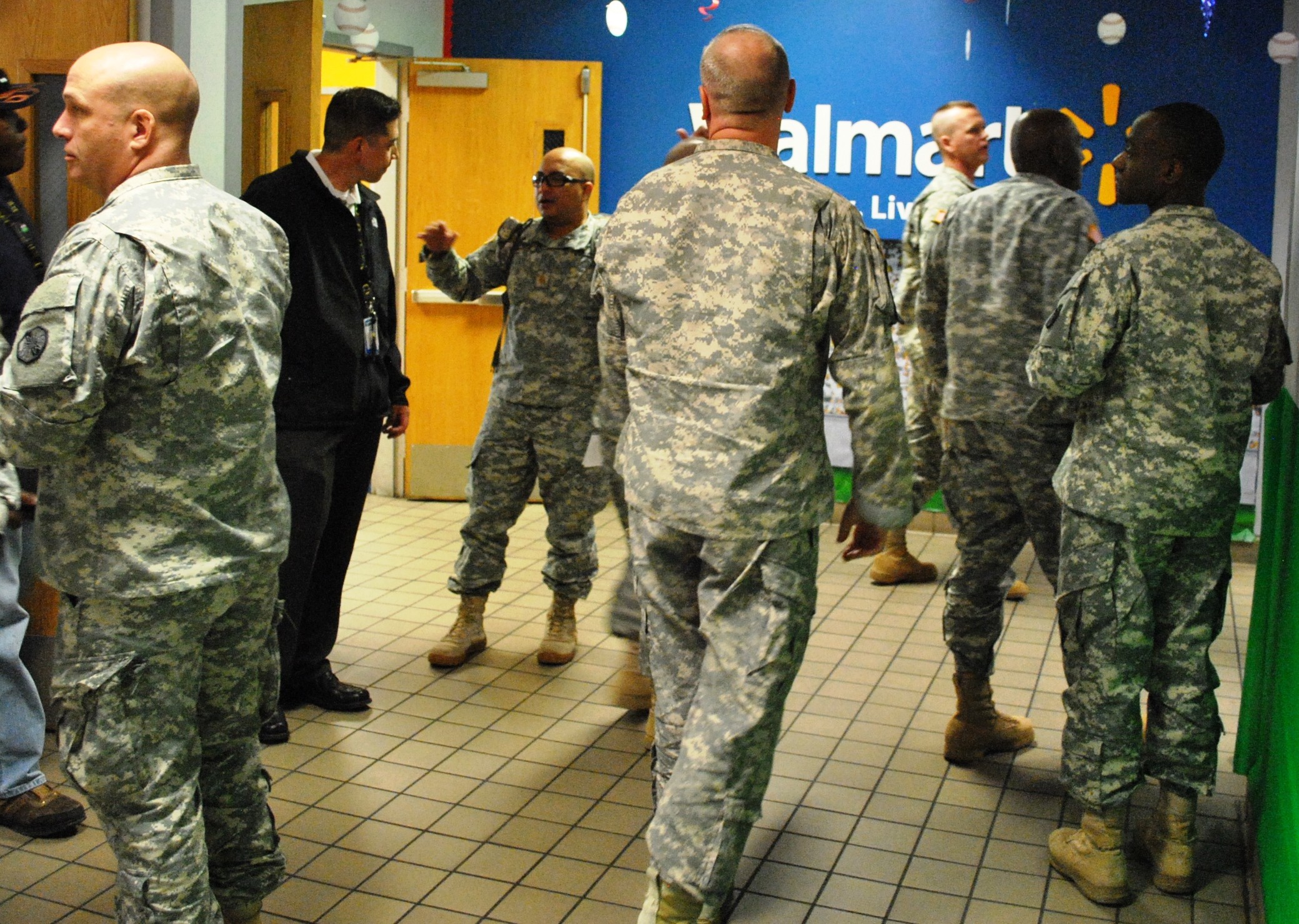

TEMPLE, Texas - Sustainment leaders from Headquarters, Headquarters Company, 13th Sustainment Command (Expeditionary) took the opportunity to tour the Wal-Mart Distribution Center in Temple, May 15.
Mr. Ron Johnson, general manager of the massive facility, led the tour and gave an extensive brief about the operations they conduct on a constant basis. With approximately $4 million in perishable and non-perishable goods moving to 140 regional Wal-Mart stores, their mission is similar to what Army logistics conducts moving every type of sustainment life support in peacetime and combat.
Col. Keith Sledd, deputy commander, 13th SC(E), emphasized the importance of studying how private industry completes their missions in contrast to the military.
"The corporate world often allows for faster innovation because their more efficient partly due to being profit-based," Sledd said. "So, going out to see a civilian entity allows us to get some good ideas we may be able to apply in the military to try and improve our processes and systems."
As the group of about 40 officers and non-commissioned officers from the 13th SC(E) split into two groups, one being led through the "dry goods" side of the warehouse and the other the "perishable goods" side, two other Wal-Mart employees explained the detailed process of getting hundreds of thousands of pounds of product off their shelves in the warehouse into consumer hands all within typically 48-72 hours.
Johnson explained that moving a perishable good such as ice cream from the factory it originates from anywhere in America to their distribution center and on to the retail store is a massive undertaking. The product must stay entirely frozen while moving in trucks, on the various electric carts carrying pallets of goods across the warehouse floor, and back onto a Wal-Mart truck to be shipped to its final location. If the product at any point becomes unfrozen, the product cannot be sold and becomes waste. In turn, wasted product will not turn profit, and the mission fails.
The sustainment community for the Army operates in a similar fashion in order to constantly supply troops with the multitude of various products that keep the force prepared for any mission they are handed.
"The Soldiers that went today got to see how civilian enterprise does business. In some ways, we're after the same thing, focusing on efficiency and effectiveness," said Sledd. "They can see how they (Wal-Mart) may have done it, implement those same systems with a different technology, and try to emulate that process where possible to improve our ability to support the war fighter."
Currently, Wal-Mart has five distribution centers in Texas. The center in Temple supports retail stores in Austin, San Antonio, across Central Texas, and through the Rio Grande Valley. Everyday Wal-Mart trucks can be seen on Texas highways, and across America, transporting their goods in a detailed, time-sensitive manner. According to Johnson they are striving to exceed government standards set forth for their industry and achieve their goals almost flawlessly.
Wal-Mart also tracks the hiring of military veterans across the corporation. At the Temple Distribution Center, they currently employ about 180 veterans. Johnson says they recognize them as often as possible for their service.
Social Sharing