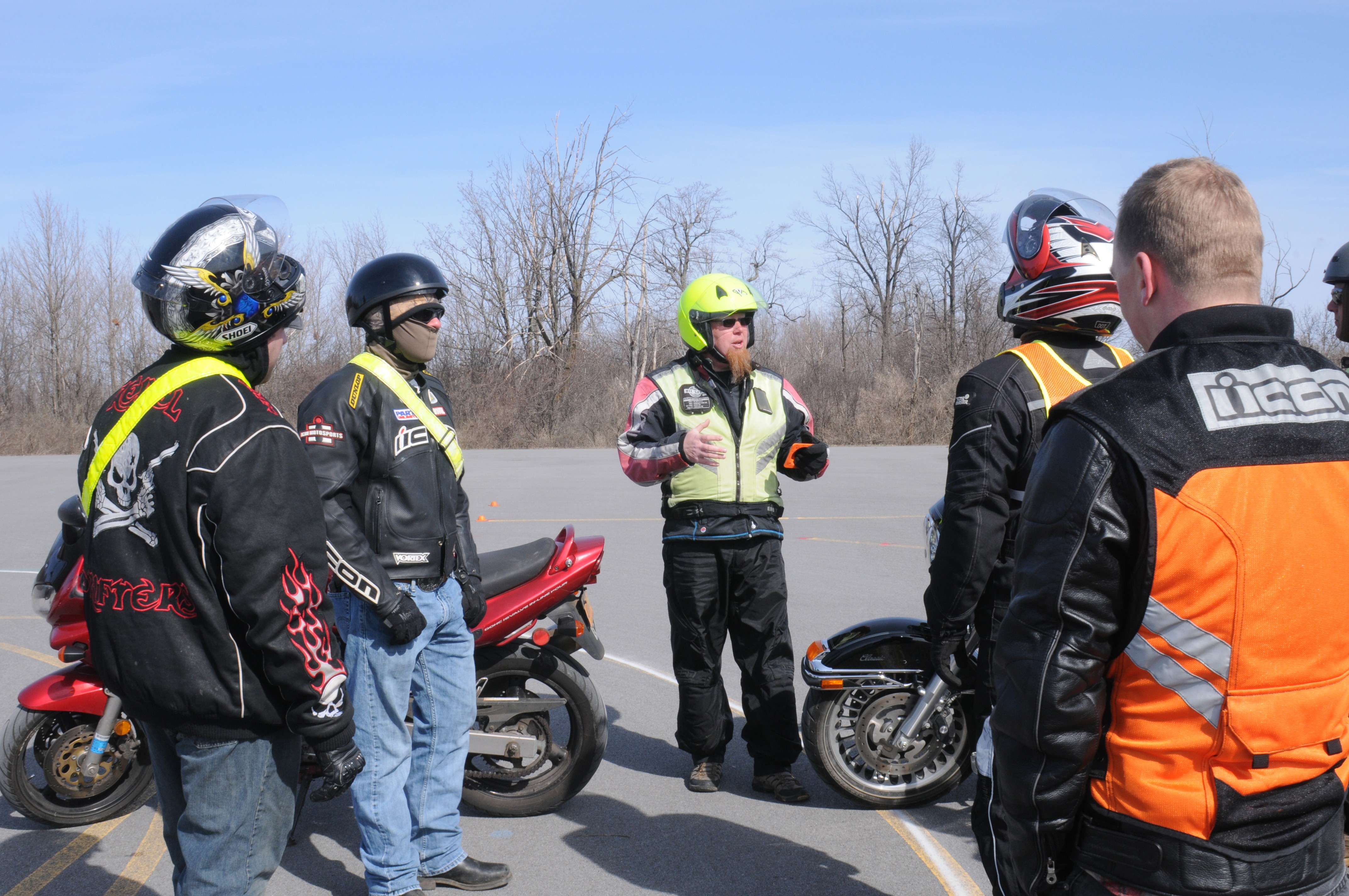

FORT DRUM, N.Y. -- It was just over 20 degrees when the motorcycles came rumbling onto the training range across from Clark Hall on April 17. Six riders arrived to take the Experienced Riders Course in anticipation of the upcoming season.
The Soldiers easily maneuvered through cones and performed the required tasks before graduating from the half-day course.
Jim Farney, one of the instructors from the Command Safety Office's Army Traffic Safety Training / Motorcycle Driving Safety programs, was on hand to ensure the riders had some fun and received important refresher training.
Motorcycle training is required for all active-duty Soldiers who wish to ride motorcycles on or off the installation, according to Army Regulation 385-10.
The program offers a Basic Rider Course, and once every five years, riders must take the Experienced Rider Course or the Military Sport Bike Rider Course -- depending on the type of motorcycle they own.
The Basic Rider Course is a three-day class that combines classroom instruction and hands-on training. The class is limited to 12 Soldiers. During classroom instruction, students learn ways to minimize risk and handle different situations they may encounter on the road.
The training provides the foundational knowledge of motorcycle operation and strategies to reduce risk, Farney said.
Riders also learn what required personal protective equipment they must wear, which includes:
*Long-sleeved shirt or jacket with a minimum of 40 inches of reflective material.
*Long pants.
*Sturdy, over-the-ankle shoes or boots.
*Full-fingered protective gloves.
*Department of Transportation-approved helmet that fastens under the chin.
*Helmet with face shield or wraparound eye protection.
Instructors bring a variety of training motorcycles -- dual-sport, sport bikes, standard and cruisers -- to the hands-on training and performance evaluation portion of the course. Instructors coach the students to help them develop the basic control skills required to ride, which include clutch / throttle control, straight-line riding, stopping, turning and shifting. Later, students learn more advanced skills, like stopping quickly, cornering and swerving.
"Even as these new riders hit the streets, they are still inexperienced when it comes to recognizing specific hazards," said Joseph Semones, Command Safety Office director - rear and garrison safety director. "For instance, when negotiating a curve, slower speeds are required. (However), due to the gravel and sand left from the harsh winter, an even slower speed is required to prevent the bike from sliding from beneath the rider or the rider losing control."
During the Experienced Rider and Sport Bike courses, Soldiers receive refresher training to make sure they are always on their game when they hit the road, Farney said.
"The Experienced Rider Course is a combination of mentoring and assessment," he said. "This course is conducted on the individual's own motorcycle. Since completing the basic course, students should have transitioned those skills to their own machine and built on them in their real-world experience."
The Sport Bike Course targets riders in the demographic most often involved in crashes and fatalities in the military -- often involving high rates of speed, Farney added.
"Students are challenged to gain a better understanding of the capabilities of their motorcycles, and it emphasizes control and precision -- not speed," he explained. "Many newer sport bike riders have found the speed component of their motorcycle, but (they) are not fully aware of the remaining capabilities of their motorcycle and often are riding a piece of equipment that exceeds their experience level.
"The course offers them an opportunity to recognize these capabilities," Farney continued. "The classroom section is equally important and focuses on individual experience and skill, and provides a risk assessment of their own riding behavior."
The Safety Office offers motorcycle training course dates through October, although the later classes are weather-dependent. Soldiers can go to https://apps.imcom.army.mil/AIRS/default.aspx to register for upcoming classes.
Another way the Army is trying to help ensure new and experienced riders stay safe is through the Motorcycle Mentorship Program -- an organization every unit should have, Semones added.
The MMP provides an organization for all riders in the unit to create a "supportive environment of responsible motorcycle riding and enjoyment," according to the U.S. Army Combat Readiness / Safety Center. This also promotes safe behavior and supports commanders' accident prevention programs.
For more information about the Army's motorcycle standards, MMP or regulations, visit https://safety.army.mil/mmp/.
For more information about motorcycle safety courses at Fort Drum, call 772-4672.
Social Sharing