FORT DRUM, N.Y. -- It's often said that a truly effective teacher is one who continually seeks out opportunities to further his or her own learning. A hunger for knowledge and a desire to present that knowledge in the most effective manner possible can make the difference between a presenter and a truly inspiring educator.
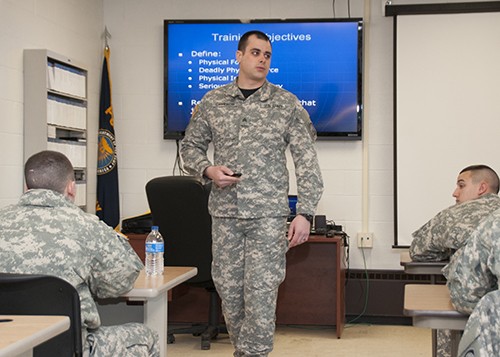
Four Soldiers from Fort Drum Directorate of Emergency Services' Training Division recently learned the value of continuing education when they completed a rigorous New York State Instructor Development Course in Watertown.
These Soldiers have experience in training other military policemen, as they are responsible for teaching the "Guardian Academy," a three-week course required for all incoming MPs and civilian police at Fort Drum.
Plans and Training Officer Dave Shannon said that while all MPs come to Fort Drum with some level of training, the Guardian Academy provides in-depth training.
"We take the knowledge they've been given at their (advanced individual training) and we expand on it, and also tailor it so that they are more locally trained for what we do specifically on Fort Drum," Shannon said. "We teach the military aspect of things, and a lot of the courses that we teach are also aligned with New York state standards."
With the Instructor Development Course in Watertown, Shannon saw an opportunity for the Soldiers to further expand their knowledge base and to gain some valuable training in effective teaching strategies.
The course, offered through the Jefferson County Sheriff's Department, also drew participants from several other local law enforcement agencies. The intensive two-week program covered a wide range of topics, such as defining objectives, structuring and writing lesson plans, effective communication skills, and instructional strategies.
"In 15 years of military service, it's probably the hardest course I've ever been a part of," Staff Sgt. Michael Henning said.
"In the Army, we learn different ways to teach a Soldier. When you take a class like this, they really get into the meat and bones of psychology -- what it takes to learn and how to teach so that people can understand the material."
Sgt. Ross Cameron said that the material on differentiated teaching theories was especially valuable to him.
"As an instructor, the way that you teach should be based upon the way that people learn," Cameron said. "You need to assess whether someone is an auditory learner, a visual learner and so on, and teach the material in a way that they can learn. If you aren't paying attention to that, you can't be an effective instructor."
For the two younger instructors, the course also offered an opportunity to gain experience in presenting material.
The setting, both admitted, was a little bit intimidating at first. Spc. Peter Nolan said that although he was anxious about presenting material to a room full of seasoned law enforcement personnel, he saw it as an opportunity to learn from the wealth of experience these officers possessed.
"Some (of the students) had been police officers since before I could walk. I was very honored that I could even be in the same class as them," Nolan said.
Early in the program, students were expected to complete public speaking drills in order to gain confidence in their skills. Each student drew a word out of a basket and had to present an impromptu speech, one to three minutes long, regarding that word.
"This helped everyone overcome their fear of public speaking," Nolan said. "Just standing up in front of a dozen people and having to speak about something random really made a visible difference in my confidence level over the two-week course."
Difficult written tests were given frequently as the students progressed through the fast-paced course, to ensure that they were retaining the information presented.
"They wanted to make sure that you understood the material, not just that you were able to recite the answers," Cameron said. "That's the way the tests were made up -- if you weren't able to truly understand and explain the material, you wouldn't pass the course."
"They didn't have time to teach things over and over again," he continued. "They taught a subject and then moved on. So you had to pay attention and read up more on your own time."
In addition to 70 hours of class time, each student said he put in numerous hours of study time at home.
"I would come home every day, eat dinner, go to the gym, and come home and review everything we went over in the classroom," Nolan said.
Henning added that he spent approximately 30 hours studying outside of class during the two-week course.
The next portion of the course required students to learn about lesson planning, developing and measuring objectives, and successful teaching methods.
"The Army typically provides the material to be taught," Henning said. "We look through it and present it. In this course, we had to first figure out our objectives. We had to create a lesson plan, and everything that goes with it, to make sure that we met those objectives."
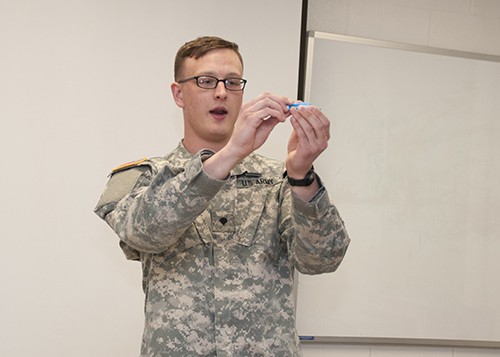
The Instructor Development Course took things to a new level. Students were required to determine objectives, then organize, plan and teach an in-depth 50-minute lesson. They learned about effective communication methods and proper use of visual aids to enhance learning.
Although this was one of the most difficult tasks for him, Spc. Brian Kennedy said he found it to be the most valuable portion of the program.
"Putting the class together and then teaching it was a new experience," Kennedy said. "It made me feel more comfortable standing up in front of people and giving them information, knowing that I had put it all together myself.
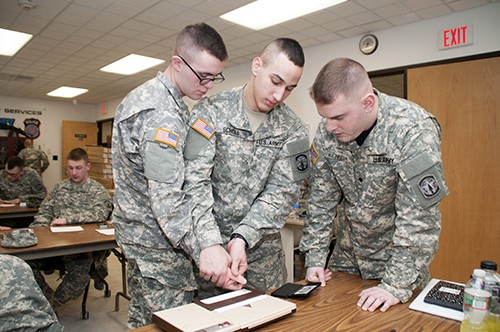
In preparation for the teaching portion of the class, the four Soldiers gathered over the weekend to help one another.
"Each of us practiced teaching our class to make sure that we covered the topic and that we met the time requirement," Henning said. "You can talk for days about one topic. We needed to take the high points and the most important information, and make a one-hour presentation."
The Soldiers provided feedback to one another and coached each other over the course of the weekend. They were determined that every one of them should pass the course.
Kennedy said that the mentoring provided by his peers was vital to his success.
"That's what the Army is all about -- the higher enlisted helping out the lower enlisted," he said. "I also went to college for quite a while, so there were areas I helped them out in. It was all about working together to make sure we all did well."
As representatives of the Army, it was equally important to them to show the community that they were every bit as professional and skilled as their civilian counterparts.
"Our battalion commander and the garrison commander both want the Army to have more visibility in the community," Henning said. "When we go to these classes, the local police agencies are watching us. It was important to us to show our mettle."
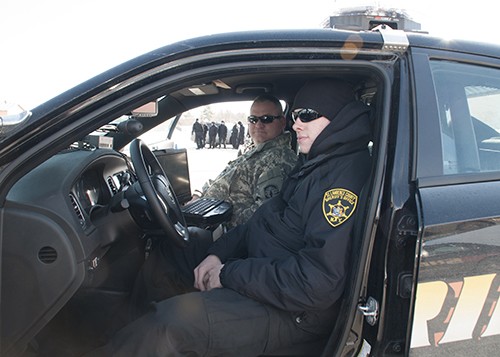
By the time they had completed the course, the Soldiers had exchanged contact information with officers from several other local law enforcement agencies. Having a good working relationship with local law enforcement organizations is mutually beneficial, Cameron said.
"We've had several occasions where we've gotten information about an off-post situation," he said. "To have a good relationship with their officers means that we can communicate openly and there's a deep level of trust among us."
Upon completing the Instructor Development Course, students received certification allowing them to teach general law enforcement topics.
The training instructors from Fort Drum made such a lasting impression on their peers during this course that they have been called upon several times to provide training to local law enforcement agencies.
"Hamburg Police Department SWAT team recently asked for Sgt. Cameron to give them a class on the (Mine-Resistant Ambush Protected Vehicle), because they had one donated to them," Shannon said. "He taught Jefferson County law enforcement how to use the vehicle on Fort Drum, and they recommended him to the Hamburg P.D."
In the next few months, Henning and Cameron will travel south to Kingston on a temporary duty assignment to teach U.S. Army National Guard law enforcement supervisors how to train their subordinates in properly handling active shooter situations. The remainder of the National Guard unit from Kingston will then travel to Fort Drum in August to complete this training.
"We offer a lot of courses to other agencies so that they can come and train with our people," Shannon said. "They see our Soldiers providing excellent training, so when they do training, they often invite them to attend."
Fort Drum's location also makes it an ideal setting for training. Not only does the installation possess a great deal of training space, it means that law enforcement agencies need not send their staff several hours away to receive in-service professional development.
"Some of these local agencies have told us that by our offering even one training event, they have been able to save their entire training budget for the year, just because they didn't have to send (their staff) to Rochester or Utica or beyond," Shannon said.
"They are thankful for the opportunity to get such great training so close to home," he said.
"The Soldiers here are very dedicated," Shannon continued. "They know what the value of the training is, and they are serious about providing it to the best of their abilities."
"We are one of the only installations that the military police Soldiers are certified to instruct law enforcement topics to civilian police officers, whereas most installations call upon the local civilian agencies to train their military police officers," he said.
The training instructors attribute their ability to deliver exemplary training to the high level of support they receive.
"This is a high-caliber program because Todd Julian, chief of law enforcement, Greg Ferguson, the director of emergency services, and Lt. Col. Michelle Goyette, 91st MP battalion commander, provide us with the opportunity for extra training," Henning said.
"They could tell us that they want us only to focus on learning here on post," Cameron said. "The fact that they give us the time, the resources and the training we need to work with other agencies is great, and it means that we can then provide even better training for all the MPs who work on Fort Drum."
Social Sharing