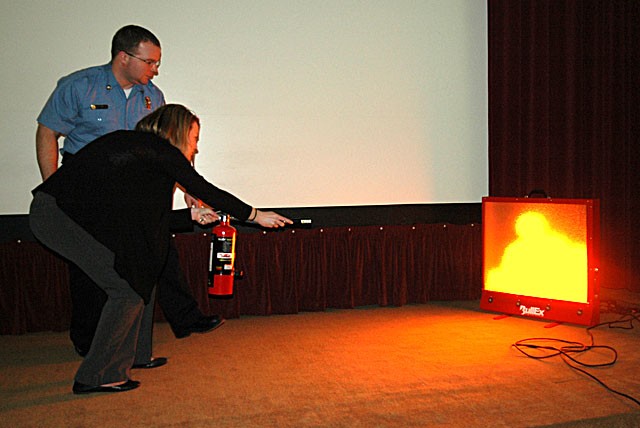
ABERDEEN PROVING GROUND, Md. - Remembering the acronyms "R.A.C.E." and "P.A.S.S." can save lives and property, according to Fire Protection Inspector William Bond from the APG Fire & Emergency Services.
During fire extinguisher training at the APG South conference center March 5, Bond said during a fire, people should remember the R.A.C.E. procedure, which stands for Rescue, Alarm, Confine and Extinguish.
During the ?"Rescue" stage, Bond said people should rescue others only if it is safe to do so. ?"It sounds selfish, but if you don?'t rescue yourself first, who can call for help?" he said.
During the ?"Alarm" stage, alert others to evacuate by yelling, ?"Fire," activate the building?'s fire alarm, and call 911. To prepare for an emergency, Bond recommends that people always take note of their surroundings, including the location?'s emergency exists and fire extinguishers.
During the ?"Confine" stage, close all doors and windows as you exit the building, if it is safe to do so. During the ?"Extinguish" stage, people should assess if the situation is safe to use a fire extinguisher.
Bond said fighting a fire should only be attempted after all R.A.C.E principles have been accomplished and it is safe to do so.
?"Do not ever put yourself in harm?'s way by thinking you have to put a fire out," he said. ?"When in doubt, let the responding firefighters extinguish the fire."
Bond said fire extinguishers should be used to put out small fires only. When using a fire extinguisher remember the four step P.A.S.S. procedure. P.A.S.S. stands for ?"Pull, Aim, Squeeze and Sweep."
During the ?"Pull" phase, users must pull the safety pin out of the extinguisher before it can be used. The safety pin ensures that the extinguisher is not accidently discharged. ?"A fire extinguisher will not work if the safety pin is broken inside the device," he said.
The user should then crouch low and aim the extinguisher nozzle toward the base of the fire, while maintaining a safe distance and squeeze the handle to release the extinguishing agent.
?"This is comparable to pulling the trigger on a water gun," Bond said.
During the ?"Sweep" phase, users should sweep the nozzle in a controlled motion so that most of the extinguishing agent goes onto the fire until the flames appear to be out. When the fire appears to be out back away from the fire.
?"Never turn your back to a fire," he said. ?"Even if you think it is extinguished."
Bond said there are different classes of fire extinguishers for the different types of fires. The most common fire extinguisher is classified as ABC. ABC extinguishers are multi-purpose dry chemical extinguishers sold in stores for home use. Bond recommends users carefully read the device?'s instruction manual before an incident occurs.
He also recommends placing several extinguishers at each level of a home, in plain sight, and no more than five feet above the floor. In addition to putting an extinguisher in the kitchen, garage and on each floor, Bond recommends placing one near the clothing dryer which can catch on fire when people do not clean the lint traps.
Because fire extinguishers can lose air pressure over time, Bond recommends visually inspecting fire extinguishers every month. If the gauge is indicating low air pressure, discard the extinquishers as directed by local waste management facilities. Buy new at any local home store.
The APG Fire & Emergency Services hosts fire prevention training the first Wednesday of every month at the APG South Conference Center, Bldg. E4810. APG Fire & Emergency Services can also provide training for employees on site. For more information call 410-306-0093, or e-mail William.j.bond1.civ@mail.mil. For more information on fire extinguishers visit https://www.usfa.fema.gov/citizens/home_fire_prev/extinguishers.shtm.
Social Sharing