
ANNISTON ARMY DEPOT, Ala -- Accountability is key for Anniston Army Depot's Turbine Drive Train Division and a computerized system, available to employees via their computer access cards, provides the required tracking assistance.
"Every task performed in the shop is tracked with the employee's CAC," said Chris Williams, acting division chief for the Turbine Drive Train Division. "So, once the engine is built and tested, we can go back and see every process. It is complete accountability."
Williams said the level of tracking, down to the serial number of each part used to rebuild or repair the AGT 1500 engines, is unique among the installation's shops.
But, this accountability is only one aspect of the turbine engine shop's efforts to ensure quality and standardization in their products.
Since nearly all processes involved in the disassembly, reclamation and reassembly of turbine engines at the depot take place under one roof, Williams and the rest of the division's workforce are better able to control the flow of materials.
"A few items have to leave our shop, but, most of the engine components are handled here," said Williams.
Overhauling a turbine engine begins with disassembly, where various parts are sorted into two groups: those to be discarded or sold as scrap and parts to be reclaimed.
Parts which can be reused are cleaned in the division's new cleaning line before going to the machining area.
Williams said the machine shop boasts unique capabilities, such as the plasma spray equipment, which adds metal onto components, bringing their thickness back to specifications.
"Powdered metal moves through a flame, which heats it to allow it to adhere properly to the part," said Jason Harvey, machinist leader.
The parts are then smoothed using a grinder, tested to ensure they meet specifications and put into production.
"Specifically, we use this plasma spray capability on low pressure housing, which holds parts spinning up to 30,000 revolutions per minute," said Williams. "When this housing wears down, we can build it up and use it again."
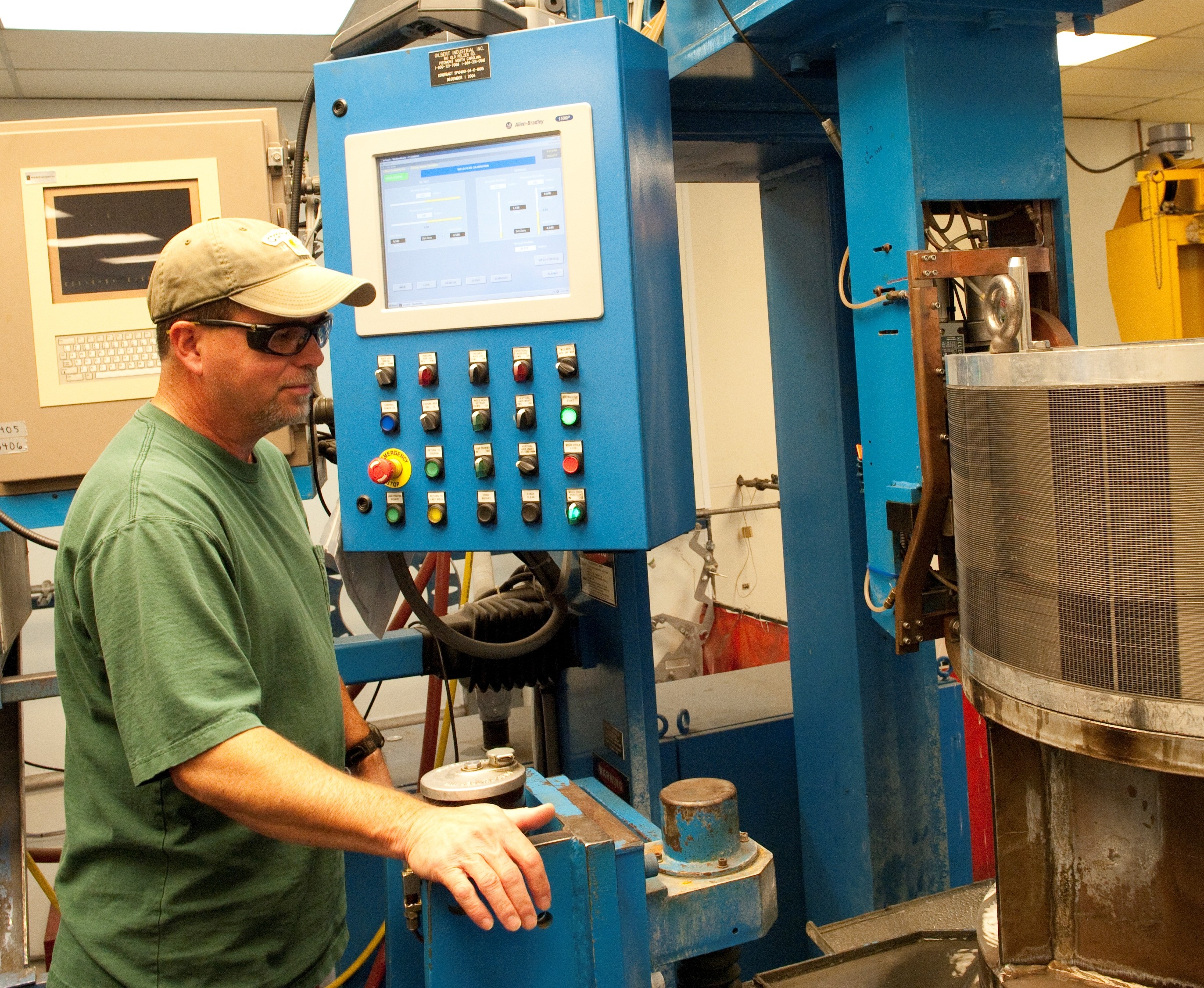
In another machining area, welders use machines to secure the interior and exterior edges of plates together, ensuring air flow within the nearly 46-inch-thick stack of plates, but not allowing the air to escape the core of the rear module.
The Sciaky welding system used creates a pressure weld along the Inconel 625 plates.
The plates, comprised of an alloy of 15 elements, are able to resist the high temperatures they will be exposed to when the engine is in use.
Testing to ensure the rebuilt parts and components are within specifications can be done in the on-site precision measurement lab.
This lab uses coordinate measuring machines capable of measuring to within a thousandth of an inch.
Components, both reclaimed and new, are compiled into kits by Honeywell, a contractor on the property and the original equipment manufacturer for the AGT 1500 turbine engine, which distributes the kits to the point of assembly.
Once each engine is rebuilt, it is ready for testing in one of the state-of-the-art dynamometer test cells.
During testing, according to Williams, the engines are attached to a water brake, which simulates the weight load the engine will be required to pull once it is mated to a transmission and assembled into a M1 Abrams tank.
Tests conducted in the cells check for the engine's oil usage, horsepower and overall performance.
From there, final repairs or corrections to the engine are made and the engine is either mated with a transmission and put into service or "canned" and placed in storage.
Social Sharing