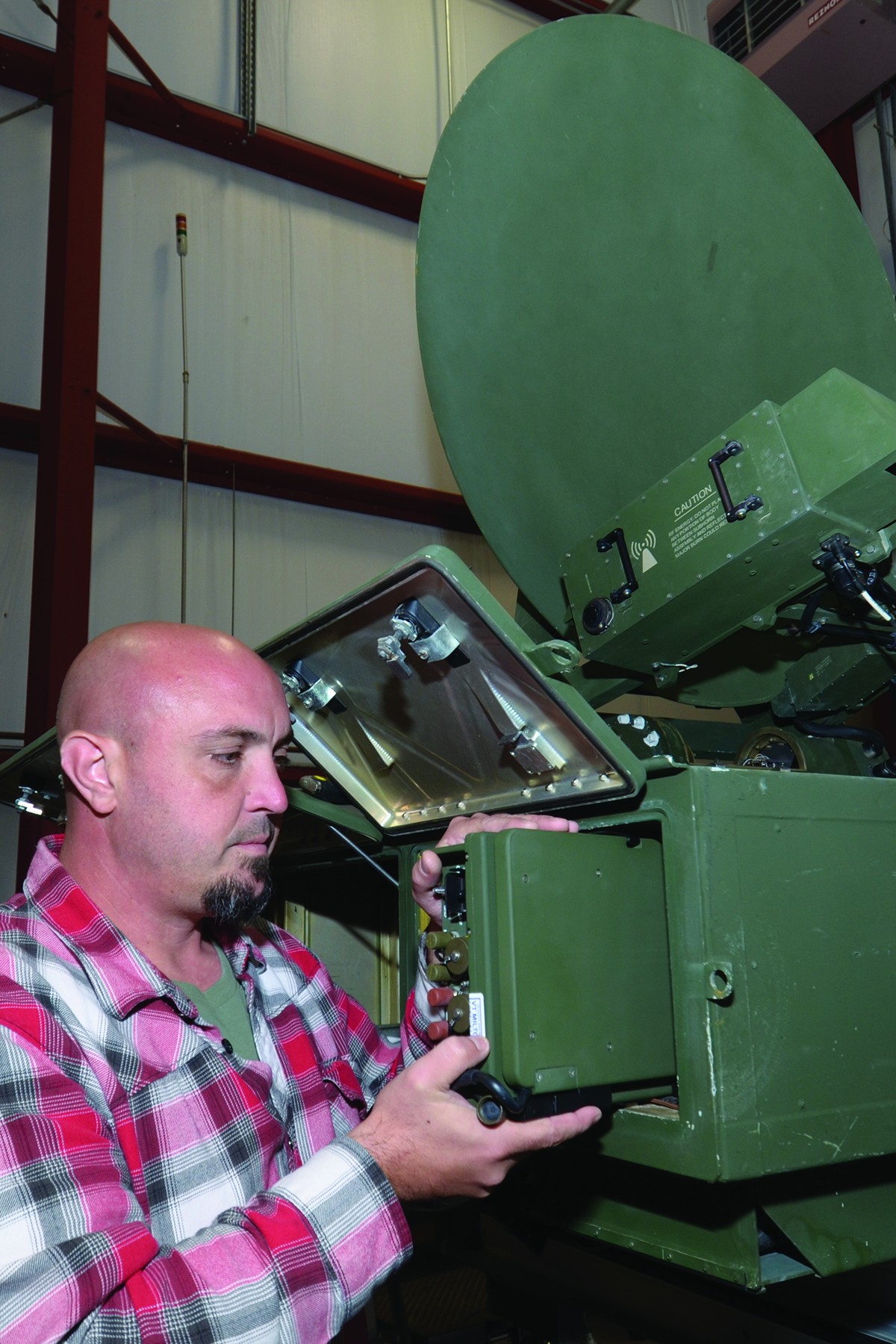
TOBYHANNA ARMY DEPOT, Pa. -- Teamwork and continuous improvement helped reduce the repair cycle time (RCT) on the AN/TSC-154 Secure Mobile Anti-Jam Reliable Tactical Terminal (SMART-T) Reset program.
Collaboration between two Tobyhanna Army Depot directorates proved to be the solution to mission success and warfighter support. SMART-T terminals are Reset by employees in the Communications Systems Directorate's Tactical Satellite (TACSAT) Equipment Branch and the humvees are Reset by workers in the Systems and Integration Support Directorate's Tactical Vehicles Branch. Personnel here became part of the Reset program as early as 2006.
The extremely high frequency (EHF) and advanced extremely high frequency (AEHF) systems are disassembled, refurbished, tested and repaired.
"Every employee in the shop is capable of cradle-to grave support in EHF and AEHF systems. We use Qualification Task Lists to track everyone's training requirements and reflect their capabilities," said Jonathan Miller, TACSAT Branch chief. "Teamwork on the SMART-T is not just good, it's great. The branch has a great group of people working together. The employees have maintained cohesive relationships with other depot personnel to stay on schedule."
The SMART-T is a satellite terminal mounted on a humvee that's capable of translating data without jamming, detection or interception. The system can also provide data beyond the line-of-sight and function as a stand-alone operation when removed from the vehicle. More than 300 systems are in use by the Army, Air Force, Marine Corps, White House and Pentagon.
"It's evident that teamwork in the SMART-T shop and across directorates is the reason we have come such a long way in reducing the RCT. The reduction proves the value of the Lean initiatives we have incorporated into the process," said Lorraine Henry-Hunt, director, Communications Systems Directorate.
In fiscal year 2009, depot officials sponsored a Lean event that focused on the big picture and future of the of the humvee repair process. As a result, incorporating multiple process improvements decreased the RCT from 80 to 65 days. Since then, additional upgrades have cut the RCT to 57 days for the entire system.
By introducing a multi-level Bill of Material (BOM), employees were able to further reduce the RCT for the humvee Reset to 39 days, according to Helen Pietryka, production controller in the Production Management Directorate. She remarked that continuous monitoring of the BOM ensures the quality of the product and promotes flow. "By monitoring the BOM as a team, it not only enables continuous improvement, but allows for cross training between jobs," she said.
Personnel participating in the Lean event noticed that in addition to a high RCT, there were other parts of the process that needed streamlining.
"A new process was developed that provided the standardization and visual management needed to succeed," said John Triboski, productivity improvement specialist. "Simultaneous scheduling of work on the systems and terminals made it possible for technicians to establish the continuity necessary to meet customer requirements."
Other new processes include conducting video and telephone conferences using a live website called the Acquisition Logistics Performance Scorecard (ALPS).
"We're able to maintain constant contact with our customer since improving the communication flow," Miller said. "Weekly meetings with quality assurance specialists, production controllers, engineers, prime shop employees, and the customer have opened the lines of communication, and created an effective cross functional team."
Pietryka pointed out that the ALPS application allows for direct contact with the customer to help bridge the gap and helps the team to evolve.
Continuous process improvement efforts, teamwork and concentration on customer needs have resulted in zero warranty repair returns for more than eight years.
"Depot employees performed every task asked of them with precision and timely excellence, clearly showing a clear knowledge of the equipment and troubleshooting techniques," according to a member of the Marine Corps via an interactive customer evaluation. "I highly recommend working with this team in the future."
Additional customer feedback mentioned the "outstanding job" employees did establishing thorough test procedures for the equipment. "The entire team in the antenna section worked hard and had pride in sending out a quality product," said another Marine.
Production control boards are in place, quality and Lean objectives are posted and sections are taped off, allowing employees to easily track the terminal through the repair process.
With the success of Lean improvements, employee morale has increased.
"At first, shop personnel were hesitant to make the necessary changes. Slowly, they began taking ownership of the process by providing new input and sustaining previous improvements," Triboski said. "Through teamwork, Tobyhanna is able to optimize the use of personnel, provide the best value for customers and secure significant competitive advantage for long-term growth."
Tobyhanna Army Depot is the Defense Department's largest center for the repair, overhaul and fabrication of a wide variety of electronics systems and components, from tactical field radios to the ground terminals for the defense satellite communications network. Tobyhanna's missions support all branches of the Armed Forces.
About 3,700 personnel are employed at Tobyhanna, which is located in the Pocono Mountains of northeastern Pennsylvania. Tobyhanna Army Depot is part of the U.S. Army Communications-Electronics Command. Headquartered at Aberdeen Proving Ground, Md., the command's mission is to research, develop, acquire, field and sustain communications, command, control computer, intelligence, electronic warfare and sensors capabilities for the Armed Forces.
Social Sharing