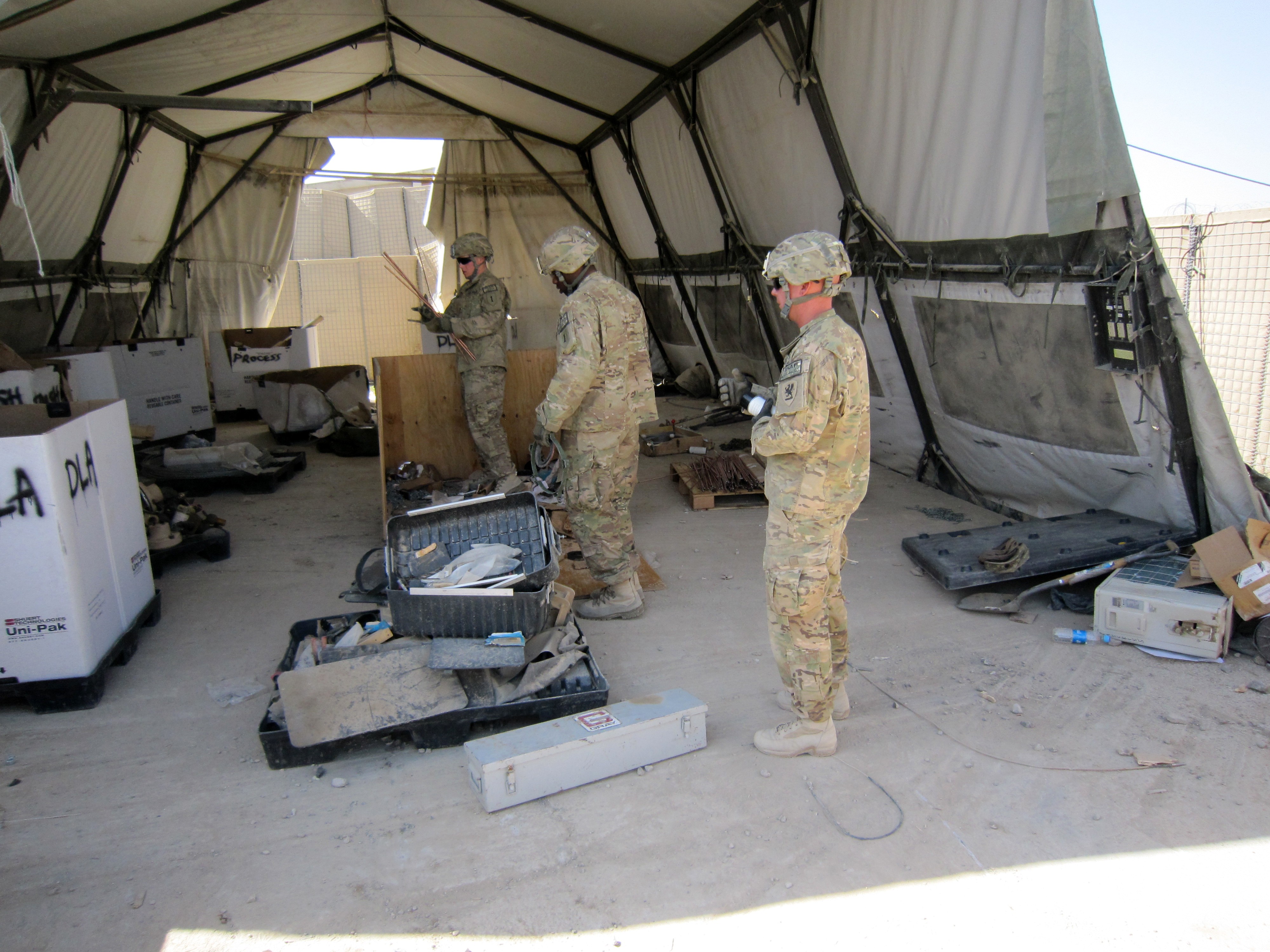
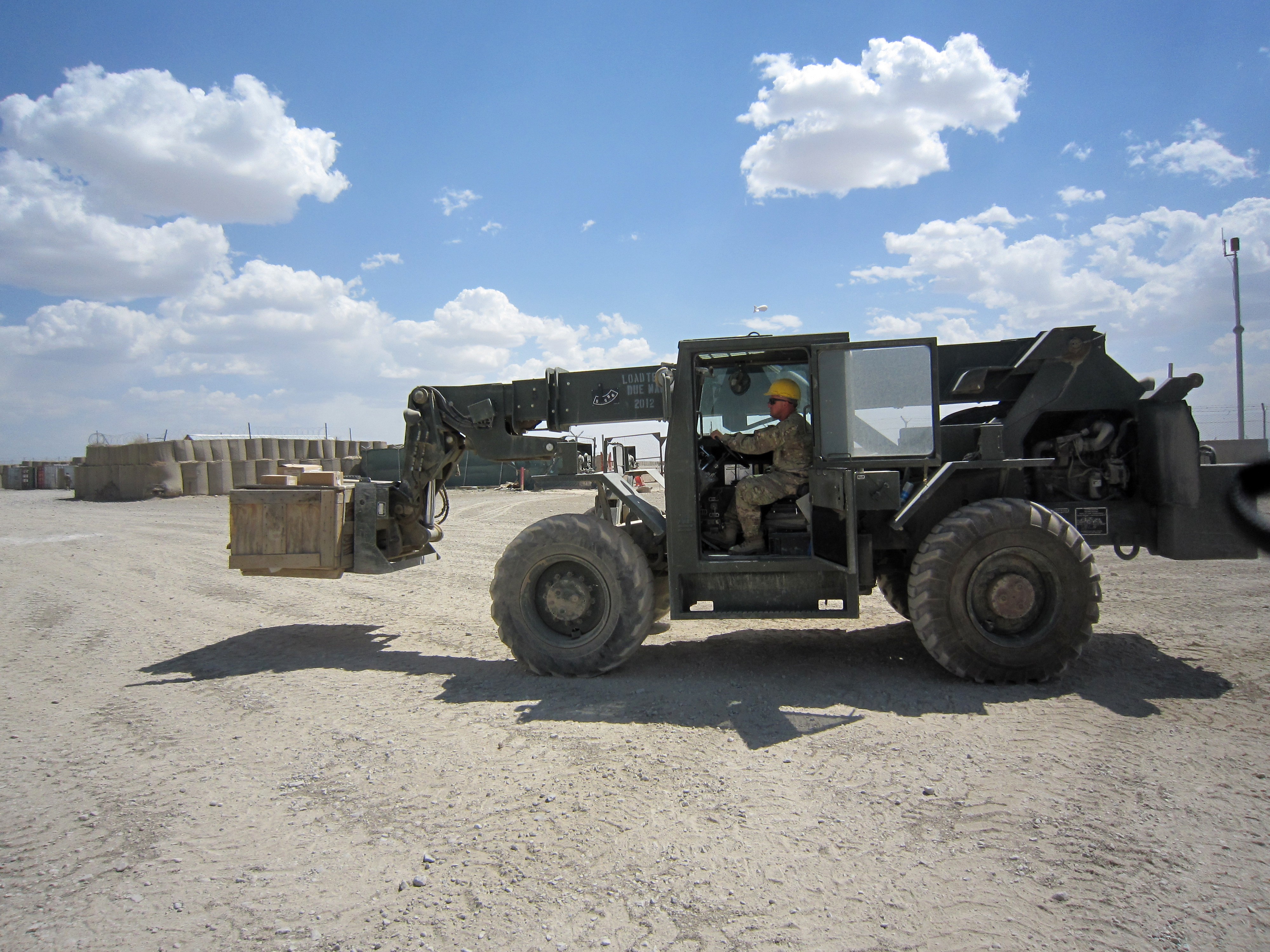
Responsible retrograde is an integral part of the U.S. mission to close or transfer bases to the Afghan National Security Forces in 2014. To facilitate this process in the Paktika and Ghazni provinces, the 701st Brigade Support Battalion (BSB), 4th Infantry Brigade Combat Team, 1st Infantry Division, reopened the retrograde yard at Forward Operating Base (FOB) Sharana in June 2012.
This was done as part of the brigade's mission to reduce materiel and equipment at FOBs and combat outposts (COPs) throughout the Paktika and Ghazni provinces. The materials that had accumulated over the past 10 years in these provinces had to be removed or transferred to the local communities or the Afghan security forces.
The 701st BSB had to support the Soldiers who were still in contact with the enemy. Using old fashioned cross-level distribution allowed for accumulated materiel to be made available to units still conducting operations in the area. Cross-level distribution sped up receipt time and reduced the cost of purchasing and shipping materiel from other locations.
RETROGRADE MISSION
In May 2012, the 701st BSB was given the retrograde mission. The unit was directed to take in materiel from across two provinces and process it for either redistribution to U.S. units, shipment to Bagram Airfield (BAF) for retrograde, or transfer to local nationals in order to reduce the brigade's footprint. This set conditions for the eventual closure or transfer of bases to Afghanistan.
The first task was to determine what this mission entailed and what equipment and personnel were required to complete it. When planning the retrograde yard process, I used my own experience as a logistics officer, the BAF retrograde sort yard standard operating procedures, and information left behind by a previous unit.
GETTING ORGANIZED
The mission started with pulling together personnel and equipment from companies across the 701st BSB. The personnel came from a variety of military occupational specialties (MOSs), not only logistics, which proved to be both a help and a hindrance. With only logistics personnel, the unit would have had a knowledge base to process materiel faster. However, having personnel from different MOSs facilitated the identification of many items and minimized the time spent in research and documentation.
First, we identified the equipment needed to run the retrograde yard. This list started with trucks to transport personnel to and from the yard and for moving materiel around the yard and to other designated locations. For example, hazardous materials (HAZMAT) needed to be moved to a disposal facility on FOB Sharana. We also needed materials-handling equipment, including forklifts and a rough-terrain container handler (RTCH).
We started with two 10,000-pound capacity variable-reach forklifts and a set of 6,000-pound forks to use on a 10,000-pound forklift to move items in and out of containers. However, as time passed, we ended up with only one 10,000-pound forklift and had to file transportation movement releases when we needed smaller forklifts and RTCH support. We often used RTCHs from FOB Sharana to unload containers from inbound trucks, move containers within the yard, and load trucks for outbound movement to the next higher level facility.
Next, we identified the need for automation systems to operate the Nonsecure Internet Protocol Router Network, Secret Internet Protocol Router Network, and the U.S. Central Command Regional Intelligence Exchange System. We used these systems to identify materiel and to tell our customers and higher headquarters what we received, processed, and shipped.
We also needed a facility for processing materiel. This at least needed to be a tent large enough to allow for the simultaneous sorting of multiple packages by supply class. Although not always possible, a facility large enough for containers to be dropped, unpacked, and repacked was ideal.
RETROGRADE PROCESS
After determining what equipment would be used, we identified the process for responsibly downsizing materiel stores with the eventual withdrawal from Afghanistan in mind. This process needed to be sustainable by U.S. military personnel and would likely continue for a while after the official transfer of bases back to Afghanistan to ensure that all materiel and equipment had been recovered or transferred.
The process that we used included three different stages of sorting to ensure that all materiel was identified and designated as one of the following:
• Able to be processed for further retrograde.
• Disposable through local-national trash or scrap metal pickup.
• Disposable as HAZMAT.
• Nonretrogradable materiel.
The process started with customer units and contractors dropping materiel at the yard in a number of different configurations and providing paperwork with at least a description of what they were dropping. They also provided, if possible, information such as national stock numbers or part numbers to facilitate the sorting and identification process.
Personnel then began identifying each package according to the supply class of its contents. Next, HAZMAT, scrap metal, and other nonretrograde materiel that would slow down later processes were identified. These items were segregated and consolidated into different locations to facilitate their packaging and disposal through different agencies and processes.
We then moved the packages into "further sort," where we broke them down into specific classes and identified materiel that the customer had not identified or that was missed on the initial paperwork. During this step, materiel was also identified for redistribution, which was a vital part of the retrograde process because it provided cost savings to units and made materiel available when needed.
Lastly, materiel was moved to the "final sort" area where it was packaged based on whether or not the materiel needed escort for shipment to the next level of retrograde. At this stage, materiel had one last chance to be redistributed to units. After it went to outbound, materiel was no longer available for redistribution. This ensured that the proper documentation of a container or truck's contents was provided to the next level of retrograde at BAF.
GETTING STARTED
The next step was to establish the kinds of materiel that would be processed through the yard with the understanding that at times items would arrive that did not fit our guidelines but would still have to be processed. We determined early on that the materiel this yard would process included classes I (subsistence), II (clothing and individual equipment), IV (construction and barrier materials), VIII (medical materiel), and IX (repair parts). At times, HAZMAT, scrap metal, and other miscellaneous materiel would arrive in containers and kicker boxes and would still have to be processed for retrograde or disposal.
After identifying what we would receive, we needed a tracking system. A Microsoft Excel spreadsheet was created to document the items during processing. The unit also needed to track the movement of packages, including received kicker boxes, crates, containers, shipped containers, and the value (recorded in dollars) of items received, redistributed, shipped, and processed.
When our gates first opened on June 21, 2012, the 10th Sustainment Brigade provided us with a mobile redistribution team that was made up of personnel from the 1462nd Transportation Company, Michigan Army National Guard, to assist in establishing operations. The team was trained in identifying materials for retrograde and disposal and helped to further streamline our processes. It also aided us in quickly setting up and obtaining operational readiness within a few weeks. Within 10 days, we were fully self-sustaining and processing $8 million to $10 million worth of materiel every month.
RETROGRADE SUPPORT OPERATIONS
Nonretrograde materiel removal is vital to the overall operation of a retrograde yard because of the amount of materiel that is brought in from FOBs and COPs and by contractors. We removed nonretrograde materiel, such as scrap metal and HAZMAT, through a couple of different ways.
First, a Defense Logistics Agency scrap removal team visited the yard about every two to three weeks with locally contracted trucking services to remove scrap items. The scrap usually included miscellaneous metal parts (nonarmor or mine-resistant armor packages), tires, and plastic items, such as large water tanks. The Defense Logistics Agency personnel and the yard officer-in-charge or noncommissioned officer-in-charge (NCOIC) checked each item before it was loaded to ensure it could not be used against coalition forces.
Second, every other week the retrograde NCOIC collected from the mayor cell local nationals who visited the FOB for work. He brought them with trucks to remove the accumulated trash for disposal at the burn pit. Both missions were necessary because of the amount of nonretrograde materiel that was created through the retrograde process.
The movement control team, which controlled trucks entering and leaving the FOB, provided an avenue for requesting trucks and containers provided by national carriers to move materiel from the retrograde yard to the retrograde sort yard at BAF.
Most of the time when customers dropped materiel for retrograde, it was not in containers. The best way to transport this materiel was to contract with local-national trucking companies because obtaining containers through normal military channels was cumbersome and time-consuming. Using local-national trucking also provided work for the Afghan people.
We preferred for customers make appointments to drop off materiel, but that was not always possible because of mission requirements. It was our policy not to turn anyone away, even without paperwork; we just informed them of what they needed to provide for the next delivery.
REQUIRED DOCUMENTS
For personnel bringing materiel to the yard, the only paperwork required was a Department of Defense Form 1750 (shipping document) with as much detail as possible. The form allowed the operations personnel to properly identify all materiel flowing through the yard for initial sort and its value.
For items that had held HAZMAT, like engines and axles, the only additional item we asked for was a memo documenting that the HAZMAT had been drained from the item, which was provided through our battalion portal. For customers who did not have access to the portal, we printed it off for them to fill out.
When HAZMAT was brought to the yard, we packaged it and took it to the HAZMAT yard on FOB Sharana for proper disposal. This should not have been a normal part of operations, but it occasionally happened when units from off the FOB had no other way to retrograde their waste for proper disposal. However, for units on the FOB, if we identified HAZMAT items before we off-loaded them, we informed them of the proper disposal process and sent them to the HAZMAT yard.
The retrograde yard had more than 1,000 customers and visitors, many of them visiting multiple times. The customers included units from on and off the FOB, contractors, and other organizations. Not a day passed without at least one visitor. Many of the customers and visitors we received were not delivering materiel but were looking for materiel to support their missions. This included drivers needing basic issue items for their trucks and repair facilities personnel looking for components to get vehicles and weapons fixed and back in the fight.
We even had personnel from the Army Materiel Command (AMC) looking for items to send to repair facilities to get them back into the Army system. For example, when we took over, the yard had a target acquisition system worth over $500,000 that AMC personnel were able to send to BAF repair facilities. That system was back on the shelf for use in less than 30 days.
Retrograde yard operations are a necessary part of combat operations. For every mission, the materiel that was brought in to support it eventually must be reduced. Any complex mission must have plans beyond the supply support activity for redistributing materiel. The retrograde process should be implemented as early as possible so the yard can provide a location for units and contractors to retrograde excess materiel from operational areas and allow for the redistribution of items that are hard to get.
These operations must continue until the last service member or contractor leaves to ensure that everything is removed. No mission is complete until all materiel and equipment have been recovered and handled as required.
___________________________________________________________________________________________
Capt. Michael A. Smith is the transportation officer-in-charge, 701st Support Operations, 701st Brigade Support Battalion, at Fort Riley, Kan. He was the retrograde officer-in-charge at Forward Operating Base Sharana, Afghanistan, when he wrote this article. He holds a bachelor's degree in history from Campbell University and is a graduate of Officer Candidate School, the Ordnance Basic Officers Course, and the Combined Logistics Captains Career Course.
___________________________________________________________________________________________
This article was published in the July-September 2013 issue of Army Sustainment magazine.
Related Links:
Browse Army Sustainment Magazine
Social Sharing