
Our Mission
-
The 2nd Infantry Division/ROK-US Combined Division is the last remaining permanently forward-stationed division in the U.S. Army. The 2nd Infantry Division deters aggression and maintains peace on the Korean Peninsula; and if deterrence fails, “Fight Tonight” in support of the U.S-Republic of Korea Alliance.
-
The 2nd Infantry Division - our nation’s only forward stationed division – is a vital member of an enduring alliance that is ready to “fight tonight” to deter aggression, defend the Republic of Korea, and win.
We honor the legacy of those who’ve gone before us through our unwavering readiness, exceptional discipline, exemplary character, and steadfast commitment.
We lead the way in combined operations, lethality, and the development of professional Warriors.
We are the 2nd Infantry Division – and we are
“Second to None!”
-
Our History
The Second Infantry Division has a proud and honorable history which reflects the heart of the American Soldier. Having fought in four wars, the 2nd Infantry Division is one of the most decorated divisions in the United States Army. It boasts 40 Medal of Honor recipients, and over 20 campaign participation credits.
World War I
The 2nd Infantry Division was organized on 26 October 1917, at Bourmont, Haute Marne, France. At the time of its activation, the Indianhead Division was composed of existing Army and Marine units of the American Expeditionary Forces which were the 3rd Infantry Brigade, which was a normal Organic Brigade which included the 9th Infantry Regiment; 23rd Infantry Regiment; and the 4th Marine Brigade, which consisted of the 5th Marine Regiment and the 6th Marine Regiment, a battalion of Field Artillery, and various supporting units.
Twice during "The Great War" the division was commanded by Marine Corps generals, Brigadier General Charles A. Doyen and Major General John A. Lejeune, marking the only times in U.S. Military history when Marine Corps officers commanded an Army division. Major General John A. Lejeune, was nicknamed "The Old Indian," he had led the Division in numerous important engagements, including St. Mihiel, Mont Blanc Ridge, Champagnet, and the Meuse-Argonne. He later went on to become the Commandant of the Marine Corps.
The division spent the winter of 1917 - 1918 training with French Army veterans. Though judged unprepared by French tacticians, the American Expeditionary Force (AEF) was committed to combat in the spring of 1918 in a desperate attempt to halt a German advance toward Paris. The 2nd Infantry Division drew its first blood in the nightmare landscape of the Battle of Belleau Wood, and contributed to shattering the four year old stalemate on the battlefield during the Chateau-Thierry campaign that followed.
On 28 July 1918, Maj Gen John A. Lejeune, USMC, assumed command of the 2nd Infantry Division and remained in that capacity until August 1919, when the unit was demobilized. The division won hard fought victories at Soissons and Mont Blanc, for which it was awarded the French Fourragère in the colors of the Croix de Guerre. Finally the Indianhead Division participated in the Meuse-Argonne offensive which spelled the end of any German hope for victory. On 11 November 1918 the Armistice was declared, and the 2nd Infantry Division marched into Germany where it performed occupation duties until April 1919.
The 2nd Infantry Division returned to the United States in July 1919. Having fought in every major US engagement, the Indianhead Division emerged from World War I as the most decorated American Division of the American Expeditionary Forces.
The Interwar Era
Upon returning to the United States in July 1919, the division was stationed at Fort Sam Houston, at San Antonio, Texas as one of three divisions to remain intact and on Active Duty for the entire interwar period. It remained there for the next 23 years, serving as an experimental unit, testing new concepts and innovations for the Army. In 1940 the 2nd Infantry Division was the first command reorganized under the new triangular concept, which provided for three separate regiments in each division. Indianhead soldiers pioneered concepts of airmobility and anti-tank warfare, which served the army for the next two decades on battlefields in every corner of the globe.
The Division started taking part in maneuvers at Christine, Texas between 3 and 27 January 1940. It then moved to Horton, Texas for maneuvers from 26 April to 28 May 1940, followed by maneuvers at Cravens, Louisiana from 16 August to 23 August 1940. It returned to Fort Sam Houston, where it continued training and refitting, until it moved to Brownswood, Texas for the VIII Corps Maneuvers from 1 to 14 June 1941 at Comanche, Texas. The division was then sent to Mansfield, Louisiana from 11 August through 2 October 1941 for the August-September 1941 Louisiana Maneuvers.
The Indianhead Division was then transferred to the VIII Corps Louisiana maneuver Area on 27 July 1941. In May 1942, Major General Walter Robertson assumed command of the Division. He would remain the Division Commander for the entire war through Victory in Europe Day (VE) Day in 1945. On 22 September 1942, the Division returned to Fort Sam Houston. They then moved to Camp McCoy at Sparta, Wisconsin on 27 November 1942. Four months of intensive training for winter warfare followed.
In September 1943 the division received their staging orders, and moved to the Camp Shanks staging area at Orangeburg, New York on 3 October 1943, where they got their Port Call orders. On 8 October 1943 the division officially sailed from the New York Port of Embarkation, and started arriving in Belfast, Northern Ireland on 17 October 1943. They then moved over to England, where they trained and staged for forward movement to France.
World War II
With the onset of World War II, the division moved to Ireland and Wales in October 1943, as part of the build up for operation Overlord, the Normandy invasion. There it spent ten months undergoing extensive training. On 7 June 1944, D-Day + 1, the Division landed on Omaha Beach.
Attacking across the Aure River, the Division liberated Trevieres, 10 June 1944, and proceeded to assault and secure Hill 192, the key enemy strongpoint on the road to St. Lo. With the hill taken on 11 July 1944, the Division went on the defensive until 26 July 1944. Exploiting the St. Lo break-through, the 2nd Division advanced across the Vire to take Tinchebray on 15 August 1944. After fierce, 39-day battle, the 2nd Division, fighting in the streets and alleyways, finally took their objective as the vital port city of Brest, which was liberated on 18 September 1944.
The Division took a brief rest 19 to 26 September 1944 before moving to defensive positions at St. Vith, Belgium on 29 September 1944. The Division entered Germany on 3 October 1944, and the Division was ordered, on 11 December 1944, to attack and seize the Roer River dams. Having pierced the dreaded Siegfried Line, the Division was advancing when Nazi Field Marshal Gerd Von Rundstedt unleashed a powerful German offensive in the Ardennes. Throughout the Battle of the Bulge the 2nd Infantry Division held fast, preventing the enemy from seizing key roads leading to the cities of Liege and Antwerp.
In February 1945, the Division attacked, recapturing lost ground, and seized Gemund, on 4 March 1945. Reaching the Rhine 9 March 1945, the Division advanced south to take Breisig, 10-11 March 1945, and to guard the Remagen bridge, 12- 20 March 1945. The Division crossed the Rhine 21 March 1945 and advanced to Hadamar and Limburg an der Lahn, relieving elements of the 9th Armored Division, 28 March 1945. Advancing rapidly in the wake of the 9th Armored, the 2nd Infantry Division crossed the Weser at Veckerhagen, 6 - 7 April 1945 captured Gottingen 8 April 1945, and established a bridgehead across the Saale, 14 April 1945, seizing Merseburg on 15 April 1945.
On 18 April 1945 the Division took Leipzig, mopped up in the area, and outposted the Mulde River; elements which had crossed the river were withdrawn 24 April 1945. Relieved on the Mulde, the 2nd moved 200 miles, 1 – 3 May 1945, to positions along the German-Czech border near Schonsee and Waldmunchen, where the Warrior Division relieved the 97th and 99th divisions. The division crossed over to Czechoslovakia on 4 May 1945, and attacked in the general direction of Pilsen, attacking that city on Victory in Europe (VE) Day.
The 2nd Infantry Division returned to the New York Port of Embarkation on 20 July 1945, and arrived at Camp Swift at Bastrop, Texas on 22 July 1945. They started a training schedule to prepare them to participate in the scheduled invasion of Japan, but they were still at Camp Swift on Victory in Japan (VJ) Day.
The Post World War II Era
Following WWII, the division was ordered moved to the Staging Area at Camp Stoneman at Pittsburg, California on 28 March 1946, but the move eastward was cancelled, and they received new orders to move to Fort Lewis at Tacoma, Washington. They arrived at Fort Lewis on 15 April 1946, which became their Home Station. From their Fort Lewis base, they conducted Arctic, air transportability, amphibious, and maneuver training.
The Korean War
With the outbreak of hostilities in Korea during the summer of 1950, the 2nd Infantry Division was quickly alerted for movement to the Far East Command. The division arrived in Korea, via Pusan on 23 July 1950, becoming the first unit to reach Korea directly from the United States. Initially employed piecemeal, the entire division was committed as a unit on 24 August 1950, relieving the 24th Infantry Division at the Naktong River Line.
The first big test came when the North Koreans struck in a desperate human wave attack on the night of 31 August 1950. In the 16-day battle that followed, the division's clerks, bandsmen, technical and supply personnel joined in the fight to defend against the attackers. Shortly thereafter, the Warrior Division was the first unit to break out of the Pusan Perimeter and they led the Eighth Army drive to the Manchurian Border, the Indianhead Division became the first UN force to enter the North Korean Capital of Pyongyang.
When the Chinese entered the war on 26 November 1950, soldiers of the 2nd Infantry Division were given the mission of protecting the rear and right flank of the Eighth Army as it retired to the South. Fighting around Kunu-ri cost the division nearly one third of its strength, but was ten times more costly to the enemy and the way was kept open.
On 5 February 1951, the 23rd Regimental Combat Team moved into the narrow valley of Chipyong-ni. Colonel Paul Freeman, the 23rd Regimental Combat Team Commander, realized that he occupied a salient in front of the main defensive line and requested permission to fall back, however; Lieutenant General Matthew Ridgway, the Eighth United States Army Commanding General, ordered the 23rd Regimental Combat Team to make a stand against Communist Chinese Forces.
On 13 February 1951, the 23rd Regimental Combat Team, with the attached French Battalion, was cut off and surrounded by three Chinese divisions. As the surrounded 23rd Regimental Combat Team exhausted supplies due to intense fighting, air drops were conducted to restock the ammunition, ration, medical and equipment supply dumps. The Air Force conducted over 131 sorties utilizing Napalm to demoralize and destroy the Communist Chinese Forces. For more than three days the 23rd Regimental Combat Team bravely fought in freezing weather killing over 5,000 Chinese and causing the Communist Chinese Forces to withdraw. The Battle of Chipyong-ni was the first major defeat for the Chinese and proved to be the turning point of the Korean War.
Again in April and May 1951, the 2nd Infantry Division was instrumental in smashing the communist's spring offensive. After smashing the communist offensive, the Indianhead Division was awarded the Presidential Unit Citation; the highest decoration the United States can award a division. What followed were alternating periods of combat and rest. While statesmen sought an armistice agreement, the Warrior Division fought for hilltops in the Iron Triangle, Pork Chop Hill, Baldy Hill, Bloody Ridge, and Heartbreak Ridge.
Finally, on 9 April 1953, the Division was moved to a rear area and on 20 August 1954, four years after its last unit arrived in Korea, the Division was alerted for re-deployment to the United States.
A Rest from the Fight
In the summer of 1954 the 2nd Infantry Division was transferred from Korea to Fort Lewis, Washington, where it remained for only two years, until being transferred to Alaska in August 1956. On 8 November 1957, it was announced that the division was to be deactivated. However, a few short months later, in the spring of 1958, the Department of the Army announced that the 2nd Infantry Division would be reorganized at Fort Benning, Georgia, with personnel and equipment of the 10th Infantry Division returning from Germany. Fort Benning remained the home of the new 2nd Infantry Division from 1958 to 1965, where they were initially assigned the mission of a training division. To improve combat readiness, in March 1962 the Division was designated as a Strategic Army Corps (STRAC) unit. Following this the Division became engaged in intensified combat training, tactical training, and field training exercises, in addition to special training designed to improve operational readiness.
In January 1963, the division was selected as the first Army division to be organized under the Reorganization Objective Army Division concept, providing for three brigades supported by armor, cavalry and artillery units, as well as administrative and support elements.
The Cold War Era
On 1 July 1965, the division's colors returned to the Republic of Korea. The Soldiers of the 1st Cavalry Division removed their First Team Division patches and became 2nd Infantry Division Warriors. The 2nd Division was assigned to guard portions of the Demilitarized Zone (DMZ), and help deter war on the peninsula. North Korean forces were engaging in increasing border incursions and infiltration attempts and the 2nd Infantry Division was called upon to help halt these attacks. On November 2, 1966, soldiers of the 1st Battalion, 23rd Infantry Regiment were killed in an ambush by North Korean forces. In 1967 enemy attacks in the DMZ increased, as a result, 16 American soldiers were killed that year.
In 1968 North Koreans continued to probe across the DMZ, and in 1969, while on patrol, 4 soldiers of 3rd Battalion, 23rd Infantry were killed, but by 1970 the North had decided that their efforts against the Division weren't worth the cost and organized attacks stopped that year. By March 1971 Republic of Korea forces had assumed the responsibility for the defense of all but 500 yards of the DMZ, allowing the 2nd Infantry Division to maintain combat readiness in case of any eventuality.
On 18 August 1976, CPT Arthur G. Bonifas and 1LT Mark T Barrett, of the United Nations Joint Security Force, were attacked and killed by North Korean border guards during a routine tree-trimming operation within the Joint Security Area.
Three days later on 21 August 1976, the United Nations Command responded with Operation Paul Bunyan. The 2nd Infantry Division assembled Task Force Brady, named after the Division Commander, in support of Task Force Vierra, named after the Joint Security Area (JSA) Battalion Commander. At 0700 hours a Republic of Korea Special Forces company, the 9th Infantry Regiment, and B Company, 2nd Engineers, moved into the JSA and cut down the infamous “Panmunjeom Tree”. B-52 bombers, escorted by U.S. F-4 fighters and ROK F-5 fighters flew at a high altitude near the JSA. At Osan Air Base, F-111 fighters had been armed and fueled, ready to take off at short notice. The aircraft carrier Midway task force had also been moved to a station just offshore. The 2nd Infantry Division delivered an unmistakable message to the North Koreans, as well as to the world.
Throughout the 1980 and early 1990s, Soldiers of the 2nd Infantry Division continued to patrol along the DMZ. With the end of the Cold War, 2nd Infantry Division Warriors left the DMZ in 1992, but remained forward deployed along the most heavily defended border in the world. In 1994, the death of the North Korean leader, Kim, IL Sung, created increased tensions on the Korean Peninsula, this time the North was threatening nuclear development. In 1994, and again in 1999, the 2nd Infantry Division received their 4th and 5th Republic of Korea Presidential Unit Citations.
On 29 March 1995, the 3rd Brigade, 2nd Infantry Division was reactivated at Fort Lewis, Washington as part of I Corps. It gained the fame of becoming the Army's first Stryker Brigade Combat Team in May of 2000.
The Global War on Terrorism
From November 2003 to November 2004, the 3rd Brigade Stryker Brigade Combat Team deployed from Fort Lewis, Washington in support of Operation Iraqi Freedom. In the sands of Iraq the 3rd Brigade Stryker Brigade Combat Team proved the value of the Stryker Brigade concept in combat and logistics operations.
In August 2004, the 2nd Brigade Combat Team deployed to Iraq where they worked side by side with the Republic of Korea Army; just as it had while stationed in Korea. This deployment was unique in that it was the first operational deployment from the Republic of Korea.
In Iraq, the 2nd BCT was given strategic command to much of the sparsely populated area South and West of Fallujah. Their mission, however, changed when the major strategic actions began to take place within the city of Fallujah. The 2nd BCT was refocused and given control of the eastern half of the volatile city of Ar-Ramadi. For this mission, the Brigade fell under the direct command of the 1st Marine Division and for the second half of the deployment; they were attached to the 2nd Marine Division. This command structure was ironic in that during World War I the 5th Marine Regiment and the 6th Marine Regiment of the 1st Marine Division had fought under the US Army's 2nd Infantry Division.
The 2BCT fought in the Fallujah offensive in November 2004 and provided Iraqis the opportunity to vote in the historic national elections of January 2005. The 2BCT also trained and partnered with thousands of Iraqi Security Force soldiers, enabling them to better secure their country. Additionally, the 2BCT provided humanitarian relief to hundreds of displaced civilians, schools, hospitals, and the underprivileged across its area of operations. In August 2005, the 2BCT redeployed from Iraq to its new home at Fort Carson, Colorado.
From June 2006 to September 2007, the 3rd Stryker Brigade Combat Team deployed from Fort Lewis, Washington in support of Operation Iraqi Freedom. During the 3rd Stryker Brigade’s second deployment to Operation Iraqi Freedom their mission was to assist the Iraqi security forces with counter-insurgency operations in the Ninewa Province.
On 1 June 2006 at Fort Lewis, Washington the 4th Brigade, 2d Infantry Division was formed. From April 2007 to July 2008 the 4th Stryker Brigade Combat Team was deployed in as part of the surge to regain control of the situation in Iraq. The brigade assumed responsibility for the area north of Baghdad and the Diyala province.
From October 2006 to January 2008, the 2nd Infantry Brigade Combat Team deployed from Fort Carson, Colorado in support of the Multi-National Division – Baghdad (1st Cavalry Division) and was responsible for assisting the Iraqi forces to become self-reliant, bringing down the violence and insurgency levels and supporting the rebuilding of the Iraqi infrastructure.
The 5th Stryker Brigade Combat Team deployed to southern Afghanistan in support of Operation Enduring Freedom in June 2009. It was the first Army brigade to deploy to Afghanistan with Strykers and the first full combat brigade to deploy with Land Warrior System. In July 2010, the 5th Stryker Brigade Combat Team was inactivated and reflagged as the 2nd Stryker Brigade Combat Team, 2nd Infantry Division.
In September 2009 at Fort Lewis, Washington the 3rd Stryker Brigade Combat Team deployed to Diyala province, Iraq that was its third deployment to Iraq and second to Diyala province.
In the fall 2009 the 4th Stryker Brigade Combat Team deployed to Iraq for a second time in support of Operation Iraqi Freedom. The last America Combat Brigade pulled out of Iraq 18 August 2010. Convoys of the 4th Stryker Combat Brigade moved out of Iraq to Kuwait, symbolizing the end of their year-long deployment and the departure of the last combat troops in Iraq.
As part of the upcoming rotation of forces operating in Afghanistan, the 3rd Stryker Brigade Combat Team (-) deployed in December 2011. This is the 3rd Stryker Brigade’s first deployment to Afghanistan.
Current Operations
Today, Warriors wearing the 2nd Infantry Division patch are spread out across world. Reflecting the Warrior Ethos of the today's highly modular fighting force the Division is a melting pot of experience and expertise as they face the dangerous threat posed by the communist North Korea and terrorism.
-
History
The Korean Augmentation to the United States Army (KATUSA) Soldier Program was initiated on 15 July 1950 by an informal agreement between the Honorable Syngman Rhee, President of the ROK, and General of the Army Douglas MacArthur, Commander in Chief, United Nations Command (UNC). The concept of this program originally was to augment the U.S. fighting forces just after the outbreak of the Korean War. After the armistice, KATUSA Soldiers remained with Army in Korea units to receive training that was not readily available in the ROKA and to enhance Army in Korea's mission capability. The KATUSA Soldier Program has been a continuous one since 1950 with only periodic strength adjustments dictated by requirements. Originally, KATUSA Soldiers were returned to the ROKA after serving with the U.S. Army. Since 1968, however, KATUSA Soldiers remain with the U.S. Army until their service commitments are completed. The ROKA Support Group was established on 11 May 1965 at the request of the Commander, Eighth Army, as a ROKA officer liaison group to administer the KATUSA Soldier program. Its name was changed from ROKA Liaison Group to ROKA Support Group in November 1986. On 1 November 1997, the ROKA Support Group was reorganized as a unit directly under Headquarter (HQ), ROKA G2/G3, and was later reorganized on 1 December 2009 directly under HQ, ROK Army’s Personnel Command.
The Mission and Importance of the KATUSA Soldier Program
The mission of the KATUSA Soldier Program is to augment Army in Korea with ROK Army Soldiers in order to increase the ROK/U.S. combined defense capability on the Korean peninsula. The KATUSA Soldier Program is significant not only because of the military manpower and monetary savings that it provides to the U.S. Army, but also because it represents ROK/U.S. cooperation and the combined commitment to deter war. The KATUSA Soldier Program is also symbolic of ROK/U.S. friendship and mutual support.
Responsibilities to the KATUSA Soldier Program
All theater U.S. Army and ROKA personnel have an inherent responsibility to ensure the success of the KATUSA Soldier Program by observing and implementing the policies and procedures contained in Army in Korea Reg 600-2. All personnel, U.S. Army or ROKA, are strongly encouraged to submit suggestions and recommendations that may improve the KATUSA Soldier Program.
Headquarters 2nd Infantry Division/ROK-US Combined
-
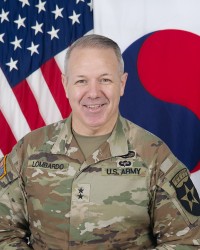 Commanding General 2nd Infantry Division ROK - U.S. Combined DivisionMajor General Charles Lombardo
 -
 Division Command Sergeant Major 2nd Infantry Division ROK - U.S. Combined DivisionCommand Sergeant Major Christopher Shaiko
 -
 Deputy Commanding General - ROK 2nd Infantry Division ROK - U.S. Combined DivisionBrigadier General Woo Jang Lee
 -
 Deputy Commanding General - Maneuver 2nd Infantry Division ROK - U.S. Combined DivisionBrigadier General Scott C. Woodward
 -
 Deputy Commanding General - Support 2nd Infantry Division ROK - U.S. Combined DivisionBrigadier General Jason H. Rosenstrauch
 -
 Chief of Staff ROK 2nd Infantry Division ROK - U.S. Combined DivisionColonel Wan Seok Seo
 -
 Chief of Staff 2nd Infantry Division ROK - U.S. Combined DivisionColonel Chad P. Corrigan
2nd Combat Aviation Brigade
-
Brigade CommanderColonel Jason Raub
210th Field Artillery Brigade
-
Brigade CommanderColonel David O'Leary
2nd Infantry Division Sustainment Brigade
-
Brigade CommanderColonel Dwight Towler
2nd Infantry Division Artillery
-
Brigade CommanderColonel Thomas Putnam
Korea Rotational Force (KRF) - Stryker Brigade Combat Team
-
Brigade CommanderColonel Sean Nolan
2nd Infantry Division
-
Secretary of the General Staff
Mission
The 2ID/RUCD Secretary of the General Staff team serves as a focal point for command and staff actions. They also coordinate Command Group actions with General and Special Staff. The SGS team also provides timely and accurate information to the command group as well as supervises administrative support and coordinates with protocol section for visiting dignitaries. Most importantly, the SGS team serves as the Command Group office manager, meaning having the responsibility to provide a complete spectrum of executive services, to include suspense management, quality control of executive correspondence, and maintenance of command and social calendars.
C1 - Personnel
Mission
The ACoS, C1 provides personnel services support to all 2ID/RUCD and supported unit Soldiers, Airmen and Family Members, and provides planning, execution, and oversight in the areas of Strength Management, Awards, Evaluations, Personnel Actions, Non-Combatant Evacuation Operations (NEO), Command Sponsorship, and Family Readiness throughout the Korean AOR. As necessary, trains Soldiers on new Personnel Systems and Equipment to a standard consistent with quality service, and manages resources to achieve successful execution, and Soldier well-being for all personnel and family members assigned to and supported by the C1.
C2 - Intelligence
Mission
The ACoS C2 Plans, coordinates, directs, and synchronizes intelligence activities in support of 2ID/RUCD Armistice and Wartime operations in order to provide the Commander and Warfighter with accurate, timely, and predictive, fused multi-source intelligence.
C3 - Operations
Mission
The ACoS, C3 conducts all missions concerning training, operations and plans, force development and modernization within the division during current Armistice conditions and once the division transitions to war.
C4 - Logistics
Mission
The ACofS, C4 is the coordinating staff proponent for logistical policy, sustainment training, and all matters related to supply, maintenance, transportation and food service. Coordinates for sustainment of current and future operations; monitors logistical requirements; reports logistical status; and provides for continuous sustainment of the Division. Organizes and directs limited reconstitution operations to replenish and sustain the Division.
C5 - Plans
Mission
The 2D Infantry Division/ROK-US Combined Division C5 Plans Section provides the Division Commander with comprehensive staff estimates and synchronized, feasible, and flexible plans to enable the Division and its subordinate units to accomplish their assigned missions.
C6 - Information Management
Mission
The ACoS, C6 section plans, maintains, and defends the Division communications infrastructure to provide secure and non secure voice, data, and video services for all Division command posts and Major Subordinate Commands.
C8 - Resource Management
Mission
To provide world-class resource management support and service to the Second-to-None Division through Planning, Programming, Budgeting, and Execution (PPBE) process as well as management of Defense Travel System (DTS), Government Purchase Card, Government Travelers Charge Card, and civilian manpower program to ensure the Division is fiscally sound and resourced to accomplish its full spectrum mission and live up to its “fight tonight” mandate.
C9 - Civil Military
Mission
The ACofS C9 plans, coordinates, integrates, and synchronizes 2ID/RUCD Civil-Military Operations across the entire spectrum of conflict in order to strengthen our Korean-American relationships, protect our combat initiative in battle, and set conditions for and coordinate stability operations.
Chaplain
Mission
The 2D Infantry Division/ROK-US Combined Division Unit Ministry Team provides religious support across the range of military operations in support of the 2D Infantry Division/ROK-US Combined Division’s mission to deter aggression and maintain peace on the Korean Peninsula; and if deterrence fails, “Fight Tonight” in support of the US-Republic of Korea Alliance.
Equal Opportunity
Mission
2ID/RUCD EO mission - to provide direction and sustain a comprehensive effort to maximize human potential by eliminating discriminatory behaviors or practices that undermine teamwork, mutual respect, loyalty, and shared sacrifices of the men and women of Americas Army to ensure fair treatment for all persons based solely on merit, fitness, and capability, in support of readiness. Provide equal opportunity and fair treatment for all military personnel and Family members without regard to race, color, religion, gender, or national origin, and to provide an environment free from unlawful discrimination and offensive behavior.
Inspector General
Mission
Serve as the confidential advisor and fact finder to the Commanding General,2d Infantry Division and report on the state of the economy, efficiency, discipline, morale, and readiness of assigned and attached units and activities.
Provost Marshal
Mission
The 2ID/RUCD Provost Marshal provides dual Division and Garrison Law and Order, Fire, Physical and Installation Security support to USFK Soldiers, Civilians, and Family Members throughout the USAG-Red Cloud area of responsibility in order to increase safety, mitigate risk, and reduce indiscipline.
Public Affairs Office
Mission
Public Affairs informs and educates our unit members and interested public audiences about important events within the division; creates, improves and sustains mutually beneficial relationships with those publics that affect the 2ID/RUCD operational environment.
Retention
Mission
Serves as the program administrator and expert technical advisor to the Commander and Command Sergeant Major on all reenlistment aspects of the Army Retention Program. Reenlists, on a long-term basis, sufficient numbers of highly qualified Active Army Soldiers. Enlist, or transfer and assign sufficient numbers of highly qualified Soldiers who are separating from the Active Army into RC units, consistent within geographic constraints. Achieve and maintain Army force alignment through the retention, transfer, or enlistment of highly qualified Soldiers in critical skills and locations. Adequately support special programs such as the U.S. Military Academy Preparatory School (USMAPS) and ROTC “Green to Gold” programs.
Division Safety Office
Mission
The purpose and mission of the 2d Infantry Division Command Safety Office is to:
- Communicate the Commanding General’s commitment to the safety and health of our Service Members, Civilians and Family Members.
- Provide a single, integrated framework for the 2d Infantry Division safety and occupational health mission, vision, goals and objectives.
- Develop a safety culture where engaged leadership takes ownership of safety and integrates safety and composite risk management into our everyday mission and live."
Staff Judge Advocate
Mission
Serve as the confidential advisor and fact finder to the Commanding General, 2d Infantry Division and report on the state of the economy, efficiency, discipline, morale, and readiness of assigned and attached units and activities.
Division Surgeon
Mission
The Division Surgeon Office applies aggressive and systemic Force Health Protection procedures to all assigned and attached 2D Infantry Division/ROK-US Combined Division assets and improves and sustains the perishable medical skills of the divisions medical personnel.
-
Second Combat Aviation Brigade (Talon)
-
Mission
The 2nd Combat Aviation Brigade is to conduct theater aviation operations in support of 8th Army. On order the Brigade provides combat aviation support to the GCC (Ground Component Command) as an element of the CAF (Combined Aviation Force).
Lineage
- Constituted in the Regular Army and activated 20 June 1957 at Fort Richardson, Alaska, as the 2nd Aviation Company, an element of the 2d Infantry Division
- (Transferred [Less personnel and equipment] 16 December 1957 to Department of the Army control)
- Reorganized and assigned 14 June 1958 to 2d Infantry Division at Fort Benning, Georgia
- Reorganized and redesignated 20 February 1963 as Headquarters and Headquarters Company, 2d Aviation Battalion (Organic elements constituted 25 January 1963)
- Reorganized and redesignated 16 September 1988 as Headquarters and Headquarters Company, 2nd Combat Aviation Brigade
Contact Information
Contact the 2nd Combat Aviation Brigade at usarmy.humphreys.2-id.list.web-2cab@mail.mil
-
Mission
3-2nd Aviation Regiment (GSAB) conducts theater-wide airborne C2, MEDEVAC, Heavy Lift Combat, CS and CSS operations. O/O conducts general support aviation operations in support of 2ID and Eighth Army.
Campaign Participation Credit
World War II
Naples-Foggia
Rome-Arno
North Apennines
Po Valley
Korean War
UN Offensive
CCF Intervention
First UN Counteroffensive
CCF Spring Offensive
UN Summer-Fall Offensive
Second Korean Winter
Korea, Summer-Fall 1952
Third Korean Winter
Korea, Summer 1953
Vietnam War
Advisory
Defense
Counteroffensive
Counteroffensive, Phase II
Counteroffensive, Phase III
Tet Counteroffensive
Counteroffensive, Phase IV
Counteroffensive, Phase V
Counteroffensive, Phase VI
Tet 69/Counteroffensive
Summer-Fall 1969
Winter-Spring 1970
Sanctuary Counteroffensive
Counteroffensive, Phase VII
Consolidation II
Cease-Fire
Decorations
- Presidential Unit Citation (Army) for DAK TO DISTRICT
- Valorous Unit Award for PLEI ME
- Valorous Unit Award for DUC CO
- Meritorious Unit Commendation (Army) for EUROPEAN THEATER
- Meritorious Unit Commendation (Army) for KOREA
Lineage
The 52nd Aviation Regiment was constituted 31 May 1940 in the Regular Army as Headquarters and Headquarters Detachment, 204th Quartermaster Battalion (Gas Supply) and activated 10 June 1942 in Compton, California. The battalion participated in four campaigns on the Italian peninsula during World War II. On 16 May 1949, the unit was reorganized and redesignated as Headquarters and Headquarters Company, 52nd Transportation Truck Battalion. The unit participated in nine campaigns during the Korean War and was inactivated on 10 May 1955 in Japan.
The unit was redesignated and activated on 7 November 1955, at Fort Bragg, North Carolina, as the 52nd Transportation Battalion. On 22 December 1962, the unit was converted and redesignated as the 52nd Aviation Battalion. From 1963 through 1972, the unit served in the Republic of Vietnam participating in seventeen campaigns, earning the Presidential Unit Citation, two Valorous Unit Awards, and eight Vietnamese Unit Citations. The battalion was inactivated 16 April 1988 in the Republic of Korea.
On 16 January 1996, at Camp Humphreys, Korea, the unit was redesignated as the 52nd Aviation Regiment, a parent regiment under the United States Army Regimental System. On 16 February 1996, 2nd Battalion, 501st Aviation Regiment, was redesignated as 2nd Battalion, 52nd Aviation Regiment.
On 17 October 2006, 2-52nd de-activated and re-activated as the newly designated 3rd Battalion, 2nd Aviation Regiment (General Support Aviation Battalion) under the 2nd Combat Aviation Brigade.
Contact Information
Email: Contact the 3rd General Support Aviation Battalion at usarmy.humphreys.2-id.list.web-2cab@mail.mil
-
Mission
602nd ASB provides aviation and ground field maintenance, replenishment of all classes of supplies, and medical support for the CAB. On order, deploy to war in order to sustain the CAB during aviation operations.
Lineage
- 602d Aviation Support Battalion
- Constituted 25 January 1963 as C Company, 2d Aviation Battalion
- Activated 20 February 1963 as C Company, 2d Aviation Battalion
- Reorganized and redesignated 16 September 1988 as C Company, 2nd Combat Aviation Brigade
- Reorganized and redesignated 16 September 1999 as the Headquarters and Headquarters Company, 602nd Aviation Support Battalion
- Reorganized and redesignated 16 June 2005 as Headquarters and Headquarters Company, 602nd Aviation Support Battalion, 2nd Combat Aviation Brigade
Contact Information
Email: Contact the 602nd Aviation Support Battalion at usarmy.humphreys.2-id.list.web-2cab@mail.mil
-
Mission
4-2 ATK conducts deterrence against nK while strengthening the ROK and US alliance. On order, transitions to hostilities and conducts reconnaissance, security, and attack operations supporting 2ID and CFC objectives.
Campaign Participation Credit
Civil War
Peninsula
Antietam
Fredericksburg
Chancellorsville
Gettysburg
Spotsylvania
Cold Harbor
Petersburg
Shenandoah
Appomattox
Virginia 1862
Virginia 1863
Virginia 1864
Virginia 1865
Maryland 1863
Indian Wars
Comanches
Apaches
Pine Ridge
Oklahoma 1874
Texas 1874
Arizona 1876
Arizona 1881
Arizona 1882
New Mexico 1882
Colorado 1884
War with Spain
Santiago
Philippine Insurrection
Streamer without inscription
China Relief Expedition
Streamer without inscription
Mexican Expedition
Mexico 1916-1917
World War I
Streamer without inscription
World War II
Normandy
Northern France
Rhineland
Ardennes-Alsace
Central Europe
Southwest Asia
Defense of Saudi Arabia
Liberation and Defense of Kuwait
Cease Fire
Decorations
- Presidential Unit Citation (Army) for HARLANGE POCKET
- Valorous Unit Award for KUWAIT
- Army Superior Unit Award for 1996-1997
Lineage
- Constituted 4 May 1861 in the Regular Army as the 3d Cavalry
- Organized 18 June 1861 at Pittsburgh, Pennsylvania
- Redesignated 3 August 1861 as the 6th Cavalry
- Assigned 15 August 1927 to the 3d Cavalry Division
- Relieved 1 December 1939 from assignment to the 3d Cavalry Division
- Reorganized and redesignated 21 July 1942 as the 6th Cavalry, Mechanized
- Regiment broken up 1 January 1944 and its elements reorganized and redesignated as follows:
- Headquarters and Headquarters Troop as Headquarters and Headquarters Troop, 6th Cavalry Group, Mechanized
- 1st and 2d Squadrons as the 6th and 28th Cavalry Reconnaissance Squadrons, Mechanized, respectively
- After 1 January 1944 the above units underwent changes as follows:
- Headquarters and Headquarters Troop, 6th Cavalry Group, Mechanized, converted and redesignated 1 May 1946 as Headquarters and Headquarters Troop, 6th Constabulary Regiment Redesignated 2 February 1948 as Headquarters, Headquarters and Service Troop, 6th Constabulary Regiment
- 6th and 28th Cavalry Reconnaissance Squadrons, Mechanized, converted and redesignated 1 May 1946 as the 6th and 28th Constabulary Squadrons, respectively
- Above units converted and redesignated 20 December 1948 as the 6th Armored Cavalry (Headquarters, Headquarters and Service Troop, 6th Constabulary Regiment, as Headquarters and Headquarters Company, 6th Armored Cavalry; 6th and 28th Constabulary Squadrons as the 1st and 2d Battalions, 6th Armored Cavalry, respectively)
- (Battalions and companies redesignated 24 June 1960 as squadrons and troops, respectively)
- Regiment inactivated 24 October 1963 at Fort Knox, Kentucky
- Activated 23 March 1967 at Fort George G. Meade, Maryland
- Inactivated (less 1st Squadron) 31 March 1971 at Fort George G. Meade, Maryland (1st Squadron inactivated 21 June 1973 at Fort Bliss, Texas)
- Reorganized and redesignated 22 June 1973 as the 6th Cavalry, a parent regiment under the Combat Arms Regimental System
- Withdrawn 16 July 1986 from the Combat Arms Regimental System and reorganized under the United States Army Regimental System
- Reorganized and redesignated 16 June 2005 as Headquarters and Headquarters Company, 4th Battalion, 2nd Combat Aviation Brigade
Contact Information
-
210th Field Artillery Brigade
-
-
Mission
On order, 210th Field Artillery Brigade provides fires in support of ACC Operations and GCC’s counter fire fight. On order, transitions to offensive operations
Leadership
Commander
Command Sergeant Major
-
Mission
On order, 1st Battalion 38th Field Artillery alerts, deploys, and fires the Pre-ATO in support of CFC Operations; transitions to fire counter preparation and counterfire in support of 210th FAB to destroy long range artillery (LRA); and is prepared to execute Time Sensitive Targets (TSTs) for CFC.
Campaign Participation Credit
World War II
Normandy
Northern France
Rhineland
Ardennes-Alsace
Central Europe
Korean War
UN Defensive
UN Offensive
CCF Intervention
First UN Counteroffensive
CCF Spring Offensive
UN Summer-Fall Offensive
Second Korean Winter
Korea, Summer-Fall 1952
Third Korean Winter
Korea, Summer 1953
Decorations
- Presidential Unit Citation (Army), Streamer embroidered HONGCHON (2d Infantry Division cited; DA GO 72, 1951)
- Belgian Fourragere 1940 (38th Field Artillery Battalion cited; DA GO 43, 1950)
- Belgian Fourragere 1950 : Cited in the Order of the Day of the Belgian Army for action in the ARDENNES (38th Field Artillery Batalion cited; DA GO 43, 1950)
- Belgian Fourragere 1950 : Cited in the Order of the Day of the Belgian Army for action on ELSENBORN CREST (38th Field Artillery Batalion cited; DA GO 43, 1950)
- Republic of Korea Presidential Unit Citation, Streamer embroidered NAKTONG RIVER LINE (38th Field Artillery Battalion cited; DA GO 35, 1951)
- Republic of Korea Presidential Unit Citation, Streamer embroidered KOREA (38th Field Artillery Battalion cited; DA GO 10, 1954
Lineage
- Constituted 5 July 1918 in the National Army as Battery A 38th Field Artillery, an element of the 13th Division
- Organized 17 August 1918 at Camp Lewis, Washington
- Demobilized 10 February 1919 at Camp Lewis, Washington
- Reconstituted 1 October 1933 in the Regular Army as Battery A, 38th Field Artillery
- Redesignated 1 October 1940 as Battery A, 38th Field Artillery Battalion, and activated at Fort Sam Houston, Texas, as an element of the 2d Division (later redesignated as the 2d Infantry Division)
- Inactivated 4 March 1958 at Fort Lewis, Washington, and relieved from assignment to the 2d Infantry Division
- Redesignated 31 March 1958 as Headquarters and Headquarters Battery, 1st Battalion, 38th Artillery
- Redesignated 1 June 1958 as Headquarters and Headquarters Battery, 1st Missile Battalion, 38th Artillery (organic elements concurrently constituted)
- Battalion activated 25 June 1958 in Germany
- Inactivated 20 March 1963 in Germany
- Redesignated 1 September 1971 as the 1st Missile Battalion, 38th Field Artillery
- Redesignated 13 September 1972 as the 1st Battalion, 38th Field Artillery, assigned to the 2d Infantry Division, and activated in Korea
Contact Information
Email: Contact the 1st Battalion, 38th Field Artillery Regiment at usarmy.hovey.2-id.list.web-210fib@mail.mil
-
Rotational Armored Brigade Combat Team
2nd Sustainment Brigade
-
Mission
2ID SBDE provides sustainment support to 8A. O/O support Counter Fire Task Force, NEO, Base Protection, and build combat power. O/O provide sustainment to WMD-E operations.
Leadership
Brigade Commander
Brigade Command Sergeant Major
-
Mission
On order, 23d Chemical Battalion deploys and conducts operations in support of Combatant Commanders or other Government Agencies in order to counter Chemical, Biological, Radioactive, Nuclear, and High Yield Explosive Threats.
Leadership
Battalion Commander
Battalion Command Sergeant Major
Campaign Participation Credit
World War II
Normandy
Northern France
Rhineland
Ardennes-Alsace
Central Europe
Korean War
UN Defensive
UN Offensive
CCF Intervention
First UN Counteroffensive
CCF Spring Offensive
UN Summer-Fall Offensive
Second Korean Winter
Korea, Summer-Fall 1952
Third Korean Winter
Korea, Summer 1953
Decorations
- Meritorious Unit Commendation (Army), Streamer embroidered KOREA 1952
- Meritorious Unit Commendation (Army), Streamer embroidered KOREA 1952-1953
- Meritorious Unit Commendation (Army), Streamer embroidered AFGHANISTAN 2007-2008
- Republic of Korea Presidential Unit Citation, Streamer embroidered KOREA 1950-1952
- Republic of Korea Presidential Unit Citation, Streamer embroidered KOREA 1952-1953
- Global War on Terrorism Expeditionary Medal 2007-2008
Lineage
- Constituted 27 May 1944 in the Army of the United States as Headquarters and Headquarters Detachment, 23d Chemical Smoke Generator Battalion, and activated in England
- Inactivated 12 November 1945 in France
- Redesignated 18 January 1949 as Headquarters and Headquarters Detachment, 4th Chemical Smoke Generator Battalion, and allotted to the Regular Army
- Activated 1 February 1949 at the Army Chemical Center, Edgewood, Maryland
- Reorganized and redesignated 4 March 1954 as Headquarters and Headquarters Detachment, 4th Chemical Battalion
- Inactivated 15 June 1959 in Germany
- Redesignated 16 September 1988 as Headquarters and Headquarters Detachment, 23d Chemical Battalion, and activated in Korea
Contact Information
2nd Infantry Division Artillery
-
HHB, DIVARTY will assist with command and control of forces and continue defense capabilities of the ROK-U.S. Alliance. The re-stationing does not increase the amount of U.S. artillery pieces on the Korean Peninsula.