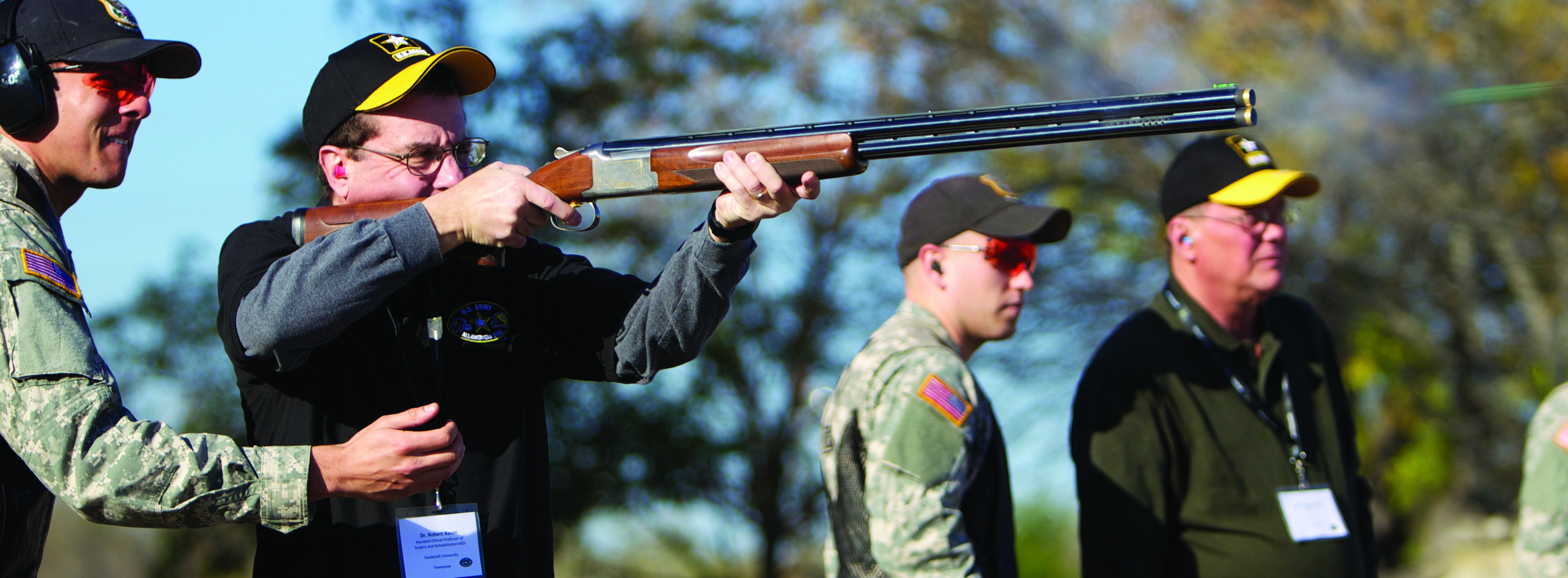
Michelle Dolan knew that going to San Antonio for the 12th U.S. Army All-American Bowl in January would be a life-changing experience.
She assumed the eye-opening revelation would come as she toured Brooke Army Medical Center and learned about the cutting-edge medicine saving the lives of gravely injured Soldiers, or at the Center for the Intrepid where wounded warriors with debilitating burns and amputations are rehabilitated not only back to the point of living full lives, but to the extent where 1 in 5 of them choose to remain on active duty.
Or maybe it would come as she was falling 13,000 feet out of an airplane in tandem with a member of the Golden Knights, the U.S. Army Parachute Team, a once in a lifetime opportunity that very few will ever experience.
It turns out the revelation came from just becoming more familiar with the Army, learning that Soldiers do more than just fight wars.
"I really love that the Army stands for personal excellence, being the best that you can be," said Dolan.
The Bristol, Tenn., councilwoman and small business owner was one of more than 100 centers of influence (COIs) who attended this year's game and associated activities.
Despite the fact that for decades the Army's been educating and training Soldiers in more than 100 viable occupations and instilling in them leadership skills highly sought after by Fortune 500 Companies, the myth remains among many that the Army is the fallback option for high school dropouts and delinquents.
"That definitely is a stigma," said Donna Marsh, a real estate broker and director at large for the Women's Business Opportunities Connections in Syracuse, N.Y. "I've been guilty of that mentality and know many people who have that mentality. I'm really looking forward to taking the information [I've acquired] back with me to try to help dispel that myth. As far as I'm concerned, [the Army] should be one of the first considerations, not the last. It really is a fantastic tool to create opportunities [for yourself] and allow you to give back at the same time. It should be considered a privilege, not a fallback."
"My perception of the Army has changed as a result of this experience," said Sadiqa Reynolds, chief of community building for the office of the mayor in Louisville, Ky. "I've found out the Army does so much more than we could ever imagine. I've heard how much the Army focuses on education and how invested the Army is in ensuring our young people have options and alternatives. They care about mentoring, so even if you don't go into the military, the point is the Army is invested in the community. This experience really helps to remind us how much we need to support our Army. It's not just about what's happening in Afghanistan and Iraq, it's about what the Army is doing in the community," said Reynolds.
Major Gen. David L. Mann, commanding general for U.S. Army Recruiting Command, told the group they were invited to the game to learn more about the Army in the hope they'd share that information with their communities and, in some cases, help the Army get into venues that have been difficult to gain access to in the past.
"Because at the end of the day, it's your Army," Mann explained. "So the more we can connect with America to make sure [potential applicants] understand what it means to be a Soldier, the opportunities that are available, you know, the better off we're going to be into ensuring that the Army, your Army, remains viable and able to support the nation."
While this information was new to many COIs, it just reinforced the message for Milwaukee radio talk show host Earl Ingram. He's allowed Army representatives to use his microphone several times to talk about education and career opportunities for Soldiers.
"I live in a community where 60 percent of African-American males ages 18 through 40 are unemployed. To have young people graduate and stand on street corners and wind up in jail is nonsensical. I think it's really important that our young people understand what opportunities exist. Everybody's not going to college. The Army is a major option."
The COIs had the opportunity to listen to and ask questions of Army Chief of Staff Gen. Raymond T. Odierno, who gave them an overview of the need for diversity in the military. What he got in return were suggestions to help veterans get jobs and to build those partnerships necessary to keep the nation's military efficient and prepared for any threat or disaster.
"There's been a detachment [between] the American public and the Army," said Carl Venditto, an Army Reserve Ambassador in Connecticut. "It isn't intentional, it just happens. I come from a community where I rarely see a Soldier. It's isn't good for America, for the Army not to have a physical presence. I think [the Army] needs more visibility in communities, go to art museums, trade shows, walk the streets, go into schools and businesses [more] and talk about what the Army can give."
"I want the Army to stay strong and the country safe," said Harvey Crone, director of career pathways at J. Sargeant Reynolds Community College in Richmond, Va. "That happens with each one of us making sacrifices. Everyone has to take some kind of initiative in this difficult time we're in to ensure we keep this country strong economically. We have to ensure the public knows that and Congress, as well."
(Excerpts relating to Maj. Gen. Mann and Gen. Odierno were provided by Rob McIlvaine from Army News)
Social Sharing